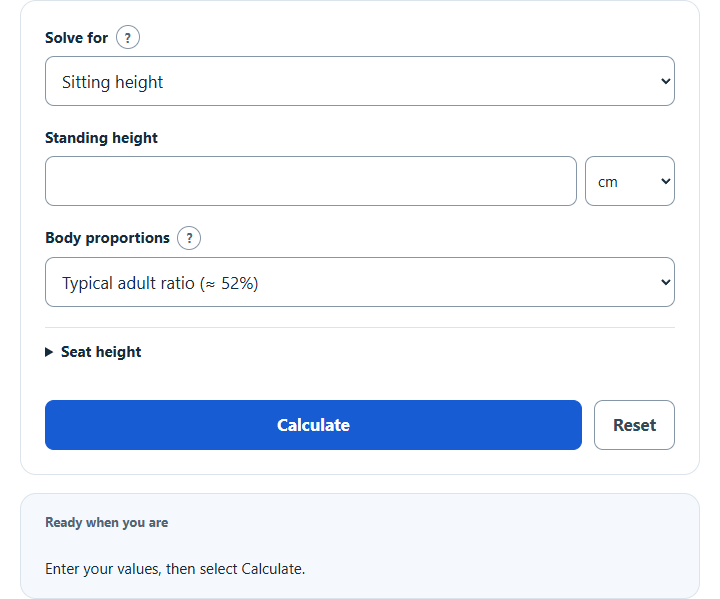
Estimate sitting height from standing height with a typical 52% ratio, or calculate it exactly from leg length, plus the sitting-height ratio.
- All Health and Medical Calculators
- Height to Weight Ratio Calculator
- APE Index (Wingspan To Height Ratio) Calculator
- Waist to Height Ratio Calculator / WHtR Calculator
- Waist to Hip Ratio Calculator
- Waist to Thigh Ratio Calculator
Sitting Height Definition
Sitting height is the vertical distance from the seat surface to the top of the head, measured seated erect on a firm, flat surface with the head level. The NIOSH anthropometric definition excludes the chair or stool height. A floor-to-head seated measurement must have the seat-surface height subtracted first.
- SH is seat-surface-to-head sitting height
- TH is your total height measured standing
- LL is derived subischial leg length: standing height minus measured sitting height; it is not knee-to-hip, knee height, thigh length, or a direct bone measurement
The NCHS measurement method derives subischial length by subtracting sitting height from stature. Thus LL = TH − SH, TH = SH + LL, and SH = TH − LL. The sitting-height ratio (Cormic index) is SH ÷ TH × 100. These are identities between consistent measurements: standing height alone gives only an estimate of sitting height (the calculator's default assumes a typical adult ratio of about 52%), and a measured knee-to-hip length cannot replace LL.
What is the correct height for my desk?
Workstation fit uses several body and equipment dimensions; seat-to-head sitting height alone does not determine desk height. OSHA neutral-posture guidance describes supported feet on the floor or a stable footrest, roughly horizontal thighs, and knees near hip height. The lower legs are roughly vertical in an upright seated posture; a perfect 45-degree knee bend is not the target.
Adjust the work surface so shoulders stay relaxed, elbows remain near the body, and wrists and forearms can stay aligned. Place the screen in front of you, with its top at or below eye level as appropriate for comfortable reading. The Oregon OSHA workstation checklist also calls for leg clearance and support rather than deriving one desk setting from a body-height ratio.
How should I interpret sitting height?
Sitting height and its ratio describe the entered dimensions. Apart from the typical 52% ratio used to estimate sitting height from standing height alone, this calculator does not apply an adult average or label a person as having long or short legs. Meaningful comparisons require an appropriate reference population and consistent measurement technique. Both sitting height and the derived leg difference must be positive and smaller than standing height; this arithmetic check is not a clinical assessment.
How to calculate a sitting height?
Sitting height example problem:
First, measure standing height. In this hypothetical example, TH = 175 cm.
Next, measure seat-to-head sitting height as 90 cm. The derived leg difference is LL = 175 − 90 = 85 cm. This 85 cm is not a thigh or knee-to-hip measurement.
Rearranging the same identity recovers the measured sitting height below. This demonstrates the arithmetic; it does not independently predict sitting height from standing height alone.
SH = TH − LL
SH = 175 cm − 85 cm
SH = 90 cm. The corresponding descriptive sitting-height ratio is 90 ÷ 175 × 100 ≈ 51.43%.