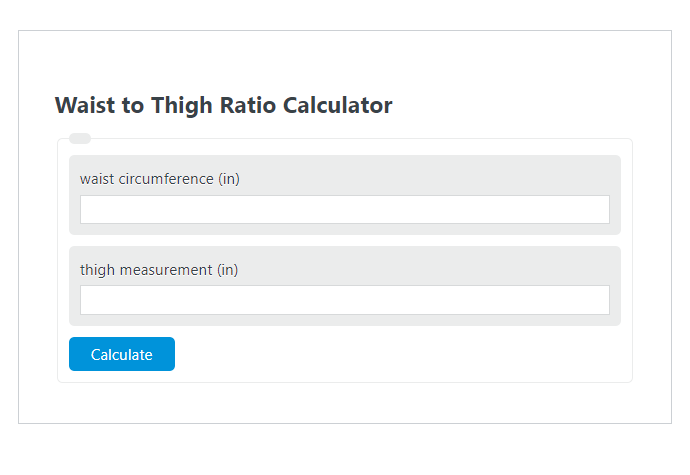
Calculate waist to thigh ratio from waist and thigh circumference in inches or cm, solve for a missing measurement, or plan a change to hit a target WTR.
- All Health and Medical Calculators
- Hips to Waist Ratio Calculator
- Neck to Waist Ratio Calculator
- Shoulder to Waist Ratio Calculator
- Waist to Height Ratio Calculator
- Thigh to Height Ratio Calculator
- Ideal Thigh Size Calculator
Waist to Thigh Ratio Formula
The waist to thigh ratio (WTR) compares waist circumference to thigh circumference. It is a simple body-proportion metric that shows how large the waist is relative to the thigh. Because both measurements use the same unit, the final result is a unitless ratio.
- WTR = waist to thigh ratio
- W = waist circumference
- T = thigh circumference
If you know the ratio and one body measurement, you can rearrange the equation to solve for the missing value:
This calculator is useful whether you want to calculate the ratio directly or back-calculate the waist or thigh measurement from a known ratio.
How to Calculate Waist to Thigh Ratio
- Measure your waist circumference.
- Measure your thigh circumference.
- Make sure both values use the same unit, such as inches or centimeters.
- Divide the waist measurement by the thigh measurement.
If the result is larger, the waist is larger relative to the thigh. If the result is smaller, the thigh is larger relative to the waist. A value of 1 means the two measurements are equal.
Example 1
If the waist is 32 in and the thigh is 24 in:
Example 2
If the ratio is 1.20 and the thigh circumference is 22 in, the waist would be:
How to Measure Correctly
Good measurements matter more than extra decimal places. For consistent tracking, use the same tape, the same side of the body, and the same measuring locations each time.
| Measurement | How to Take It | Best Practice |
|---|---|---|
| Waist circumference | Wrap a flexible tape around the waist at your chosen reference point. | Keep the tape level, snug, and not compressing the skin. |
| Thigh circumference | Measure around the fullest part of one thigh. | Stand naturally and use the same leg each time. |
| Units | Use inches, centimeters, or another length unit. | Both inputs must use the same unit before dividing. |
For repeat measurements, it helps to measure under similar conditions, such as the same time of day and before exercise. Small differences in tape placement can noticeably change the ratio.
How to Interpret the Result
The waist to thigh ratio is best used as a comparison and tracking metric. It tells you how body dimensions relate to one another, but it does not explain why the ratio changed. A new result may come from a change in waist size, thigh size, or both.
- Lower ratio: smaller waist relative to thigh circumference.
- Higher ratio: larger waist relative to thigh circumference.
- Stable ratio: body proportions are staying similar over time, even if absolute measurements change.
For the most useful interpretation, track the ratio together with the underlying measurements rather than looking at the ratio by itself.
Why People Use This Calculator
This calculator can help with:
- Tracking body-proportion changes over time
- Comparing waist and leg measurements during fitness programs
- Checking whether a ratio stays consistent as body size changes
- Estimating a missing waist or thigh value when the ratio is already known
- Adding another measurement alongside tools such as waist-to-height or waist-to-hip comparisons
Common Mistakes
- Mixing units such as inches for the waist and centimeters for the thigh
- Using inconsistent measuring points from one check-in to the next
- Pulling the tape too tight, which can reduce the circumference artificially
- Measuring over bulky clothing instead of close to the body
- Comparing ratios without the raw measurements, which hides what actually changed
Quick Reference
| Question | Answer |
|---|---|
| Is the result a percentage? | No. It is a ratio, not a percent. |
| Can I use centimeters instead of inches? | Yes. Any unit works as long as both measurements use the same unit. |
| Do I need exact fractions of an inch or centimeter? | Precision helps, but consistency in measurement method matters more. |
| Can this calculator solve for waist or thigh? | Yes, if you already know the ratio and one of the measurements. |
Additional Notes
Because the formula is based on division, the ratio remains the same whether you use inches, centimeters, or meters, provided both measurements are converted to the same unit first. That makes the waist to thigh ratio especially useful for comparing body proportions across different measurement systems.
If you are monitoring changes over time, record all three values together: waist circumference, thigh circumference, and the calculated ratio. This gives a clearer picture than the ratio alone and makes trend analysis much easier.