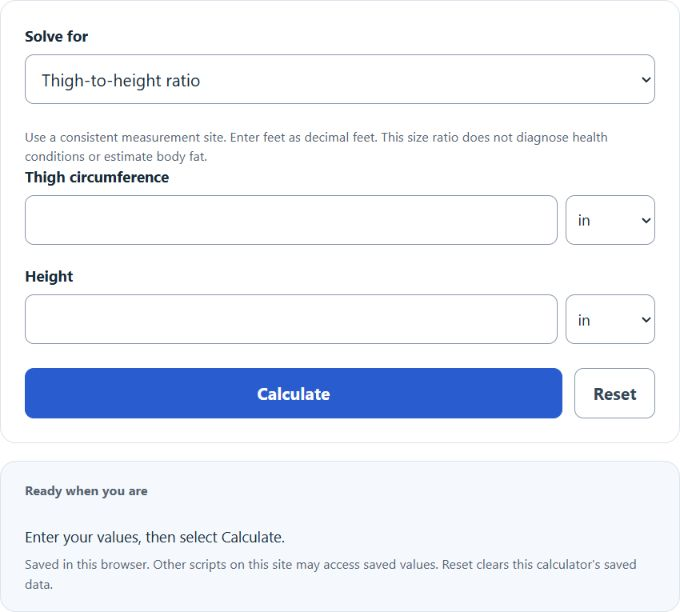
Calculate thigh circumference, height, or thigh-to-height ratio by selecting a solve mode and entering the two known values. Supported length units are in, ft, cm, and m; unit changes preserve the measurement.
Disclaimer: Educational use only. This calculator does not diagnose health conditions or estimate body fat percentage. For personalized guidance (including for children/adolescents), consult a qualified clinician.
Thigh to Height Ratio Formula
The thigh-to-height ratio (THR) compares thigh circumference to total height using the same unit of length for both measurements. It is a simple proportional metric that can be useful for personal tracking, physique monitoring, clothing fit comparisons, and documenting changes over time.
Where:
- THR = thigh-to-height ratio
- TC = thigh circumference
- H = height
If you want to solve for a missing value, the formula can be rearranged as follows:
How to Calculate Thigh to Height Ratio
- Measure the circumference of one thigh at a consistent location.
- Measure total body height.
- Choose each measurement’s unit; the calculator converts both to the same unit internally.
- Divide thigh circumference by height.
- Record the result as a decimal, or multiply by 100 if you prefer a percentage-style value.
For example, if thigh circumference is 24 inches and height is 70 inches:
That can also be written as approximately 34.3% of height.
How to Measure Correctly
Consistency matters more than anything else when tracking THR. Small differences in tape placement can change the result enough to make comparisons misleading.
- Stand relaxed with weight evenly distributed.
- Measure the same leg each time if you are tracking over weeks or months.
- Use the same landmark for every measurement, commonly the midpoint between the hip crease and the top of the kneecap, or the largest part of the thigh if that is your chosen standard.
- Keep the tape level all the way around the leg.
- Pull the tape snug without compressing the skin.
- Measure height without shoes for better consistency.
Why People Use THR
THR is not a diagnosis and should not be treated as a stand-alone health indicator. Its value is mainly in comparison over time. People often use it to:
- track lower-body size changes during strength training
- compare physique changes during bulking or cutting phases
- monitor symmetry and growth in sports training
- document body proportions for tailoring or apparel sizing
- combine with other body measurements for a broader picture
Interpreting the Result
A higher THR means the thigh circumference is larger relative to height. A lower THR means the thigh circumference is smaller relative to height. By itself, the number does not tell you whether the change came from muscle gain, fat gain, swelling, measurement error, or natural body structure.
THR is most useful when:
- you measure under the same conditions each time
- you track trends instead of focusing on a single reading
- you compare it with body weight, waist measurements, training volume, and progress photos
Common Mistakes
- Choosing the wrong unit for an entered measurement
- Changing measurement location from one session to the next
- Measuring after a hard workout when muscle pump or swelling may temporarily increase circumference
- Pulling the tape too tight and compressing soft tissue
- Comparing against other people without accounting for sex, frame size, training background, and genetics
Using THR Alongside Other Metrics
THR becomes more informative when paired with additional measurements. Depending on your goal, you may also track:
- Waist circumference for central body-size changes
- Waist-to-height ratio for another proportional measurement
- Body weight to identify whether size changes happen with overall mass changes
- Hip circumference for lower-body proportion comparisons
- Training logs to connect size changes with squat, deadlift, sprint, or cycling performance
When THR Is Most Useful
This ratio is especially practical when you want a fast, repeatable body-proportion check without specialized equipment. It can help answer questions like:
- Has my thigh size changed relative to my overall frame?
- Am I maintaining lower-body size during a fat-loss phase?
- Are my measurements becoming more consistent over time?
Frequently Asked Questions
Should THR be recorded as a decimal or percentage?
Either format works as long as you stay consistent. A THR of 0.343 is the same as 34.3%.
Do I need to use inches or centimeters?
No. Choose the correct unit for each measurement; the calculator converts them to a common unit before dividing.
Which thigh should I measure?
Choose one side and use it every time. If you are comparing symmetry, measure both thighs separately and record each value.
Is a higher THR always better?
Not necessarily. The meaning depends on your goal. A larger ratio may reflect muscle development, body-fat distribution, edema, or simple measurement differences.
Can THR estimate body fat percentage?
No. THR is a size relationship, not a validated body-fat formula.
Practical Tracking Tips
- Measure at the same time of day.
- Use the same tape measure each time.
- Take two or three readings and average them if precision matters.
- Log both the raw measurements and the computed ratio.
- Recheck your method if a change seems unusually large from one session to the next.