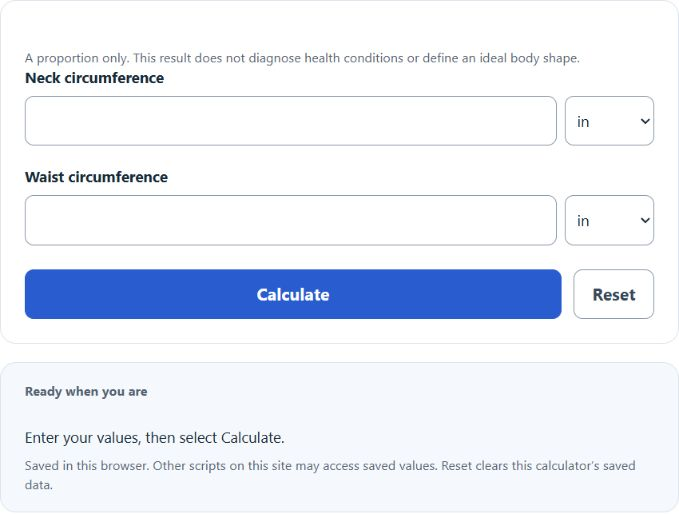
Calculate your neck to waist ratio from neck and waist measurements in in, cm, mm, or ft and see a unitless result rounded to up to four decimal places (scientific notation for very small or large values).
- All Health and Medical Calculators
- All Ratio Calculators
- Shoulder to Waist Ratio Calculator
- Chest to Waist Ratio Calculator
- Waist to Height Ratio
Neck to Waist Ratio Formula
The neck to waist ratio (NWR) compares your neck circumference to your waist circumference. It is a simple proportional measurement often used for physique tracking, clothing fit comparisons, and progress monitoring over time.
- NWR = neck to waist ratio
- N = neck circumference
- W = waist circumference
The result is unitless. You can use inches, centimeters, millimeters, or feet. Select each input’s actual unit; the calculator matches units automatically. For a manual calculation, convert both measurements to the same unit first.
How to Calculate the Neck to Waist Ratio
- Measure the circumference of the neck.
- Measure the circumference of the waist.
- Divide the neck measurement by the waist measurement.
If you already know the ratio and want to solve for one of the measurements, these rearrangements may help:
How to Use the Calculator
Enter your neck measurement and waist measurement into the calculator, then select calculate. The tool divides the neck value by the waist value and returns the ratio instantly. Use consistent tape placement and select the correct unit for each entry. Both circumferences must be positive; mixed units are converted automatically.
Examples
If the neck measures 16 inches and the waist measures 32 inches:
If the neck measures 38 centimeters and the waist measures 76 centimeters:
Both examples produce the same ratio because the measurements are proportional and use matching units.
What the Result Means
| Result Pattern | General Interpretation |
|---|---|
| Lower ratio | The waist measurement is larger relative to the neck measurement. |
| Higher ratio | The neck measurement is larger relative to the waist measurement, or the waist is comparatively smaller. |
| Same ratio over time | Your body proportions remained similar, even if both measurements changed slightly. |
| Rising ratio over time | This usually means neck size increased, waist size decreased, or both. |
| Falling ratio over time | This usually means waist size increased, neck size decreased, or both. |
This ratio is best used as a comparison metric, not as a diagnosis. It describes proportion, not overall health by itself.
Measurement Tips
- Neck: Wrap the tape around the neck at a consistent level and keep it snug without compressing the skin.
- Waist: Measure at the same location each time, ideally with the tape level all the way around.
- Posture: Stand relaxed and upright during both measurements.
- Breathing: Measure the waist after a normal exhale, not while holding the stomach in.
- Consistency: Repeating the same method matters more than the specific unit used.
Common Input Mistakes
- Selecting a unit that does not match the entered neck or waist measurement
- Pulling the tape too tight on one measurement and too loose on the other
- Measuring the waist at a different location each time
- Entering diameter instead of circumference
- Using a waist value of zero or leaving a field blank
When This Ratio Is Useful
- Tracking physique changes during training or weight loss
- Comparing proportions for tailoring or clothing fit
- Monitoring body measurement trends over time
- Adding another proportional metric alongside other body measurements
Frequently Asked Questions
Can I use centimeters instead of inches?
Yes. The calculator supports inches, centimeters, millimeters, and feet, including mixed input units selected correctly.
Is a higher neck to waist ratio always better?
Not necessarily. A higher or lower value is only a description of proportion. Whether it is desirable depends on your goal.
Why did my ratio change even though my weight did not?
Body proportions can change without large scale-weight changes. Small changes in waist size, posture, tape placement, or neck measurement technique can all affect the result.
Should this ratio be used alone?
It is usually most helpful when used with other measurements and when tracked consistently over time.