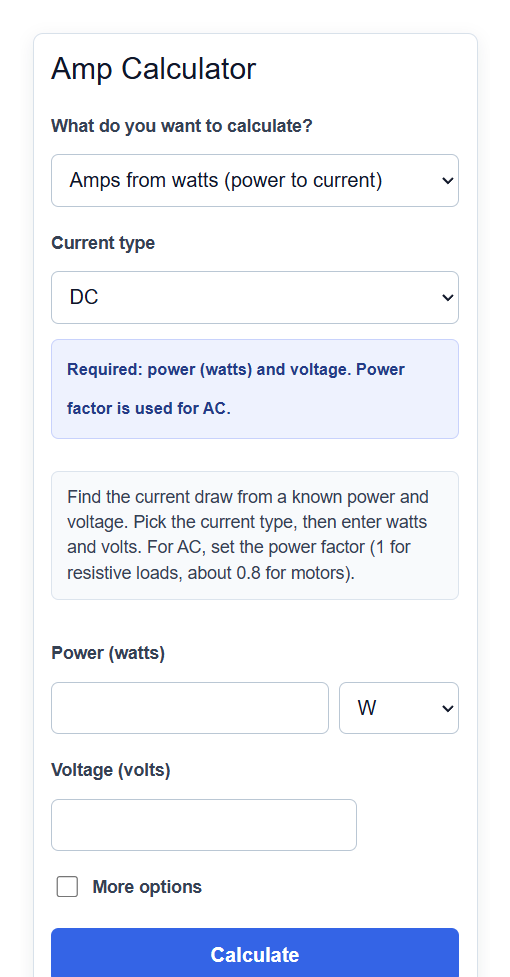
Convert watts, kW, VA, kVA, volts or ohms to amps for DC, single-phase or balanced three-phase systems with power factor and visible formulas.
Amp Formula
The current in amps depends on what you know and the type of circuit. The calculator covers five jobs: amps from power, power from amps, amps from voltage and resistance, amps from apparent power, and apparent power from amps.
Amps from power (watts):
DC: I = W / V
 AC single phase: I = W / (V * PF)
 AC three phase (line to line): I = W / (1.732 * V * PF)
 AC three phase (line to neutral): I = W / (3 * V * PF)
Amps from voltage and resistance (Ohm’s law):
I = V / R
Amps from apparent power (kVA):
Single phase: I = (kVA * 1000) / V
 Three phase: I = (kVA * 1000) / (1.732 * V)
Where:
- I is the current in amps (A)
- W is the real power in watts (W)
- V is the voltage in volts (V)
- R is the resistance in ohms (Ω)
- PF is the power factor (a value between 0 and 1)
- kVA is the apparent power in kilovolt-amps
- 1.732 is the square root of 3, used for three phase line to line
For a DC circuit, current is power divided by voltage. For AC, the power factor reduces the usable real power, so you divide by voltage times power factor. Three phase systems carry power across three conductors, so the line to line form multiplies voltage by the square root of 3. Ohm’s law gives current directly from voltage and resistance when you are working with a resistive load. The kVA modes work with apparent power instead of real power, so the power factor drops out of the equation.
Current by Circuit Type and Voltage
Use the formula that matches your circuit type. The table shows which equation the calculator applies for each selection.
| Circuit type | Amps from watts | Amps from kVA |
|---|---|---|
| DC | W / V | (kVA * 1000) / V |
| AC single phase | W / (V * PF) | (kVA * 1000) / V |
| AC three phase (line to line) | W / (1.732 * V * PF) | (kVA * 1000) / (1.732 * V) |
| AC three phase (line to neutral) | W / (3 * V * PF) | (kVA * 1000) / (1.732 * V) |
Typical power factor values you can use when one is not given:
| Load type | Typical power factor |
|---|---|
| Resistive heater or incandescent lamp | 1.0 |
| LED or fluorescent lighting | 0.9 to 0.95 |
| Induction motor (loaded) | 0.8 to 0.9 |
| Induction motor (lightly loaded) | 0.5 to 0.7 |
Example Problems
Example 1. Find the current of a 1500 watt heater on a 120 volt single phase supply. A resistive heater has a power factor of 1.0.
I = W / (V * PF) = 1500 / (120 * 1.0) = 12.5 A
The heater draws 12.5 amps.
Example 2. Find the current of a 10 kW motor on a 400 volt three phase line to line supply with a power factor of 0.85.
I = W / (1.732 * V * PF) = 10000 / (1.732 * 400 * 0.85) = 16.98 A
The motor draws about 16.98 amps per line.
Frequently Asked Questions
Why do I need the power factor to find amps?
Power factor is the ratio of real power (watts) to apparent power (volt-amps) in an AC circuit. When the load is not purely resistive, some current does no useful work, so the same real power requires more current. Dividing by power factor accounts for that extra current. For DC circuits and purely resistive AC loads, the power factor is 1 and has no effect.
What voltage should I use for three phase?
Use the line to line voltage (for example 208 V, 400 V, or 480 V) with the line to line mode, which includes the square root of 3 factor. If you only know the line to neutral voltage, use the line to neutral mode instead. Mixing the two gives a result that is off by a factor of about 1.732.
Can I convert kVA to amps without the power factor?
Yes. kVA is apparent power, which already includes the effect of power factor, so you do not apply it again. For single phase, divide volt-amps by voltage. For three phase, divide by voltage times the square root of 3. You only need power factor when converting between kVA (apparent power) and kW (real power).