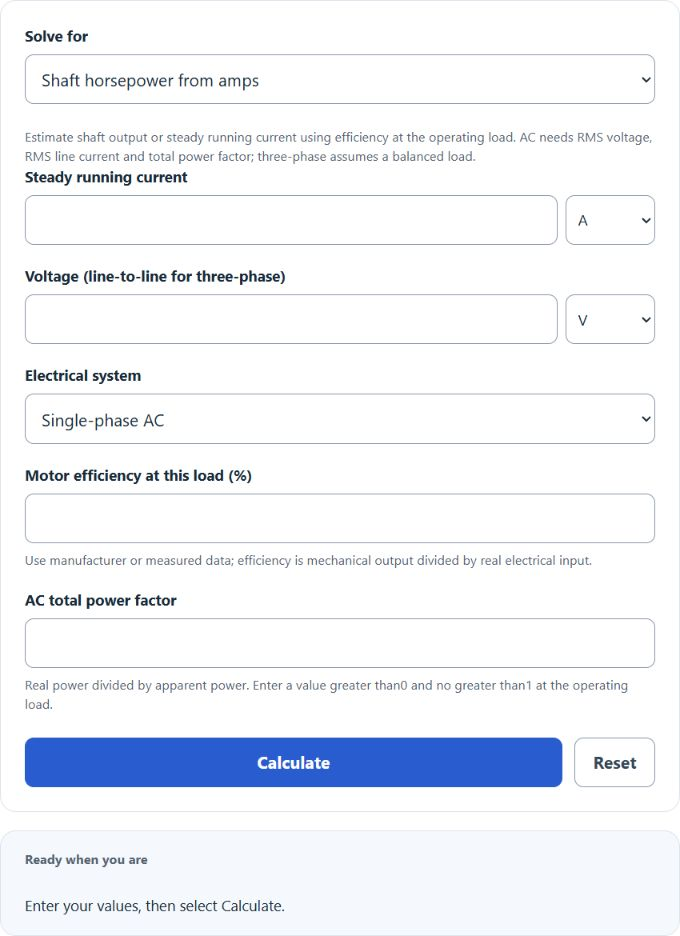
Calculate motor horsepower from amps and voltage, or solve amps from horsepower, for DC, single-phase, and three-phase systems with efficiency and power factor.
- All Unit Converters
- Mechanics and Physics Unit Converters
- HP to Amps Calculator
- Amps To Coulombs Calculator
Amp to HP Formulas
Converting amps to horsepower requires knowing the voltage of the circuit and the type of electrical system (DC, single-phase AC, or three-phase AC). One mechanical horsepower is 745.69987158227022 watts (about 745.6999 W). Electric horsepower is a separate 746 W unit; this calculator uses mechanical horsepower. For AC circuits, the power factor (PF) and motor efficiency also factor into the calculation.
DC Circuit Formula
For steady DC, input power is voltage × current and no AC power factor applies. The displayed formula includes efficiency to estimate mechanical shaft output.
Single-Phase AC Formula
Single-phase AC motors are common in residential and light commercial settings. Power factor accounts for the phase difference between voltage and current waveforms in AC circuits. Use total power factor measured or supplied for this motor at the operating load; it includes distortion as well as phase displacement.
Three-Phase AC Formula
The factor 1.732 (the square root of 3) accounts for the power contribution of all three phases in a balanced three-phase system. V refers to line-to-line voltage. Enter RMS line current. For unbalanced phases, measure and sum per-phase real power rather than applying this balanced-load formula.
Variables
- HP = mechanical horsepower (1 hp ≈ 745.6999 watts)
- V = voltage in volts (line-to-line for three-phase)
- I = steady DC current or RMS AC line current in amps
- PF = total AC power factor (greater than 0 and at most 1 in this inverse model)
- eta = shaft output / real electrical input as a decimal (greater than 0 and at most 1)
| Amps (A) | Horsepower (HP) |
|---|---|
| 0.5 | 0.080 |
| 1 | 0.161 |
| 2 | 0.322 |
| 3 | 0.483 |
| 5 | 0.805 |
| 7.5 | 1.207 |
| 10 | 1.609 |
| 12 | 1.931 |
| 15 | 2.414 |
| 20 | 3.218 |
| 25 | 4.023 |
| 30 | 4.828 |
| 40 | 6.437 |
| 50 | 8.046 |
| 60 | 9.655 |
| 75 | 12.069 |
| 90 | 14.483 |
| 100 | 16.092 |
| 125 | 20.115 |
| 150 | 24.138 |
| Illustrative ideal upper bound with PF =1 and efficiency =100%; not actual motor current or rating. Uses mechanical hp = 120 × A /745.69987158227, rounded to 3 decimals. | |
Amps to HP at 240 V (Single-Phase)
| Amps (A) | Horsepower (HP) |
|---|---|
| 0.5 | 0.161 |
| 1 | 0.322 |
| 2 | 0.644 |
| 3 | 0.966 |
| 5 | 1.609 |
| 7.5 | 2.414 |
| 10 | 3.218 |
| 12 | 3.862 |
| 15 | 4.828 |
| 20 | 6.437 |
| 25 | 8.046 |
| 30 | 9.655 |
| 40 | 12.874 |
| 50 | 16.092 |
| 60 | 19.311 |
| 75 | 24.138 |
| 100 | 32.185 |
| 125 | 40.231 |
| 150 | 48.277 |
| 200 | 64.369 |
| Illustrative ideal upper bound with PF =1 and efficiency =100%; not actual motor current or rating. Uses mechanical hp = 240 × A /745.69987158227, rounded to 3 decimals. | |
Amps to HP at 460 V (Three-Phase)
| Amps (A) | Horsepower (HP) |
|---|---|
| 1 | 1.068 |
| 2 | 2.137 |
| 3 | 3.205 |
| 5 | 5.342 |
| 7.5 | 8.013 |
| 10 | 10.685 |
| 14 | 14.958 |
| 21 | 22.437 |
| 27 | 28.848 |
| 34 | 36.327 |
| 40 | 42.738 |
| 52 | 55.559 |
| 65 | 69.449 |
| 77 | 82.271 |
| 96 | 102.571 |
| 124 | 132.488 |
| 156 | 166.678 |
| 180 | 192.321 |
| Illustrative ideal upper bound with PF =1 and efficiency =100%; not actual motor current or rating. Uses mechanical hp = √3 × 460 × A /745.69987158227, rounded to 3 decimals. | |
NEC Full Load Amps by Motor Horsepower
The following reference values reproduce the standard motor-current tables in Eaton’s control catalog, corresponding to NEC Tables 430.248 and 430.250. They are reference full-load currents for ordinary motor characteristics, not a conversion from measured current to actual shaft power. Rated motor voltage columns are 115/230 V for single-phase and 230/460 V for three-phase. Selection of conductors and protection requires the applicable current code, motor characteristics and manufacturer instructions; this calculator does not perform that selection.
| Motor HP | 1-Phase 115V (A) | 1-Phase 230V (A) | 3-Phase 230V (A) | 3-Phase 460V (A) |
|---|---|---|---|---|
| 1/4 | 5.8 | 2.9 | — | — |
| 1/3 | 7.2 | 3.6 | — | — |
| 1/2 | 9.8 | 4.9 | 2.2 | 1.1 |
| 3/4 | 13.8 | 6.9 | 3.2 | 1.6 |
| 1 | 16 | 8 | 4.2 | 2.1 |
| 1.5 | 20 | 10 | 6.0 | 3.0 |
| 2 | 24 | 12 | 6.8 | 3.4 |
| 3 | 34 | 17 | 9.6 | 4.8 |
| 5 | 56 | 28 | 15.2 | 7.6 |
| 7.5 | 80 | 40 | 22 | 11 |
| 10 | 100 | 50 | 28 | 14 |
| 15 | — | — | 42 | 21 |
| 20 | — | — | 54 | 27 |
| 25 | — | — | 68 | 34 |
| 30 | — | — | 80 | 40 |
| 40 | — | — | 104 | 52 |
| 50 | — | — | 130 | 65 |
| 60 | — | — | 154 | 77 |
| 75 | — | — | 192 | 96 |
| 100 | — | — | 248 | 124 |
| Source: Eaton motor-current tables corresponding to NEC 430.248/430.250. For ordinary speed and torque characteristics. Low-speed, high-torque or multispeed motors may require nameplate values. This is a reference table, not an installation design. | ||||
Power Factor and Motor Efficiency
The ideal expression V × I /745.6999 assumes steady DC, or single-phase AC with PF =1, and 100% efficiency. Real motors require efficiency at the operating load and, for AC, total power factor. Power factor is real input power divided by apparent power. Efficiency and PF vary by motor design and loading; light-load current alone poorly indicates shaft load.
Motor efficiency is mechanical shaft power divided by real electrical input power. Winding, rotor, magnetic, friction and air losses reduce output. Use the manufacturer’s measured performance at the load of interest. DOE part-load guidance shows that efficiency and power factor change as load decreases; no single universal efficiency curve applies to every motor.
| Load (%) | Efficiency (%) | Power Factor | Calculated line amps at 230 V | Assumed shaft hp |
|---|---|---|---|---|
| 100 | 91.7 | 0.86 | 23.74 | 10.0 |
| 75 | 92.4 | 0.82 | 18.53 | 7.5 |
| 50 | 90.8 | 0.72 | 14.32 | 5.0 |
| 25 | 84.0 | 0.52 | 10.71 | 2.5 |
| Efficiency and PF here are illustrative assumed inputs, not a manufacturer performance curve. Current is recalculated from those inputs and the stated shaft power using the same balanced-load equation. | ||||
Starting Current vs Running Current
Motor startup current can be much higher than steady running current and depends on motor design, supply, load and starting method. Locked-rotor current is not interchangeable with a steady operating measurement. The steady-state amp-to-hp model requires running current and efficiency/PF for that operating load; it does not predict startup torque, acceleration or transient power.
Motor design and starting method affect starting current and torque. A variable-frequency drive can limit motor starting current, but the achieved current depends on drive settings and the load. DOE guidance describes typical VFD starting-current limits around 1.5–2 times rated operating current; a VFD does not eliminate every inrush or transient.
Common Applications
These conversions estimate shaft output or running current when voltage, total power factor and efficiency at the operating load are known. They can support comparisons with measured performance, but current alone cannot identify motor rating, compressor capacity or a fault. Use qualified equipment selection and the applicable installation requirements for conductors, breakers, overload protection and motor replacement.