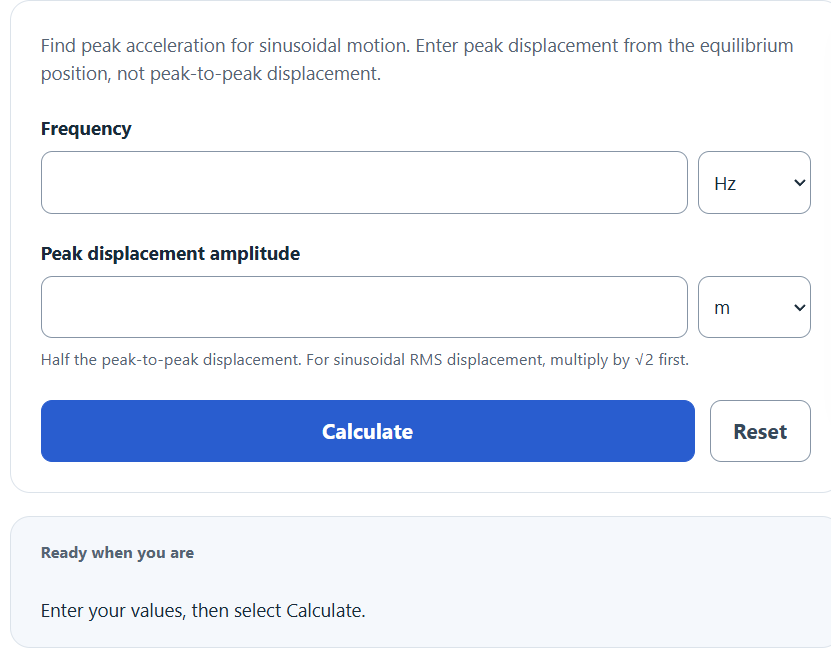
Calculate peak acceleration in m/s² from vibration frequency and amplitude, with frequency units from Hz to MHz and amplitude units from m to μm.
Acceleration From Amplitude Formula
The following equation is used to calculate the (maximum/peak) Acceleration From Amplitude for sinusoidal (simple harmonic) motion.
- Where A is the (maximum/peak) Acceleration From Amplitude (m/s^2)
- F is the frequency (Hz)
- AMP is the peak displacement amplitude from equilibrium (m), not peak-to-peak displacement
To calculate the acceleration from amplitude, multiply the amplitude by (2 times pi times the frequency) squared.
What are the units for Acceleration From Amplitude?
The most common units for Acceleration From Amplitude are m/s^2.
How to Calculate Acceleration From Amplitude?
Example Problem:
The following example problem outlines the steps and information needed to calculate the Acceleration From Amplitude.
First, determine the frequency. In this example, the frequency is determined to be 150 Hz.
Next, determine the amplitude. For this problem, the amplitude is measured to be 3 m.
Finally, calculate the Acceleration From Amplitude using the formula above:
A = (2*pi*F)^2*AMP
Inserting the values from above and solving the equation with the input values gives:
A = (2*pi*150)^2*3 ≈ 2664793.1883 (m/s^2)
FAQ
What is the significance of the acceleration due to gravity in the formula?
The acceleration due to gravity (g) is not part of the basic acceleration-from-amplitude relationship for sinusoidal motion. It is only used if you want to express the result “in g’s” (as a multiple of gravity), in which case you would divide the acceleration in m/s² by standard gravity (defined as 9.80665 m/s²).
Can this formula be used for any frequency and amplitude values?
This formula applies to sinusoidal (simple harmonic) motion. Use nonnegative frequency and peak displacement amplitude within the calculator’s finite numerical range. The motion must be well-approximated as sinusoidal, with consistent units (frequency in Hz and amplitude in meters).
How does changing the amplitude affect the acceleration from amplitude?
Increasing the amplitude directly increases the (peak) acceleration, as indicated by the formula (A = (2*pi*F)^2*AMP). Since amplitude (AMP) is in the numerator as a direct multiplier, a higher amplitude value results in a higher acceleration, assuming all other variables remain constant.