Solve sinusoidal vibration frequency, displacement, velocity, or acceleration with Hz and RPM, metric and imperial units, and peak, peak-to-peak, and RMS results.
Acceleration From Frequency and Displacement Formula
The following equation is used to calculate the acceleration amplitude from frequency and displacement (for sinusoidal/simple harmonic motion).
- Where A is the acceleration amplitude (m/s^2)
- f is the frequency (Hz)
- D is the displacement amplitude (m)
- To express acceleration in g’s: Ag = A / g, where standard gravity g ≈ 9.80665 m/s^2
What are the units for Acceleration From Frequency and Displacement?
The most common units for Acceleration From Frequency and Displacement are m/s^2 (the calculator also supports ft/s^2 and g).
How to Calculate Acceleration From Frequency and Displacement?
Example Problem:
The following example problem outlines the steps and information required to calculate the Acceleration From Frequency and Displacement.
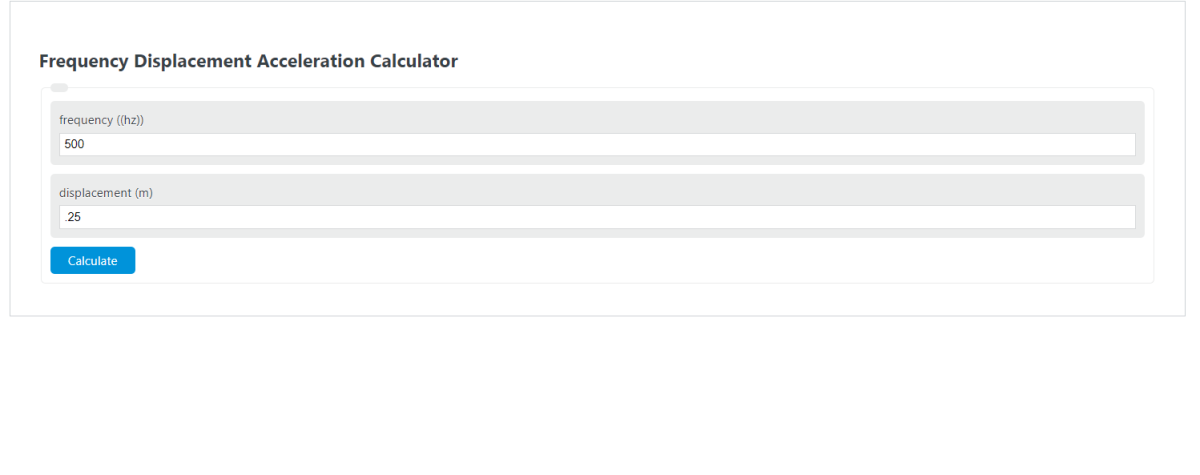
First, determine the frequency. In this example, the frequency is measured to be 500 (Hz).
Next, determine the displacement. For this problem, the displacement is calculated to be .25 (m).
Finally, calculate the Acceleration From Frequency and Displacement using the formula above:
A = 4*pi^2*f^2*D
Inserting the values from above and solving the equation gives us:
A = 4*3.14159^2*500^2*.25 = 2467396.75 (m/s^2)