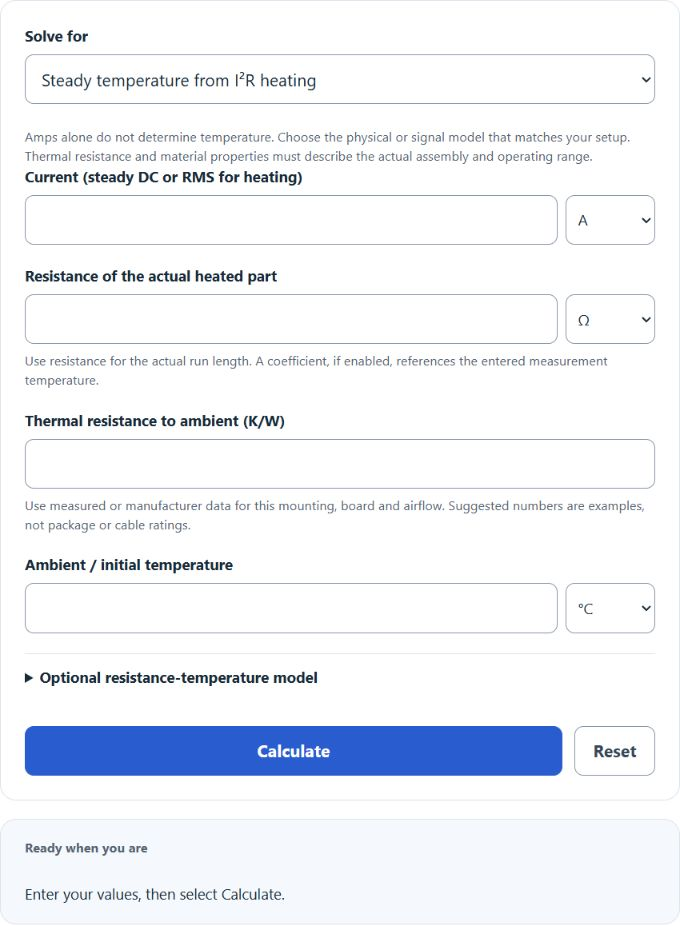
Estimate steady or transient I²R heating, model current at an entered temperature limit, scale a configured linear current-loop signal, or use the legacy IPC-2221 trace correlation. These models require setup-specific information; they do not establish a safe current.
Amps To Temperature Formula
Current through resistance dissipates heat via P = I²R. Temperature additionally requires a thermal model. Steady mode uses the assembly’s thermal resistance to ambient. Transient mode starts at ambient and assumes a uniform lumped temperature, constant resistance, specific heat and thermal resistance: ΔT(t) = I²Rθ × [1 − exp(−t/(mcθ))]. The no-cooling result I²Rt/(mc) is a comparison under the same constant-power assumptions, not a universal worst case.
Variables:
- ΔT is the temperature rise (°C or K)
- T is the final temperature (typically reported in °C or °F)
- Tamb is ambient temperature (convert all absolute temperatures consistently; the formulas use °C and temperature differences in K)
- I is steady DC current or RMS current for resistive heating (A)
- R is the resistance in ohms (Ω)
- P is electrical power dissipated as heat (W), where P = I²R
- t is heating time (s)
- m is mass being heated (kg)
- c is specific heat capacity (J/(kg·°C))
- θ is thermal resistance to ambient (°C/W)
With current and resistance alone you can calculate resistive conduction power: P = I²R. Other heat sources, such as switching losses, are not included. Thermal resistance depends on geometry, mounting, board, airflow and heat paths; generic package or cable names cannot establish it. The editable numeric and material suggestions are illustrative, not actual assembly ratings. The table below uses fixed hypothetical properties; its extreme rows are formal arithmetic extrapolations rather than predictions of material behavior.
| Amps (A) | Power (W) | Estimated rise ΔT (°C) | Estimated rise ΔT (°F) |
|---|---|---|---|
| 0.05 | 0.003 | 0.050 | 0.090 |
| 0.10 | 0.010 | 0.200 | 0.360 |
| 0.20 | 0.040 | 0.800 | 1.440 |
| 0.25 | 0.063 | 1.250 | 2.250 |
| 0.30 | 0.090 | 1.800 | 3.240 |
| 0.50 | 0.250 | 5.000 | 9.000 |
| 0.75 | 0.563 | 11.250 | 20.250 |
| 1 | 1.000 | 20.000 | 36.000 |
| 1.5 | 2.250 | 45.000 | 81.000 |
| 2 | 4.000 | 80.000 | 144.000 |
| 2.5 | 6.250 | 125.000 | 225.000 |
| 3 | 9.000 | 180.000 | 324.000 |
| 4 | 16.000 | 320.000 | 576.000 |
| 5 | 25.000 | 500.000 | 900.000 |
| 6 | 36.000 | 720.000 | 1296.000 |
| 7.5 | 56.250 | 1125.000 | 2025.000 |
| 8 | 64.000 | 1280.000 | 2304.000 |
| 9 | 81.000 | 1620.000 | 2916.000 |
| 10 | 100.000 | 2000.000 | 3600.000 |
| 12 | 144.000 | 2880.000 | 5184.000 |
| * Rounded to 3 decimals. Assumes fixed resistance R = 1 Ω. Power: P (W) = I (A)² × R (Ω). Temperature rise estimate uses a chosen thermal resistance θ = 20 °C/W: ΔT (°C) ≈ P × θ. A temperature rise in °F is ΔT°F = ΔT°C × 1.8 (no +32). Values are illustrative only; real temperatures depend strongly on mounting, airflow, heat spreading, and component ratings. | |||
What is the Relationship Between Amps and Temperature?
The relationship between current (amps), resistance, and temperature is commonly discussed using Joule heating. A current flowing through a resistance dissipates electrical power as heat: P = I²R. That heat can raise temperature, but the actual temperature (or temperature rise) also depends on how long the power is applied and how effectively heat is stored and removed (mass/heat capacity, conduction to a heatsink or PCB, convection/airflow, radiation, etc.).
How to Calculate Temperature from Amps and Resistance?
The following steps outline how to estimate temperature (or temperature rise) from current and resistance using a simple thermal model.
- Determine the current in amps (I).
- Determine the resistance in ohms (R).
- Calculate power dissipated as heat: P = I² × R (watts).
- Choose a thermal model:
- Steady-state estimate: use thermal resistance θ (K/W) applicable to the actual assembly and ambient temperature, then ΔT = Pθ. Optional linear resistance feedback uses R(T) = Rref[1 + α(T − Tref)]. With k = I²Rrefθ, rise = k[1 + α(Tamb − Tref)]/(1 − kα). The denominator and modeled resistance must be positive; coefficients must match the alloy and reference range.
- Lumped transient: use t, m and c with τ = mcθ and ΔT = Pθ[1 − exp(−t/τ)]. This mode keeps resistance constant and excludes phase changes. Its no-cooling comparison is ΔT = Pt/(mc). A temperature difference converts to °F by multiplying by 1.8, without adding 32.
- Compare results only under matching assumptions. Current-at-limit mode solves I = √[(Tlimit − Tamb)/(R(Tlimit)θ)]. Its 80% current reference is arithmetic, with no guaranteed margin or installation approval. The separate signal mode linearly maps configured 4–20 mA or 0–20 mA endpoints; outside-span outputs are extrapolations, and fault interpretation requires the transmitter configuration. The separate PCB mode inverts the legacy fit I = kΔT^0.44 A^0.725 (area in mil²; k = 0.048 external or 0.024 internal). It limits width to 400 mil, current to 35 A external or 17.5 A internal, and rise to 100 K. Nominal copper thickness is 1.378 mil per oz/ft². It is not an IPC-2152 board model or ampacity approval.
Example Problem :
Use the following variables as an example problem to test your knowledge (steady-state estimate using thermal resistance).
Current (I) = 0.2 A
Resistance (R) = 10 Ω
Ambient temperature (Tamb) = 25 °C
Thermal resistance (θ) = 100 °C/W
P = 0.2² × 10 = 0.4 W; ΔT = 0.4 × 100 = 40 K, so T = 25 + 40 = 65°C (149°F), assuming constant properties and the stated thermal resistance.