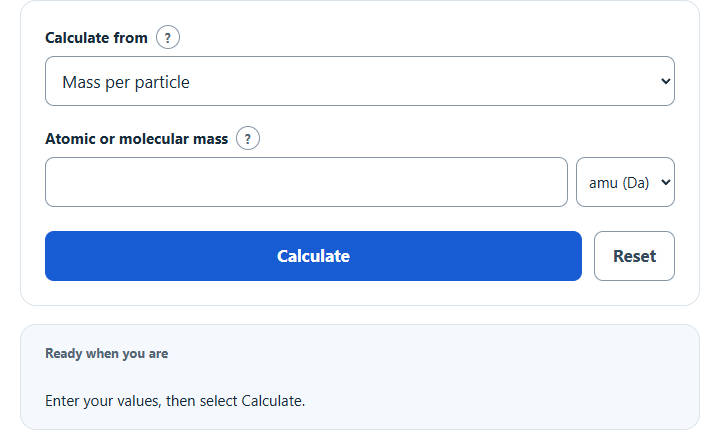
Convert amu to g/mol and to grams per particle: enter a mass in amu, Da or kDa, or a chemical formula, to get molar mass and the mass of one particle.
Calculator Functions
| Function | What it does | What it requires |
|---|---|---|
| Mass per particle | Converts a mass in amu (Da) or kDa to g/mol and to grams per particle | Requires the atomic or molecular mass |
| Chemical formula | Finds the molar mass of a compound by adding up standard atomic weights | Requires a chemical formula such as H2O, Al2(SO4)3 or CuSO4·5H2O |
| Common compound | Finds the molar mass of one of 13 listed compounds | Requires a choice from the compound list |
Every result also shows the molar mass in kg/mol and mg/mol and the mass of one particle in grams. Formulas need correct capitals (Co is cobalt, CO is carbon monoxide) and accept parentheses, brackets and a dot for water of hydration. Isotope labels and ionic charges are not accepted.
amu to g/mol Formula
| M | Molar mass (g/mol) |
| m | Mass of one atom or molecule in amu, also written u or Da |
The number does not change: a molecule of 18.015 amu has a molar mass of 18.015 g/mol. The exact factor is the molar mass constant, 1.00000000105 g/mol [1], about one part in a billion away from 1, and the calculator leaves that correction out.
Mass per particle
The second line of the result is the mass of a single particle in grams, using 1 amu = 1.66053906892 × 10⁻²⁴ g [2]. For 18.015 amu that is 2.99146 × 10⁻²³ g. With kDa selected the entry is multiplied by 1,000 first, so 64 kDa is 64,000 g/mol.
Chemical formula
n is the number of atoms of each element in the formula and A is its standard atomic weight [3]. For H₂O: 2 × 1.008 + 15.999 = 18.015 g/mol. For CuSO₄·5H₂O the five waters are included, giving 249.677 g/mol.
Common compound
The list uses the same sum of atomic weights:
| Compound | Formula | Molar mass (g/mol) |
|---|---|---|
| Water | H₂O | 18.015 |
| Sodium chloride | NaCl | 58.44 |
| Carbon dioxide | CO₂ | 44.009 |
| Oxygen | O₂ | 31.998 |
| Nitrogen | N₂ | 28.014 |
| Ammonia | NH₃ | 17.031 |
| Methane | CH₄ | 16.043 |
| Ethanol | C₂H₅OH | 46.069 |
| Glucose | C₆H₁₂O₆ | 180.156 |
| Calcium carbonate | CaCO₃ | 100.086 |
| Sulfuric acid | H₂SO₄ | 98.072 |
| Aluminum sulfate | Al₂(SO₄)₃ | 342.132 |
| Copper sulfate pentahydrate | CuSO₄·5H₂O | 249.677 |
Is amu the Same as g/mol?
They are different units that share a number. An amu measures the mass of one atom or molecule, and g/mol measures the mass of one mole of them. Because a mole was set up so the two scales line up, carbon dioxide is 44.009 amu per molecule and 44.009 g/mol.
How to Convert amu to Grams
For one particle, multiply amu by 1.66053906892 × 10⁻²⁴ [2]: an atom of 12 amu weighs 1.99265 × 10⁻²³ g. For grams per mole, keep the number and change the unit to g/mol. An amu value cannot be turned into moles on its own. Moles come from a weighed sample: moles = grams of sample ÷ molar mass.
Limits of This Estimate
- Standard atomic weights describe normal terrestrial material and are abridged to about five significant figures [3]. They are not the masses of single isotopes, so an isotope-labeled compound needs its mass entered directly.
- Elements with no standard atomic weight, such as technetium, are not supported in a formula.
- The 1 g/mol equivalence is off by about 1 part in a billion [1], far less than the uncertainty in most atomic weights.
Sources
- NIST, CODATA Value: molar mass constant: the molar mass constant, 1.00000000105 g/mol
- NIST, CODATA Value: atomic mass constant: the mass of 1 amu in kilograms
- IUPAC Commission on Isotopic Abundances and Atomic Weights, Abridged Standard Atomic Weights 2024: standard atomic weights of the elements