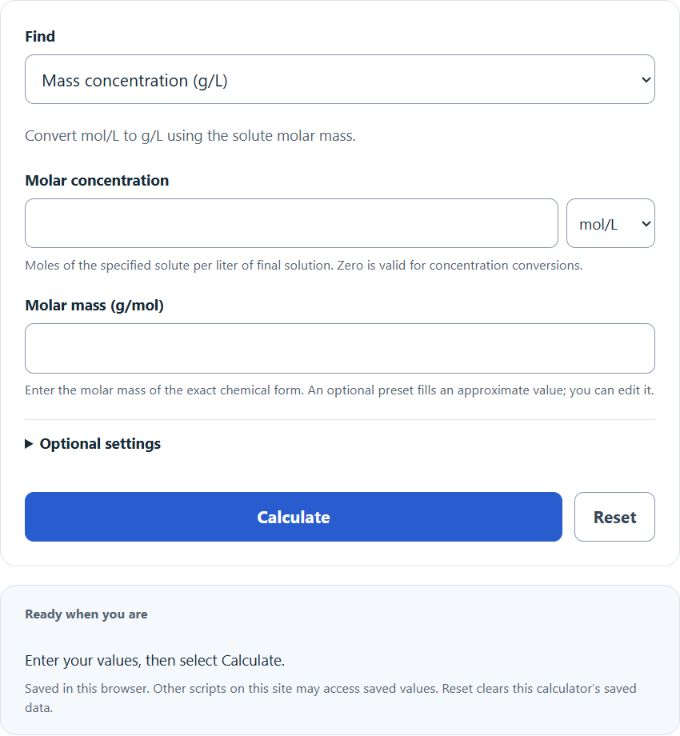
Calculate molarity, grams per liter, or molar mass from any two values, or find the solute mass needed to prepare a solution at any volume.
Related Calculators
- mol/L To Percentage Calculator
- Density To Molarity Calculator
- mg/mL To mol/L Calculator
- pH To mol/L Calculator
- All Chemistry Calculators
Molarity ⇄ Concentration Formula
The calculator uses molarity, mass concentration, molar mass, and solution volume. The base units are mol/L, g/L, g/mol, and L.
- g/L = mass concentration in grams of solute per liter of solution
- mol/L = molarity, also written as M
- g/mol = molar mass of the solute
To solve for molarity from grams per liter, rearrange the same formula:
To solve for molar mass from concentration and molarity:
For solution preparation, the calculator finds the mass of solute needed for a target molarity and volume:
- mass(g) = grams of solute to weigh out
- mol/L = desired molarity
- V(L) = final solution volume in liters
- g/mol = molar mass of the solute
Choose mass concentration, molarity, or molar mass, then enter the two required quantities. For solution preparation, enter molar mass, target molarity and final solution volume to find solute mass.
Common Molar Mass Values
Use these values when you need a quick check for common substances. Always use the molar mass that matches the exact chemical form you are preparing.
| Substance | Formula | Molar Mass |
|---|---|---|
| Water | H₂O | 18.015 g/mol |
| Sodium chloride | NaCl | 58.44 g/mol |
| Potassium chloride | KCl | 74.55 g/mol |
| Sodium hydroxide | NaOH | 40.00 g/mol |
| Hydrochloric acid | HCl | 36.46 g/mol |
| Glucose | C₆H₁₂O₆ | 180.16 g/mol |
Useful Unit Conversions
| Quantity | Conversion |
|---|---|
| Molarity | 1 mol/L = 1000 mmol/L = 1,000,000 µmol/L |
| Mass concentration | 1 g/L = 1000 mg/L = 0.001 kg/L |
| Volume | 1 L = 1000 mL = 1,000,000 µL |
| US gallon | 1 gal = 3.78541 L |
Examples
Example 1: Convert molarity to g/L
You have a 0.50 mol/L NaCl solution. Sodium chloride has a molar mass of 58.44 g/mol.
The concentration is 29.22 g/L.
Example 2: Find mass for solution prep
You want to make 500 mL of 0.10 mol/L NaOH. Sodium hydroxide has a molar mass of 40.00 g/mol.
First convert 500 mL to 0.500 L.
You need 2.00 g of NaOH; then dilute to a final volume of 500 mL.
FAQs
Is molarity the same as concentration?
Molarity is one type of concentration. It gives concentration in moles of solute per liter of solution. A value like 0.25 mol/L means there are 0.25 moles of solute in each liter of final solution.
Mass concentration, such as g/L or mg/L, gives the mass of solute per liter. You need molar mass to convert between molarity and mass concentration.
Why do I need molar mass?
Molar mass connects grams and moles. Molarity uses moles, but lab measurements often use grams. For example, NaCl has a molar mass of 58.44 g/mol, so 1 mole of NaCl has a mass of 58.44 g.
When preparing a solution, should I add the solute to the exact final volume?
No. Usually, you dissolve the measured solute in less than the final volume first. Then you add solvent until the solution reaches the final volume mark. This matters because the solute can change the final volume after it dissolves.