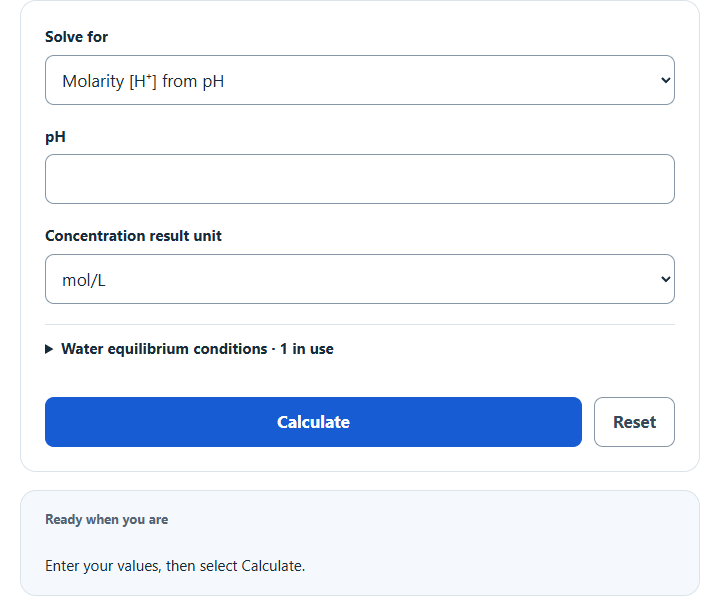
Convert pH to mol/L hydrogen-ion concentration (molarity), or find pH from molarity, with results in mol/L, mmol/L or µmol/L plus pOH and [OH⁻].
Related Calculators
- pH ↔️ pOH Calculator
- pH To OH- Calculator
- Ionic Concentration Calculator
- Molarity Calculator
- All Chemistry Calculators
pH to mol/L Formula
The following ideal dilute-solution approximation estimates hydrogen-ion concentration from pH. Thermodynamic pH is defined from ion activity; converting activity to concentration requires an activity model.
Variables:
- [H⁺] is the hydrogen ion concentration in moles per liter (mol/L)
- pH is the measure of the acidity or basicity of an aqueous solution
Use the approximation above with concentration in mol/L. In inverse mode, pH ≈ −log₁₀([H⁺]/(1 mol/L)). For hydroxide balance, pOH = pKw − pH and [OH⁻] ≈ (1 mol/L) × 10^(−pOH). The default pKw is 14, a common approximation near 25 °C; the neutral point is pKw/2. See the IUPAC definition of pH.
| pH | [H+] (mol/L) | [H+] (mmol/L) | [H+] (µmol/L) |
|---|---|---|---|
| 0 | 1.00e+0 | 1.00e+3 | 1.00e+6 |
| 1 | 1.00e-1 | 1.00e+2 | 1.00e+5 |
| 1.5 | 3.16e-2 | 3.16e+1 | 3.16e+4 |
| 2 | 1.00e-2 | 1.00e+1 | 1.00e+4 |
| 2.5 | 3.16e-3 | 3.16e+0 | 3.16e+3 |
| 3 | 1.00e-3 | 1.00e+0 | 1.00e+3 |
| 3.5 | 3.16e-4 | 3.16e-1 | 3.16e+2 |
| 4 | 1.00e-4 | 1.00e-1 | 1.00e+2 |
| 5 | 1.00e-5 | 1.00e-2 | 1.00e+1 |
| 6 | 1.00e-6 | 1.00e-3 | 1.00e+0 |
| 6.5 | 3.16e-7 | 3.16e-4 | 3.16e-1 |
| 7 | 1.00e-7 | 1.00e-4 | 1.00e-1 |
| 7.4 | 3.98e-8 | 3.98e-5 | 3.98e-2 |
| 8 | 1.00e-8 | 1.00e-5 | 1.00e-2 |
| 9 | 1.00e-9 | 1.00e-6 | 1.00e-3 |
| 10 | 1.00e-10 | 1.00e-7 | 1.00e-4 |
| 11 | 1.00e-11 | 1.00e-8 | 1.00e-5 |
| 12 | 1.00e-12 | 1.00e-9 | 1.00e-6 |
| 13 | 1.00e-13 | 1.00e-10 | 1.00e-7 |
| 14 | 1.00e-14 | 1.00e-11 | 1.00e-8 |
| [H+] is the hydrogen-ion concentration. Ideal dilute approximation: [H+] (mol/L) ≈ 10^(-pH). 1 mmol/L = 1e-3 mol/L; 1 µmol/L = 1e-6 mol/L. | |||
What is pH?
pH is a scale used to specify the acidity or basicity of an aqueous solution. It is approximately the negative of the base 10 logarithm of the molar concentration, measured in units of moles per liter, of hydrogen ions. At the default pKw of 14, neutral pH is 7; the neutral point changes with conditions. A pH below pKw/2 is acidic and a pH above it is basic. pH is not restricted to 0–14. Each one-unit decrease means ten times the hydrogen-ion activity, or approximately ten times its concentration in the ideal dilute model. For example, a pH of 4 is ten times more acidic than a pH of 5 and 100 times (10 times 10) more acidic than a pH of 6.
How to Calculate Hydrogen Ion Concentration?
The following steps outline how to calculate the hydrogen ion concentration from pH.
- First, determine the pH of the solution.
- Next, estimate [H⁺] ≈ (1 mol/L) × 10^(−pH) using the ideal dilute model.
- Finally, insert the values and calculate the result.
- Check your answer with the calculator above.
Example Problem :
Use the following variables as an example problem to test your knowledge.
pH = 3
Ideal-model hydrogen-ion concentration ≈ 10^(−3) mol/L = 0.001 mol/L