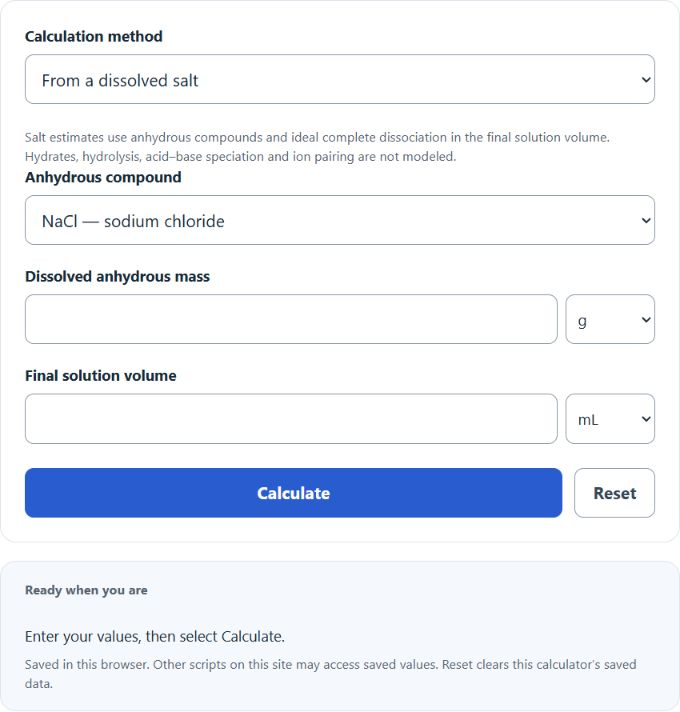
Calculate ideal stoichiometric ion concentrations from an anhydrous dissolved salt, use moles of a specified ion, or find a diluted solution’s final concentration.
- All Chemistry Calculators
- Percent Ionic Character Calculator
- Ionic Strength Calculator
- mol/L To g/L Calculator
Ionic Concentration (for a specified ion) Formula
The following formula is used to calculate the concentration of a specified ion (or any other specified dissolved species) in a solution.
Variables:
- Ci is the molar concentration of the specified ion/species i (mol/L)
- ni is the amount (in moles) of that ion/species i present in the solution (mol)
- V is the volume of the solution (L)
To calculate an ion’s concentration, divide the moles of that ion (ni) by the solution volume (V). If you start from a fully dissociated ionic compound, the moles of a given ion are found from the compound amount using stoichiometry (for example, 1 mol CaCl2 produces 1 mol Ca2+ and 2 mol Cl−). The salt mode assumes anhydrous compounds and ideal complete dissociation. Hydration, hydrolysis, acid–base speciation and ion pairing can change actual species concentrations; these equilibrium effects are not modeled.
What is an Ionic Concentration?
Ionic concentration refers to the amount (typically in moles) of a specified ion in a given volume of solution (for example, [Na+] or [Cl−]). Ions are atoms or molecules that have lost or gained electrons, resulting in a positive or negative charge. Concentration is commonly reported in moles per liter (mol/L), meaning “moles of that specified ion per liter of solution.” For ionic compounds, the ion concentration depends on how many ions each formula unit produces and how completely the compound dissociates in the solvent.
How to Calculate Ionic Concentration?
The following steps outline how to calculate the Ionic Concentration using the formula Ci = ni / V.
- First, determine the amount of the ion/species of interest (ni) in moles (using dissociation stoichiometry if starting from a compound).
- Next, determine the volume of the solution (V) in liters.
- Next, gather the formula from above: Ci = ni / V.
- Finally, calculate the concentration in mol/L.
- Choose “From moles of a specified ion” to enter ni and V directly. The dissolved-salt method instead uses anhydrous mass and final solution volume.
Example Problem:
Use the following variables as an example problem to test your knowledge.
amount of compound = 0.5 mol NaCl (assume complete dissociation)
volume of the solution (V) = 0.2 L; [Na+] = [Cl−] = 0.5 / 0.2 = 2.5 mol/L under the stated assumption