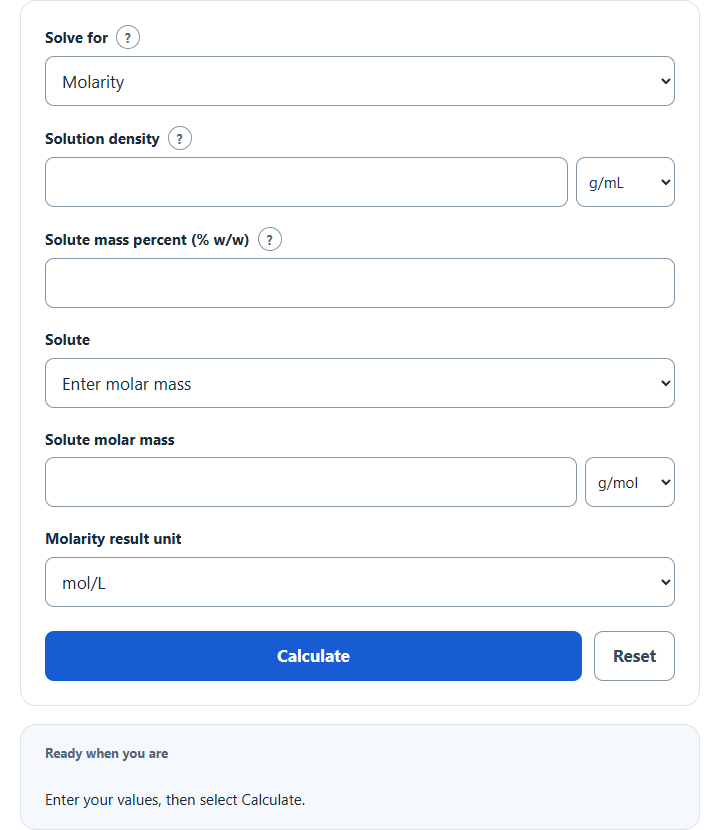
Convert density to molarity from solution density, mass percent and molar mass, or pick a common acid or base; also solves for density or mass percent.
Related Calculators
- M To g/L Calculator
- mol/L To Percentage Calculator
- Molar To ug/mL Calculator
- Mass To Moles Calculator
- All Chemistry Calculators
Calculator Functions
| Function | What it does | What it requires |
|---|---|---|
| Molarity | Finds the molarity of a solution from its density and the mass percent of solute in it | Requires the solution density, the solute mass percent (% w/w) and the solute, picked from the list or entered as a molar mass |
| Solution density | Finds the density a solution has at a given molarity and solute mass percent | Requires the molarity, a solute mass percent above zero and the solute or its molar mass |
| Solute mass percent | Finds the mass percent of solute in a solution from its molarity and density | Requires the solution density, the molarity and the solute or its molar mass |
Density is accepted in g/mL, kg/L, kg/m³ or lb/US gal, molarity in mol/L or mmol/L and molar mass in g/mol or kg/mol. The solute list holds HCl (36.46 g/mol), H₂SO₄ (98.079), HNO₃ (63.01), H₃PO₄ (97.994), acetic acid (60.052), NH₃ (17.031), NaOH (39.997), KOH (56.106), NaCl (58.44) and H₂O₂ (34.014). Every result also shows the solution mass and the solute mass in one litre.
Density to Molarity Formulas
| M | Molarity: moles of solute per litre of solution (mol/L) [2] |
| ρ | Density of the whole solution (g/mL) |
| P | Solute mass percent (% w/w): solute mass divided by solution mass, times 100 |
| MM | Molar mass of the solute (g/mol) |
One litre of solution weighs 1,000 × ρ grams. The share P ÷ 100 of that is solute, and dividing the grams of solute by the molar mass gives moles per litre [1]. The 1,000 and the 100 combine into the factor 10. Density on its own does not fix molarity: the mass percent and the solute are needed as well.
Molarity
The main formula applies directly. Nitric acid at 70% w/w with a density of 1.413 g/mL and a molar mass of 63.01 g/mol is 10 × 1.413 × 70 ÷ 63.01 = 15.697508 mol/L, the 15.7 M quoted for concentrated nitric acid [1].
Solution density
This is the main formula rearranged for density. Hydrochloric acid at 12 mol/L and 37% w/w has a density of 12 × 36.46 ÷ 370 = 1.182486 g/mL. Both the molarity and the mass percent must be above zero.
Solute mass percent
This is the main formula rearranged for mass percent. A sodium chloride solution at 1.8 mol/L with a density of 1.05 g/mL is 1.8 × 58.44 ÷ 10.5 = 10.018286% w/w. Inputs that work out above 100% are rejected, because they cannot describe a real solution.
Limits of This Estimate
- The density must be that of the solution, not of the pure solute or of water, and it must be measured at the same temperature and composition as the mass percent.
- The mass percent is weight per weight (% w/w). A percent by volume or a weight per volume figure gives a wrong answer.
- Supplier figures for density and mass percent vary by lot, so a certificate of analysis gives a closer molarity than a typical value [1].
Sources
- MilliporeSigma, Acid & Base Normality and Molarity Calculator: molarity from weight percent, density and molecular weight, with the nitric acid example
- NIST, Guide for the Use of the International System of Units (SP 811), Section 8.6: amount-of-substance concentration, mass fraction, mass density and molar mass