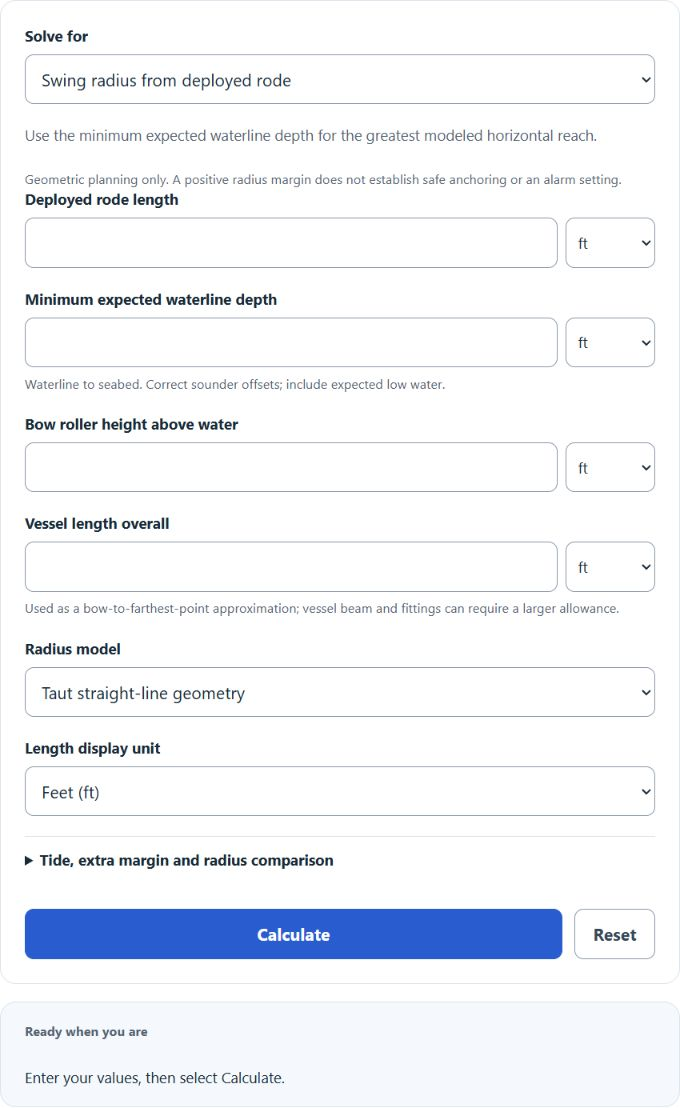
Estimate geometric anchor swing radius and diameter from rode or chosen scope, minimum and maximum water depth, bow height, vessel length and a user-chosen margin, in feet or meters.
Anchor Swing Circle Formula
The calculator finds a geometric swing radius from deployed rode or a chosen scope ratio, or solves the rode length at a user-chosen radius budget. It compares taut straight-line geometry with a full-rode envelope. Neither model establishes safe anchoring or a GPS alarm setting.
d = minimum waterline depth + bow roller height
D = d + expected depth increase
C = chosen scope × D (scope sizing mode)
H = sqrt(C² − d²)
Taut radius = H + LOA + M
Rode envelope radius = C + LOA + M
Diameter = 2 × radius; circle area = π × radius²
- C is deployed rode length.
- d and D are minimum and maximum vertical bow-to-seabed distances.
- H is the ideal horizontal reach of a taut straight rode.
- LOA is vessel length overall, used as a bow-to-farthest-point approximation.
- M is your chosen extra radial margin; the calculator cannot determine a sufficient safety margin.
For a fixed rode length, horizontal reach is greatest at the minimum depth. Scope sizing instead uses the maximum expected depth. Enter depth from waterline to seabed, correct sounder offsets, and avoid counting the same tidal change twice. Rode must span the maximum vertical distance. Vessel beam, overhangs and fittings can require a larger hull allowance than LOA.
The full-rode comparison bounds ideal fixed-length rode reach without subtracting vertical distance. The taut model assumes a straight rode and fixed anchor. Catenary, stretch, dragging, additional payout, neighboring vessels, position errors and seabed hazards are not modeled.
Inverse Rode Calculation
a = radius budget − LOA − M
Taut-model rode = sqrt(a² + d²)
Envelope-model rode = a
The horizontal allowance a must be nonnegative before it is squared. This inverse gives a rode length at the geometric radius boundary, not required or safe rode. Check the resulting scope at maximum depth separately. If the rode needed for your chosen scope exceeds the geometric limit, those inputs conflict; this tool does not justify shortening rode below appropriate holding requirements. A positive displayed radius margin is only arithmetic.
Reference Tables
The following conventional chain-length conversions are references. The calculator accepts feet or meters; convert shackles manually using the length actually marked for your equipment.
| Shackles | Meters | Feet | Fathoms |
|---|---|---|---|
| 3 | 82.3 | 270 | 45 |
| 5 | 137.2 | 450 | 75 |
| 7 | 192.0 | 630 | 105 |
| 9 | 246.9 | 810 | 135 |
| 11 | 301.8 | 990 | 165 |
| Model | Radius | Limit |
|---|---|---|
| Taut straight line | √(C² − d²) + LOA + M | Ideal fixed-anchor geometry |
| Full rode envelope | C + LOA + M | Does not include dragging or stretch |
| Scope sizing | Use C = chosen scope × D first | Chosen scope does not guarantee holding |
Worked Examples
Example 1, full-rode envelope. A vessel 200 m long has 5 conventional 90 ft shackles deployed: C = 137.16 m. With no extra margin, the full-rode envelope radius is 137.16 + 200 = 337.16 m. This is a geometry comparison, not a safe clearance recommendation.
Example 2, taut geometry. Enter 100 ft of rode, minimum waterline depth 55 ft, bow height 5 ft, vessel length 20 ft and extra margin 5 ft. Then d = 60 ft, H = √(100² − 60²) = 80 ft, radius = 80 + 20 + 5 = 105 ft and diameter = 210 ft. The full-rode envelope is 125 ft. Entering a 105 ft budget in inverse taut mode returns 100 ft of rode. These inputs illustrate arithmetic, not a suitable anchoring arrangement.
FAQ
Why is the full-rode estimate larger? It uses all rode as a radial allowance. The taut model subtracts the vertical component through right-triangle geometry. Neither model predicts actual holding.
Does a hull swing circle set my GPS alarm? No. Receiver position, anchor position, vessel heading, movement and position error affect an alarm. This calculator does not model an antenna offset or recommend alarm thresholds. Follow the equipment guidance and maintain an appropriate anchor watch.
Does this account for catenary? No. Chain sag can reduce reach in some conditions, but it can diminish under load. No catenary benefit is promised.
How do I convert shackles? A conventional 15-fathom shackle is 90 ft or 27.432 m. Confirm your actual chain markings, then enter its length in feet or meters.
Planning references: MAIB Astral annex, Royal Navy BR45 §1410 and Rocna scope and catenary guidance.