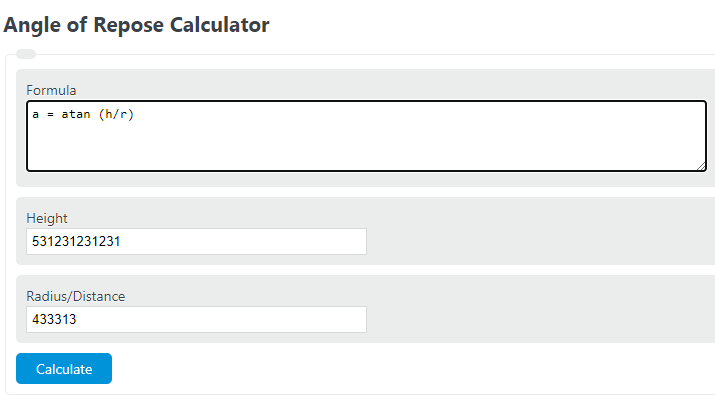
Calculate angle of repose, pile height, base radius, slope ratio, friction coefficient, and conical pile volume with metric or imperial dimensions.
- All Construction Calculators
- Cone Volume Calculator
- Central Angle Calculator
- Exterior Angle Calculator
- Interior Angle Calculator
- Reference Angle Calculator
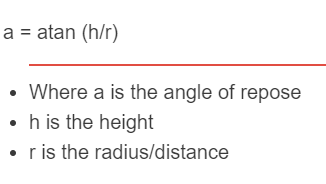
Angle of Repose Formula
- θ = angle of repose, in degrees
- h = vertical height of the pile
- r = horizontal run from the center of the pile to the edge of the base (half the base width for a symmetric cone)
The friction-relation mode uses μ = tan(θ), where μ is the coefficient of static friction between particles. The material lookup mode returns published angle ranges and, if you enter a base width, estimates a likely pile height using h = r · tan(θ).
Assumptions: the pile is a symmetric cone or wedge formed by free-pouring loose material onto a flat surface, particle properties are uniform, and no external compaction or vibration is applied. Moisture, particle shape, and packing can shift real-world results.
Typical Angles and Coefficients
Use these ranges as a sanity check for your calculated angle.
| Material | Angle of repose | μ ≈ tan(θ) |
|---|---|---|
| Dry sand | 30°–35° | 0.58–0.70 |
| Wet sand | 35°–45° | 0.70–1.00 |
| Gravel | 35°–40° | 0.70–0.84 |
| Crushed stone | 40°–45° | 0.84–1.00 |
| Coal | 35°–40° | 0.70–0.84 |
| Wheat | 23°–28° | 0.42–0.53 |
| Corn (shelled) | 21°–25° | 0.38–0.47 |
| Cement powder | 20°–30° | 0.36–0.58 |
| Flour | 40°–45° | 0.84–1.00 |
The next table tells you how to interpret your result.
| Angle | Behavior |
|---|---|
| < 20° | Very free-flowing; spreads into a shallow pile. |
| 20°–30° | Free-flowing grains and dry powders. |
| 30°–40° | Typical for dry sands, gravel, and coal. |
| 40°–50° | Steep; angular, damp, or cohesive material. |
| > 50° | Highly cohesive or compacted; recheck inputs. |
Example
You measure a sand pile that is 2 ft tall with a 7 ft base diameter. The horizontal run is 7 / 2 = 3.5 ft.
- θ = arctan(2 / 3.5) = arctan(0.571) ≈ 29.7°
- μ = tan(29.7°) ≈ 0.57
That sits just below the 30°–35° band for dry sand, suggesting the sand is slightly damp on the surface or the base was measured a bit wide.
FAQ
Do I use the diameter or the radius? The formula needs the horizontal run from the peak to the edge. If you measured the full base, select “Full base width / diameter” so the calculator divides by two.
Why is my measured angle different from the table? Moisture, particle shape, fines content, drop height, and surface vibration all change the result. Tables list typical ranges, not fixed values.
Is angle of repose the same as the friction angle? They are closely related but not identical. Angle of repose is measured on a free-formed pile; the internal friction angle is measured in a controlled shear test. For loose, dry granular material the two values are usually within a few degrees.