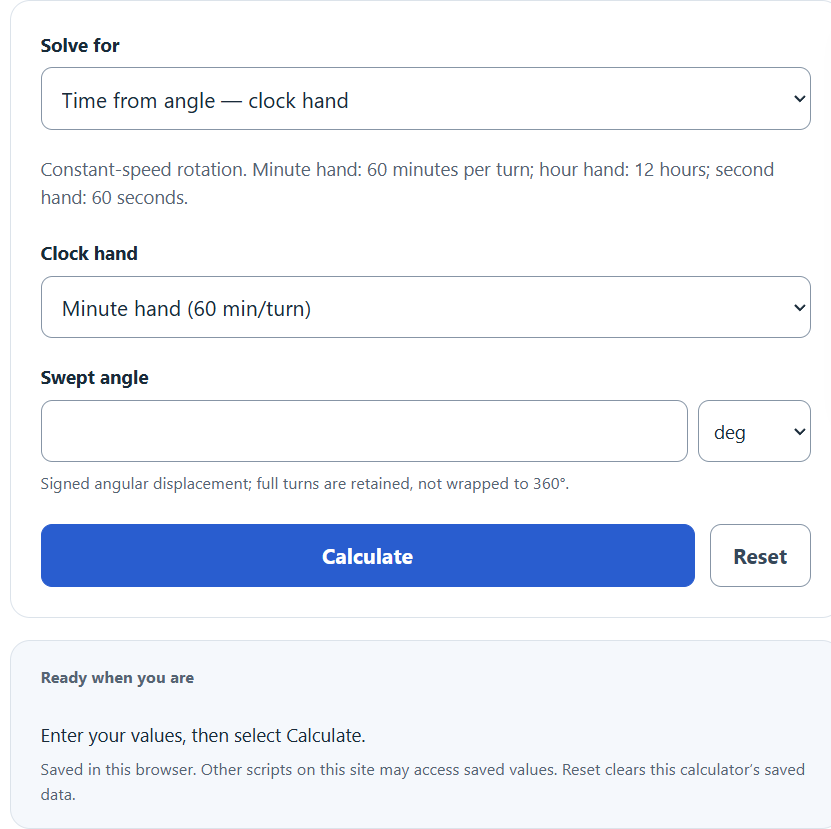
Choose a Solve for task to convert signed angle and time intervals for minute, hour or second hands, use a custom constant rotation period, or find angles between clock hands. For clock-hand angles, enter whole hours and minutes; optional seconds default to zero.
Related Calculators
- 100-Minute Clock Calculator
- RPM to Angular Velocity Calculator
- Clock Angle Calculator
- Degree to Time Calculator
- DMS Calculator
- All Unit Converters
Angle To Time Formula
Variables:
- T is the time (minutes) for the minute hand to sweep angle A (i.e., 360° = 60 minutes).
- A is the angle (degrees).
For the minute hand, convert angle to time by multiplying by 1/6 ≈ 0.1666667 (since 60/360 = 1/6). The general form for any rotating system is T = (A / 360) × P, where P is the full rotation period. Each clock hand has a different angular rate: the minute hand moves 6°/min, the hour hand moves 0.5°/min, and the second hand moves 6°/s (360°/min).
| Degrees (°) | Minutes (min) | Seconds (s) | Hours (h) |
|---|---|---|---|
| 0.5 | 0.083 | 5 | 0.001 |
| 1 | 0.167 | 10 | 0.003 |
| 2 | 0.333 | 20 | 0.006 |
| 3 | 0.500 | 30 | 0.008 |
| 5 | 0.833 | 50 | 0.014 |
| 7.5 | 1.250 | 75 | 0.021 |
| 10 | 1.667 | 100 | 0.028 |
| 12 | 2.000 | 120 | 0.033 |
| 15 | 2.500 | 150 | 0.042 |
| 20 | 3.333 | 200 | 0.056 |
| 22.5 | 3.750 | 225 | 0.063 |
| 30 | 5.000 | 300 | 0.083 |
| 36 | 6.000 | 360 | 0.100 |
| 45 | 7.500 | 450 | 0.125 |
| 60 | 10.000 | 600 | 0.167 |
| 90 | 15.000 | 900 | 0.250 |
| 120 | 20.000 | 1200 | 0.333 |
| 180 | 30.000 | 1800 | 0.500 |
| 270 | 45.000 | 2700 | 0.750 |
| 360 | 60.000 | 3600 | 1.000 |
| Uses Time (minutes) = Angle (degrees) × (60/360) = Angle/6. Equivalences (minute hand): 1° = 1/6 min = 10 s; 360° = 60 min = 1 h. If angle is in radians, convert first: 1 rad ≈ 57.2958°. | |||
Angular Rates of Real-World Rotating Systems
Angle-to-time conversion applies to any system with a known rotation period. The table below compares the angular rate of common rotating systems, which determines how much angle accumulates per unit of time. Every row uses the same underlying formula: angular rate = 360° / period.
| System | Full Rotation Period | Rate (°/min) | Rate (°/s) | Notes |
|---|---|---|---|---|
| Clock second hand | 60 s | 360 | 6 | Fastest standard clock hand |
| Clock minute hand | 60 min | 6 | 0.1 | Base case for this calculator |
| Clock hour hand | 12 h (720 min) | 0.5 | 0.00833 | Moves 30° per hour mark |
| Mean solar-time cycle | 24 h | 0.25 | 0.004167 | Basis for time zones (15°/hr) |
| Earth (sidereal day) | 23 h 56 m 4 s | 0.25068 | 0.004178 | True rotation vs. fixed stars |
| Earth around Sun | 365.25 days | 0.000685 | 0.0000114 | ~0.9856°/day of orbital motion |
| Moon around Earth | 27.32 days | 0.00916 | 0.000153 | Sidereal orbital period |
| Typical vinyl record (33⅓ RPM) | 1.8 s | 12,000 | 200 | Standard LP speed |
| Example rotor (300 RPM) | 0.2 s | 108,000 | 1,800 | Illustrative constant speed |
| Example engine (800 RPM) | 0.075 s | 288,000 | 4,800 | Varies by engine |
| Hard drive platter (7,200 RPM) | 0.00833 s | 2,592,000 | 43,200 | Standard desktop HDD |
| Angular rate = 360° / period. The solar vs. sidereal day difference (3 min 56 s) exists because Earth must rotate slightly more than 360° each solar day to compensate for its orbital motion around the Sun. | ||||
Hour Angle in Astronomy and Celestial Navigation
Astronomers formalized the angle-to-time relationship long before mechanical clocks existed. In celestial coordinate systems, a star’s position is measured using right ascension, which is expressed in hours, minutes, and seconds rather than degrees. The conversion is exact: 24 hours = 360°, making 1 hour of right ascension equal to exactly 15°, 1 minute of right ascension equal to 0.25°, and 1 second equal to 1/240° (approximately 0.004167°).
The hour angle of a celestial object is the angle between the observer’s meridian and the object’s position, measured westward in time units. When an object has an hour angle of 0h, it is on the meridian and at its highest point in the sky (transit). An hour angle of 6h means the object is 90° west of the meridian and, neglecting refraction at a nonpolar location, an object on the celestial equator is on the western horizon. This framework allowed sailors to determine longitude with a sextant and an accurate chronometer before GPS: measuring the Sun’s hour angle at local noon and comparing it to Greenwich Mean Time gave longitude directly in degrees (15° per hour of difference).
The Earth’s actual sidereal rotation rate is 360° per 23 hours 56 minutes 4.09 seconds, not 24 hours. The extra 3 minutes 55.91 seconds per day accumulates because Earth is simultaneously orbiting the Sun, requiring a small additional rotation to bring the Sun back to the same apparent position. This adds approximately 0.9856°/day of “extra” rotation, so 360° per sidereal day is a slightly faster rate than 360° per mean solar day.
Time Zones and the 15-Degree Rule
The modern time zone system is a direct product of angle-to-time conversion. The ideal mean-solar-time mapping uses 360° in 24 hours, or 15° of longitude per hour. Actual civil time zones need not be 15° wide or differ by whole hours. In practice, time zone boundaries follow political and geographic borders rather than strict meridians, so actual zones deviate from the ideal 15° bands.
Sundials used this relationship for thousands of years before clocks were invented. The Sun’s hour angle changes by roughly 15° per hour, but sundial hour-line spacing depends on the dial geometry and latitude. The equation of time, which describes the difference between apparent solar time (what a sundial reads) and mean solar time (what a clock reads), varies by up to 16 minutes 33 seconds across the year due to Earth’s elliptical orbit and axial tilt. The equation of time crosses zero about four times per year; longitude within the time zone and daylight-saving corrections still affect agreement with civil clock time.
FAQs
What is the significance of converting angles to time?
Any rotating system with a fixed period links angle directly to elapsed time through the ratio T = (A / 360) × P. The relationship appears in clock mechanics, astronomy, celestial navigation, motor engineering, and signal processing. On this page, the basic formula assumes a clock-style mapping for the minute hand: 360° = 60 minutes.
Why does 1° of longitude equal 4 minutes of time?
The mean-solar-time longitude mapping is 360° per 24 hours, giving 15° per hour. Dividing further: 15° per 60 minutes = 0.25° per minute, or equivalently 1° per 4 minutes. This is the conversion sailors used for centuries to find their longitude at sea by comparing local solar noon to a reference clock set to Greenwich time.
What is the difference between a solar day and a sidereal day in angle terms?
A sidereal day is 23 hours 56 minutes 4.09 seconds, during which Earth rotates exactly 360° relative to distant stars. A solar day is 24 hours, during which Earth rotates approximately 360.9856° relative to distant stars. The extra 0.9856° per day is required to compensate for Earth’s orbital motion. Over a full year, these extra daily increments sum to one full extra rotation (360°), which is why a year contains approximately one more sidereal day than solar days.
Can this formula be used for any rotating system?
Yes. For any system with a known period P, use T = (A / 360) × P, with A in degrees and T and P in the same time units. The custom-period Solve for tasks accept a positive constant rotation period in seconds, minutes, or hours, making it applicable to motors, planetary bodies, spinning machinery, or any other periodic rotator.
How accurate is the angle-to-time conversion?
The formula is exact for a constant-speed model; input uncertainty, floating-point arithmetic and display rounding limit the numerical result. The precision limit is the accuracy of the rotation period itself. For a mechanical clock, the period drifts slightly with temperature and spring tension. For Earth’s rotation, the period itself changes measurably over geological time due to tidal braking from the Moon, changing the long-term day length; short-term variations also occur.
Is there a way to convert time back to angle?
Yes. For the minute hand: A = 6T (degrees, T in minutes). For the hour hand: A = 0.5T (degrees, T in minutes). For the second hand: A = 6T (degrees, T in seconds). For any period P: A = (T / P) × 360, with T and P in matching units. The calculator above solves in both directions for all three clock hands and custom periods.