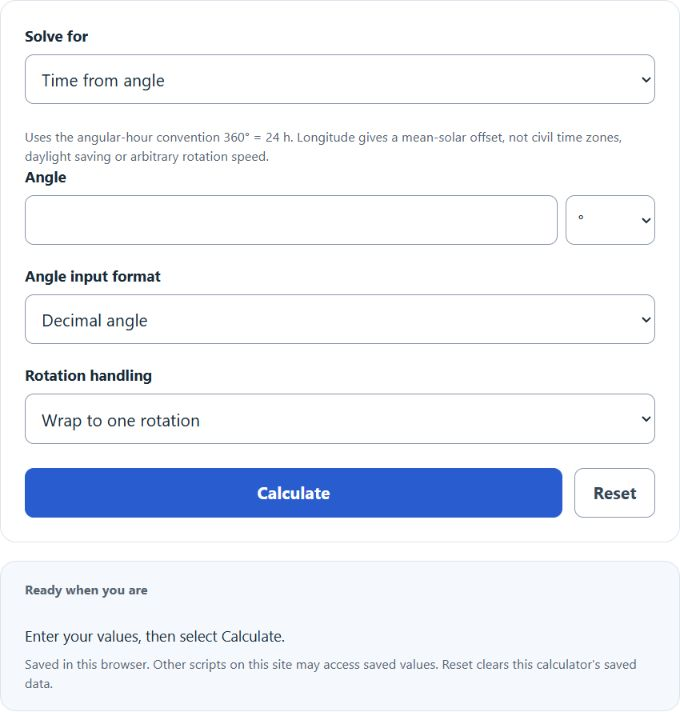
Convert degrees or radians to time, time to angle, or longitude difference to solar time using 360° = 24 hours with normalized HMS results.
- All Unit Converters
- MOA Calculator (minute of angle)
- mm to Degree Calculator
- Degree to Points Calculator
Degree To Time Formula
The following formula is used to calculate the time from degrees.
Variables:
- T is the time (minutes)
- D is the degree (°)
In the angular-hour convention, multiply degrees by 4 to obtain minutes of angular time: 360° = 24 h. This is not a general physical rotation-speed calculation. Longitude differences estimate mean-solar time offsets, not legal clock time or daylight-saving rules.
| Degrees (°) | Time (min) |
|---|---|
| ¼ | 1 |
| ½ | 2 |
| 1 | 4 |
| 1½ | 6 |
| 2 | 8 |
| 3 | 12 |
| 5 | 20 |
| 7½ | 30 |
| 10 | 40 |
| 12 | 48 |
| 15 | 60 |
| 20 | 80 |
| 22½ | 90 |
| 30 | 120 |
| 36 | 144 |
| 45 | 180 |
| 60 | 240 |
| 90 | 360 |
| 120 | 480 |
| 180 | 720 |
| *Main relation: 1 degree = 4 minutes. For seconds, multiply minutes by 60. Note: 1 rad ≈ 57.2958°. | |
What is Degree To Time?
This conversion expresses an angle in hour units, using 15° per hour. For longitude, east is positive and the calculator reports B minus A. Wrapped longitude uses the shortest signed difference from −180° to under 180°; exactly opposite longitudes use −12 h. It does not determine a civil clock time, calendar date or precise physical sidereal rotation period.
How to Calculate Degree To Time?
The following steps outline how to calculate the Degree To Time using the formula T = D * 4.
- First, determine the degree (D) value.
- Next, multiply the degree value by 4 to calculate the time (T) in minutes.
- Finally, calculate the Degree To Time.
- After inserting the degree value and calculating the result, check your answer with the calculator above.
Example Problem:
Use the following variables as an example problem to test your knowledge.
degree (°) = 20; T = 20 × 4 = 80 minutes = 1 h 20 m.