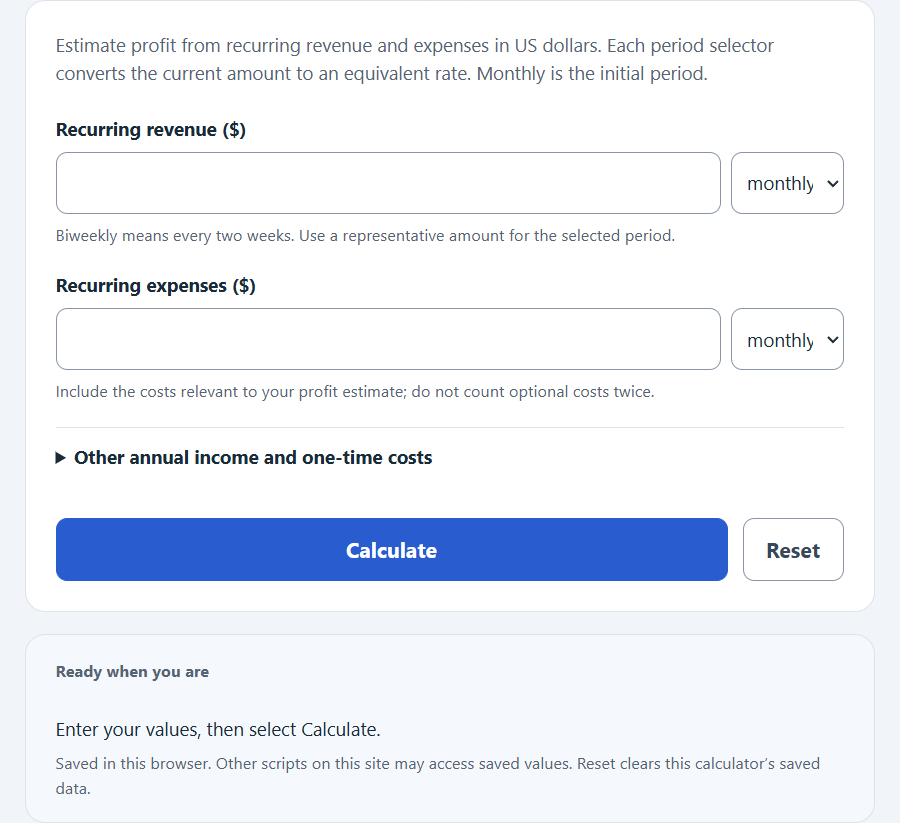
Calculate annual profit from revenue and expenses entered weekly, biweekly, monthly, quarterly, or yearly, plus other income and one-time costs.
Annual Profit Formula
The calculator converts your revenue and expense entries to annual amounts, then subtracts to find profit. It also calculates margin and break-even values from the same inputs.
- Revenue: income amount entered for the selected period.
- Expenses: recurring costs entered for the selected period.
- P_r, P_e: period multiplier (52 weekly, 26 biweekly, 12 monthly, 4 quarterly, 1 annual).
- Other Income: extra annual income such as interest or refunds.
- One-Time Costs: yearly non-recurring costs like equipment or repairs.
The calculator multiplies your revenue and expense entries by the period factor, adds the optional annual extras, and returns annual, monthly, weekly, and daily profit. The margin uses total annual income, including other income. Required monthly recurring revenue subtracts other annual income before dividing annual costs by 12, with a minimum of zero. Costs and other income are held fixed.
Reference Tables
Use these tables to interpret your result and to convert period entries quickly.
| Profit Margin | Interpretation |
|---|---|
| Below 0% | Loss. Expenses exceed revenue. |
| 0% to 5% | Profit is $0 to $5 per $100 of total income. |
| 5% to 10% | Profit is $5 to $10 per $100 of total income. |
| 10% to 20% | Profit is $10 to $20 per $100 of total income. |
| Above 20% | Profit exceeds $20 per $100 of total income. |
| Period | Multiplier to Annual |
|---|---|
| Weekly | x 52 |
| Biweekly | x 26 |
| Monthly | x 12 |
| Quarterly | x 4 |
| Annual | x 1 |
Example Problems
Example 1. A small shop earns $12,000 in monthly revenue and pays $8,500 in monthly expenses. There is no other income or one-time cost. Annual revenue is $144,000 and annual expenses are $102,000. Annual profit is $42,000. Profit margin is 29.17%.
Example 2. A freelancer earns $2,000 weekly and pays $600 weekly. Other annual income is $1,500 from interest. One-time costs are $4,000 for a new laptop. Annual revenue is (2,000 x 52) + 1,500 = $105,500. Annual expenses are (600 x 52) + 4,000 = $35,200. Annual profit is $70,300. Profit margin is 66.64%.
FAQ
Does this calculate net profit or gross profit? The result depends on the income and costs included. Sales less cost of goods sold gives gross profit; operating profit also deducts operating expenses. Net profit additionally accounts for applicable non-operating items, interest, and tax. This calculator does not classify those items for you.
Should I include taxes in expenses? Include them if you want after-tax profit. Leave them out for pre-tax profit. Be consistent across periods.
What is the break-even monthly revenue? It is the minimum recurring monthly revenue needed to cover entered annual costs after other annual income, assuming those costs and other income stay fixed. It is not a model of costs that rise with sales.
Why is my margin negative? Annual expenses plus one-time costs are higher than annual revenue plus other income. Reduce costs or raise revenue to move above zero.