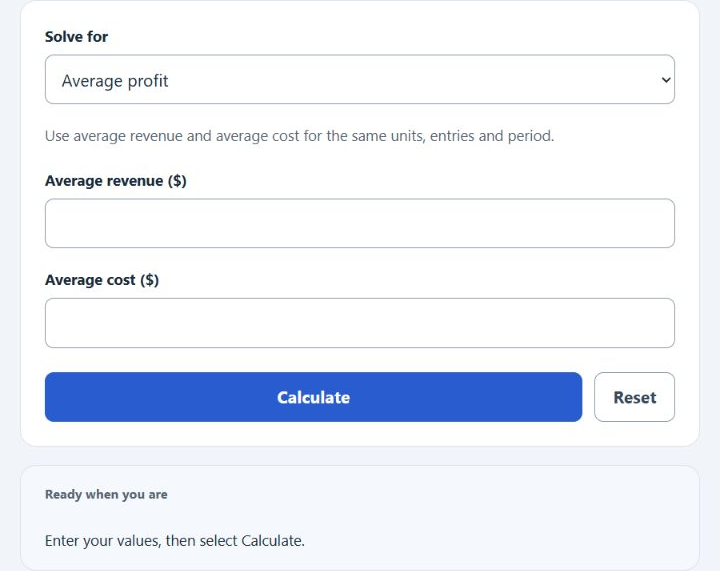
Choose average profit, a reverse calculation, margin and markup, break-even units, or service cost and price. Average revenue and cost must use the same observations and weights. Break-even shows both continuous units and the whole-unit threshold; optional service overhead defaults to zero, and a blank service margin shows costs only.
Average Profit Formula
The following formula is used to calculate the Average Profit.
- Where Pave is the Average Profit ($)
- AR is the average revenue ($)
- AC is the average cost ($)
To calculate average profit, subtract average cost from average revenue for matching observations and weights. Margin divides profit by revenue; markup divides profit by cost. A zero denominator is undefined. Price for a target margin is cost divided by (1 minus margin as a decimal); rounded prices may differ slightly from the target.
How to Calculate Average Profit?
The following example problems outline how to calculate Average Profit.
Example Problem #1:
- First, determine the average revenue ($). In this example, the average revenue ($) is given as 65.
- Next, determine the average cost ($). For this problem, the average cost ($) is given as 5.
- Finally, calculate the Average Profit using the equation above:
Pave = AR - AC
The values given above are inserted into the equation below:
Pave = 65 - 5 = 60.00 ($)
Example Problem #2:
The variables needed for this problem are provided below:
average revenue ($) = 70
average cost ($) = 8
Entering these values and solving gives:
Pave = 70 - 8 = 62.00 ($)