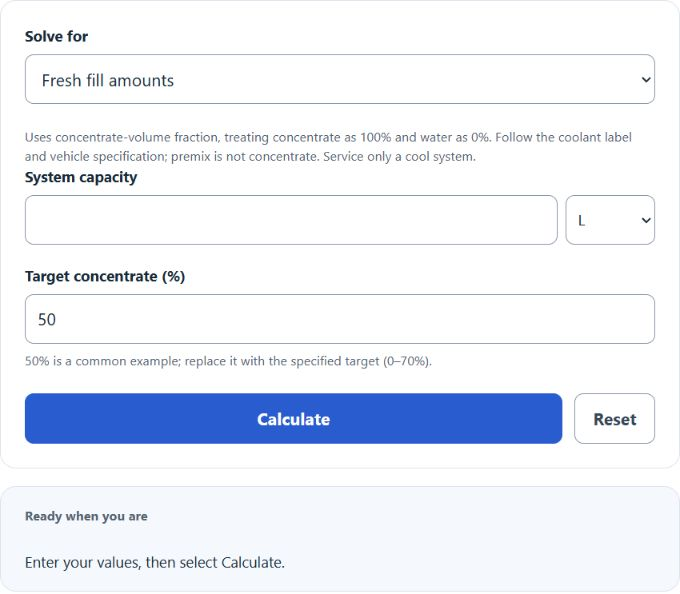
Calculate antifreeze-to-water ratios for a fresh fill, adjust an existing coolant mix to a target percentage, or check a mixture in gallons, liters, quarts, and ounces.
Antifreeze Ratio Formula
The calculator uses nominal concentrate-volume fraction: concentrate is treated as 100% and water as 0%, not as a chemical glycol-purity measurement. Choose Fresh fill amounts, Drain and replace to a target, or Check mixed volumes. Use the product label and vehicle specification to choose a compatible coolant and target.
Mixing Relationships
Full Refill With Concentrate
Full Refill With 50/50 Premix
Partial Drain and Refill
- P = antifreeze percentage
- A = antifreeze volume
- T = total coolant volume
- C = cooling system capacity
- W = distilled water volume
- D = volume drained
- R = antifreeze fraction of the refill fluid, where concentrate is 1, 50/50 premix is 0.5, and water is 0
- A_final = antifreeze volume after draining and refilling
- P_final = final antifreeze percentage after refilling
Fresh fill amounts assumes an empty system and uses capacity and target percentage. Drain and replace uses capacity, current fraction and target, then solves for the volume replaced by concentrate or water. Check mixed volumes uses concentrate and water amounts. The total-volume rearrangement and 50/50 premix relationships above are reference equations, not additional calculator modes. The drained coolant must have the same composition as the remaining coolant.
Common Antifreeze Mix Targets
| Antifreeze Percentage | Concentrate / Water Ratio | Typical Use |
|---|---|---|
| 40% | 40 / 60 | Use only if specified by the product and vehicle requirements |
| 50% | 50 / 50 | Common target for many vehicles |
| 60% | 60 / 40 | Colder conditions, if allowed by the coolant label |
| 70% | 70 / 30 | Often near the practical upper limit for many coolants |
Coolant Volume Unit Conversions
| Unit | Equivalent |
|---|---|
| 1 US gallon | 3.78541 liters, 4 quarts, or 128 US fluid ounces |
| 1 liter | 0.264172 US gallons or 1.05669 US quarts |
| 1 US quart | 0.946353 liters |
| 1 imperial gallon | 4.54609 liters |
Example Calculations
Example 1: Full refill at 50%
You have a 3 gallon cooling system and want a 50% antifreeze mix using concentrate and distilled water.
You need 1.5 gallons of antifreeze concentrate and 1.5 gallons of distilled water.
Example 2: Partial drain and refill with concentrate
Choose Drain and replace: capacity 3 US gallons, current concentrate fraction 40%, and target 60%. The calculator gives 1 US gallon to drain and replace with concentrate. The mass-balance check is:
After the refill, the coolant mixture is 60% antifreeze.
FAQ
Can 50/50 premix make a different target percentage?
Not by itself during a full refill. A 50/50 premix is already 50% antifreeze and 50% water, so filling an empty system with only 50/50 premix gives about a 50% final mixture. To reach a different percentage, you need concentrate, water, or a calculated partial drain and refill.
What antifreeze percentage should you use?
Many vehicles commonly use a 50/50 mix, but the correct target depends on the coolant type, climate, and vehicle requirements. Do not assume that more antifreeze is always better. Very high antifreeze concentrations can reduce heat transfer and may fall outside the coolant manufacturer’s recommended range.
Why does the partial drain calculation assume the drained coolant has the same mix?
The model requires an evenly mixed system. Follow the vehicle service procedure and allow the engine and system to cool before opening or draining it. The calculation assumes the portion drained has the same antifreeze percentage as the rest of the system. If the system was not mixed, the real final percentage may be different.