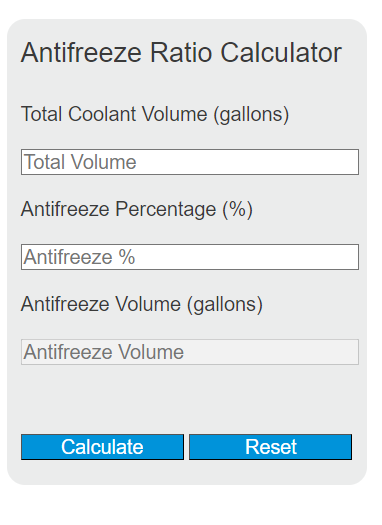
Enter the total coolant volume and the desired antifreeze percentage into the calculator to determine the antifreeze volume needed for your vehicle’s cooling system.
Antifreeze Ratio Formula
The core formula for determining antifreeze volume is:
AV = (AP / 100) * TV
Where AV is the antifreeze volume, AP is the antifreeze percentage (%), and TV is the total coolant system volume. All volumes should use the same unit (gallons, liters, or quarts).
Freeze and Boil Protection by Concentration
The relationship between ethylene glycol concentration and thermal protection is non-linear. Pure antifreeze actually freezes at a higher temperature than a 60% mixture, because glycol-water solutions form a eutectic system where the lowest freezing point occurs near 60% glycol. Exceeding 60% concentration raises the freeze point again while reducing heat transfer capacity.
| Ethylene Glycol % | Freeze Point | Boil Point (no cap) | Boil Point (15 psi cap) |
|---|---|---|---|
| 0% (pure water) | 32 F / 0 C | 212 F / 100 C | 250 F / 121 C |
| 10% | 26 F / -3 C | 214 F / 101 C | 252 F / 122 C |
| 20% | 18 F / -8 C | 216 F / 102 C | 254 F / 123 C |
| 30% | 4 F / -16 C | 219 F / 104 C | 257 F / 125 C |
| 40% | -12 F / -24 C | 222 F / 106 C | 260 F / 127 C |
| 50% | -34 F / -37 C | 226 F / 108 C | 265 F / 129 C |
| 60% | -62 F / -52 C | 230 F / 110 C | 270 F / 132 C |
| 70% | -34 F / -37 C | 238 F / 114 C | 277 F / 136 C |
| 100% (pure glycol) | 8 F / -13 C | 388 F / 198 C | N/A |
A standard 15 psi radiator cap pressurizes the system and raises the effective boiling point by roughly 38 F (21 C) above atmospheric boiling temperature. This is why most vehicles can operate with coolant temperatures of 185 to 220 F under normal conditions without boiling over.
Freeze Point vs. Burst Point
A coolant mixture does not freeze solid at a single temperature the way pure water does. Instead, it begins forming ice crystals (slush) at the listed freeze point. The burst point is the temperature at which enough ice has formed to generate the expansion pressure needed to crack an engine block or radiator. For ethylene glycol, the burst point is typically 20 to 40 F below the freeze point. A 50% mixture with a freeze point of -34 F has a burst point near -65 F to -75 F. This margin is why occasional brief exposures slightly below the rated freeze temperature do not necessarily cause catastrophic damage.
Ethylene Glycol vs. Propylene Glycol
Most automotive antifreeze uses ethylene glycol (EG), but propylene glycol (PG) formulations exist for applications where toxicity is a concern.
| Property | Ethylene Glycol | Propylene Glycol |
|---|---|---|
| Toxicity | Toxic (lethal dose ~100 mL for adults) | Low toxicity (FDA GRAS status) |
| Freeze Point at 50% | -34 F / -37 C | -31 F / -35 C |
| Heat Transfer Efficiency | Higher | Lower (40-60% more viscous) |
| Cost | Lower, widely available | Higher, less common |
| Primary Use | Automotive, industrial HVAC | Food processing, solar thermal, RVs |
| Min. Effective Concentration | 25-30% (for corrosion inhibitors) | 25-30% |
Propylene glycol requires a slightly higher concentration to match the freeze protection of ethylene glycol. It also reduces heat transfer performance more significantly at higher concentrations, making it less suitable for high-performance or heavy-duty engines. However, for RVs, boats, and any system where incidental contact with potable water is possible, PG is the safer choice.
Coolant Technology Types
The glycol base is only one component of antifreeze. The additive package that prevents corrosion differs across three main technologies, and mixing incompatible types can cause gel formation that clogs the cooling system.
| Type | Full Name | Common Colors | Service Life | Typical Vehicles |
|---|---|---|---|---|
| IAT | Inorganic Additive Technology | Green | 2 years / 30,000 mi | Pre-2000 domestic vehicles |
| OAT | Organic Acid Technology | Orange, red, dark green | 5 years / 150,000 mi | GM (Dex-Cool), Honda, Toyota |
| HOAT | Hybrid Organic Acid Technology | Yellow, turquoise, pink | 5 years / 150,000 mi | Ford, Chrysler, BMW, Mercedes |
IAT coolants use silicates and phosphates that deposit a protective film on metal surfaces but deplete relatively quickly. OAT coolants use organic acids that protect only where corrosion actually begins, allowing a much longer service interval. HOAT blends combine both approaches. Always consult the vehicle owner’s manual for the specified coolant type, as color alone is not a reliable indicator across all brands.
The Concentration Tradeoff: Cooling vs. Protection
Water transfers heat approximately 2x more efficiently than ethylene glycol. Pure water would be the ideal engine coolant from a thermal standpoint alone, which is why most racing vehicles run straight water with a surfactant additive. However, water provides zero corrosion protection and zero freeze protection. The practical operating range for antifreeze concentration in street vehicles is 40% to 60%, with most manufacturers specifying 50%. Running above 60% glycol concentration actually degrades both freeze protection and cooling efficiency simultaneously. At 70% glycol, the freeze point rises back to -34 F (the same as 50%), while heat transfer drops meaningfully. The minimum recommended concentration is 25 to 30%, below which the corrosion inhibitor package loses effectiveness.
Climate-Based Ratio Recommendations
| Climate Type | Lowest Expected Temp | Recommended Ratio (Antifreeze:Water) | Freeze Protection |
|---|---|---|---|
| Hot / Desert / Track | Above 26 F / -3 C | 30:70 | 4 F / -16 C |
| Mild / Subtropical | Above 0 F / -18 C | 40:60 | -12 F / -24 C |
| Four-Season / Temperate | Above -20 F / -29 C | 50:50 | -34 F / -37 C |
| Severe Cold / Arctic | Below -20 F / -29 C | 60:40 | -62 F / -52 C |
For the vast majority of drivers in temperate climates, 50:50 provides the best balance of freeze protection, boil-over resistance, corrosion inhibition, and cooling performance. Only increase beyond 50% if you regularly experience sustained temperatures below -20 F.
Common Vehicle Cooling System Capacities
Knowing your system’s total volume is essential for accurate mixing. Below are representative capacities; always confirm with your owner’s manual, as variations exist across trim levels and optional equipment (rear heaters, oil coolers).
| Vehicle Category | Typical Capacity |
|---|---|
| 4-cylinder compact (Civic, Corolla) | 5 – 7 qt / 4.7 – 6.6 L |
| 6-cylinder midsize (Camry, Accord) | 7 – 9 qt / 6.6 – 8.5 L |
| V8 sedan/muscle (Mustang GT, Charger) | 12 – 16 qt / 11.4 – 15.1 L |
| Full-size truck (F-150, Silverado) | 14 – 20 qt / 13.2 – 18.9 L |
| Heavy-duty diesel (Duramax, Cummins) | 24 – 32 qt / 22.7 – 30.3 L |
| SUV with rear heat (Tahoe, Expedition) | 16 – 22 qt / 15.1 – 20.8 L |
Note that the drainable volume is typically 60 to 70% of total system capacity, because coolant trapped in the heater core and engine block passages does not drain by gravity alone. When performing a partial drain and refill, account for the retained fluid’s existing concentration using the Partial Drain tab in the calculator above.
Measuring Your Current Concentration
Two common tools measure existing coolant concentration. A refractometer uses a drop of coolant on a glass prism and reads the refractive index against a calibrated scale, giving accuracy within 1 to 2 percentage points. A hydrometer (floating ball or disc type) draws coolant into a chamber and measures specific gravity. Refractometers are preferred for their precision and ability to distinguish between ethylene and propylene glycol. Both tools are inexpensive ($10 to $30) and essential for anyone performing partial drain-and-refills, since guessing the starting concentration leads to either over- or under-protection.