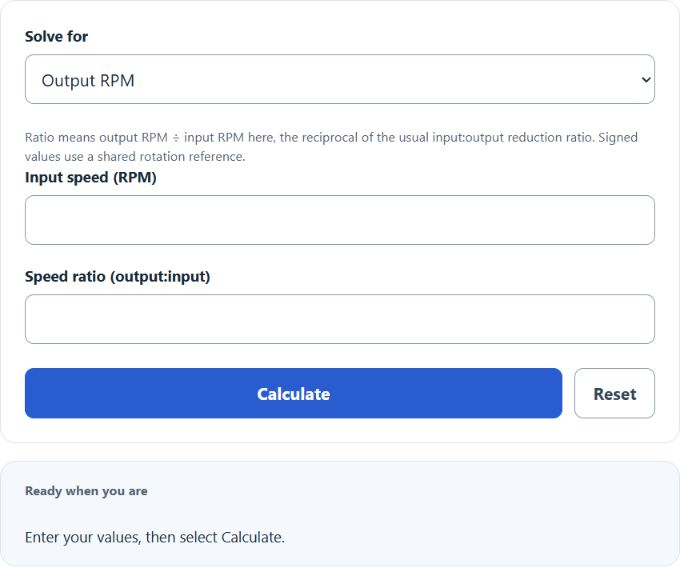
Select output RPM, input RPM or output:input speed ratio, then enter the two known values. This speed-ratio convention is the reciprocal of the usual input:output reduction ratio.
Related Calculators
- RPM to Torque Calculator
- Wheel Force Calculator
- Engine kW to Wheel kW Calculator
- Gradeability Calculator
- All Automotive Calculators
RPM Gear Ratio Formula
The RPM gear ratio calculator uses the relationship between input speed, output speed, and the gear ratio written as output:input.
- GR = RPM gear ratio, written as output:input
- Output RPM = rotational speed after the gear set, pulley set, or drive system
- Input RPM = rotational speed entering the system, often from a motor or engine
If you enter input RPM and gear ratio, the calculator finds the output RPM by multiplying them. If you enter output RPM and gear ratio, it finds the required input RPM by dividing output RPM by the ratio. If you enter input RPM and output RPM, it finds the gear ratio by dividing output RPM by input RPM.
Common RPM Gear Ratio Results
| Gear Ratio, output:input | Effect on RPM | Example with 1,000 Input RPM |
|---|---|---|
| 0.25 | Output speed is reduced to 25% | 250 RPM |
| 0.50 | Output speed is reduced by half | 500 RPM |
| 1.00 | Output speed equals input speed | 1,000 RPM |
| 2.00 | Output speed is doubled | 2,000 RPM |
| 3.00 | Output speed is tripled | 3,000 RPM |
Example Calculations
Example 1: Calculate output RPM
You have an input speed of 1,750 RPM and a gear ratio of 0.40.
The output speed is 700 RPM.
Example 2: Calculate gear ratio
You have an input speed of 3,000 RPM and an output speed of 900 RPM.
The RPM gear ratio is 0.30, meaning the output speed is 30% of the input speed.
FAQ
What does an RPM gear ratio below 1 mean?
A gear ratio below 1 means the output RPM is lower than the input RPM. For example, a ratio of 0.50 means the output rotates at half the input speed.
What does an RPM gear ratio above 1 mean?
A gear ratio above 1 means the output RPM is higher than the input RPM. For example, a ratio of 2.00 means the output rotates twice as fast as the input.
Why does the calculator require exactly two values?
Select the variable to solve and enter its two required values. Division requires a nonzero denominator: two zero speeds do not define a ratio, and zero ratio cannot uniquely determine input speed. Signed values use a shared rotation reference. A zero ratio is an algebraic case, not a finite engaged fixed-gear ratio.