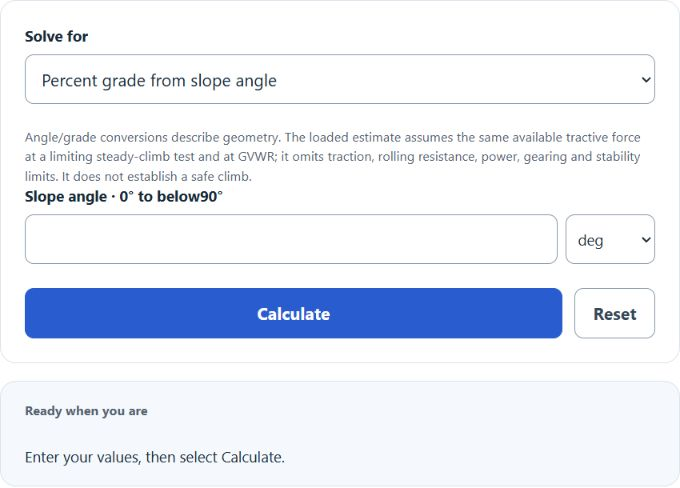
Calculate vehicle gradeability as percent grade from slope angle, convert percent grade to angle, or estimate loaded gradeability from test weight and GVWR.
Related Calculators
- Tractive Force Calculator
- Torque to Weight Ratio Calculator
- hp To kg Ratio Calculator
- Drivetrain Loss Calculator
- All Automotive Calculators
How the Gradeability Calculator Works
Gradeability describes an uphill climbing capability and is usually expressed as percent grade. A20% grade rises20 units per100 horizontal units. The conversion tasks describe slope geometry. The loaded task is an idealized constant-tractive-force comparison using a limiting steady-climb test and a target rated gross vehicle weight (GVWR); it does not establish safe operating capability.
The loaded comparison assumes the same available tractive force at both vehicle loads and neglects rolling resistance and other forces. A test that was merely completed does not measure the maximum available climbing force. Use manufacturer ratings and controlled engineering validation for actual vehicle capability.
Gradeability Formula
- GRB = estimated gradeability as a percent grade
- a = slope angle of the test track
- Wv = actual vehicle weight during the test
- WGVWR = rated gross vehicle weight used for the estimate
If your angle is entered in degrees, it must be converted to radians before the trigonometric functions are evaluated.
Percent grade and slope angle are related, but they are not the same unit.
Because the formula uses a weight ratio, the vehicle weight and GVWR can be entered in pounds or kilograms as long as both use the same unit.
What the Result Means
A higher result means the vehicle can theoretically handle a steeper climb at GVWR under this simplified model. If the estimated gradeability is 35%, the vehicle is being estimated for a slope that rises about 35 units for every 100 units of horizontal distance.
Do not confuse percent grade with degrees. Even a small angle can represent a surprisingly large percent grade, which is why roadway slopes and vehicle test data can look very different when expressed in different units.
Angle to Percent Grade Reference
| Slope Angle | Equivalent Percent Grade | Rise per 100 Horizontal Units |
|---|---|---|
| 5° | 8.75% | 8.75 |
| 10° | 17.63% | 17.63 |
| 15° | 26.79% | 26.79 |
| 20° | 36.40% | 36.40 |
| 25° | 46.63% | 46.63 |
| 30° | 57.74% | 57.74 |
How to Use the Calculator
- Select the loaded task and enter a limiting steady-climb test angle, or select an angle/grade conversion task for geometry only.
- Select the correct angle mode so the value is interpreted as degrees or radians properly.
- Enter the vehicle weight during the test.
- Enter the rated gross vehicle weight used for the idealized comparison.
- Calculate the estimated gradeability and interpret the answer as a percent grade.
Example
Idealized example: assume a vehicle reaches its limiting steady climb at30° while weighing2,000 lb, and the same available tractive force is assumed at a rated gross weight of2,500 lb. Neglect rolling resistance and all other limiting factors.
The constant-force model gives43.64% grade. This is a model output under the stated assumptions, not proof that the loaded vehicle can safely climb that slope.
How Each Input Affects the Estimate
- Higher test-track angle: increases the estimated gradeability.
- Higher vehicle test weight: increases the estimate because more climbing ability was demonstrated under load.
- Higher GVWR: lowers the estimate if the test angle and test weight stay the same.
- Using consistent units is essential for the two weight inputs, even though either lb or kg can be used.
Important Assumptions
This calculator uses an idealized force balance: P = Wtest × sin(test angle), then holds P constant at the target weight. The force-to-grade relationship is illustrated in the DOE-hosted ETA-TP002 engineering procedure, section5.3.1; the weight-transfer assumption here is a modeling inference. Primary engineering reference.
- Rolling resistance is not directly added.
- Aerodynamic drag is neglected.
- Surface traction limits are not included.
- Drivetrain losses, tire deformation, and wheel slip are not independently modeled.
- Engine or motor power, torque curve, gearing, and cooling limits may affect real hill-climb performance.
Because of these assumptions, the estimate is most useful for quick comparisons, early design checks, and interpreting test results rather than replacing full vehicle validation.
Input Validity Check
For a finite nonnegative percent grade, the sine argument x must satisfy0≤x<1. At x=1 the modeled slope is vertical, so percent grade is undefined; x>1 has no real angle in this model.
If the calculator returns an invalid result, double-check the angle mode, the entered slope angle, and whether both weight values use the same measurement system.
Common Mistakes
- Confusing degrees with percent grade.
- Mixing pounds and kilograms between the vehicle weight and GVWR fields.
- Using curb weight instead of the actual test weight including payload, fuel, passengers, or cargo.
- Assuming the estimate guarantees real-world performance on loose, wet, icy, or uneven surfaces.
- Forgetting that uphill climbing ability and downhill braking performance are different topics.
Frequently Asked Questions
Is a 30% grade the same as a 30° slope?
A 30% grade is much less steep than a 30° slope. A 30° angle corresponds to about 57.74% grade.
Can I use kilograms instead of pounds?
Yes. The vehicle weight and GVWR can be entered in kilograms or pounds as long as both use the same unit.
Why does gradeability decrease as GVWR increases?
The same available climbing capability has to move more total weight, so the estimated climb the vehicle can sustain becomes less steep.
When is this calculator most useful?
It is helpful when comparing vehicles, interpreting hill-climb test data, estimating loaded performance from a lighter test condition, or doing a quick feasibility check before more detailed analysis.