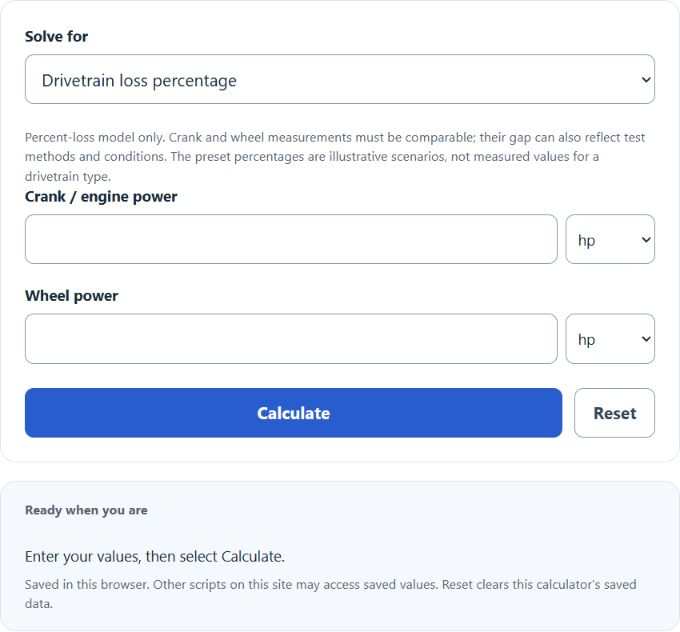
Calculate drivetrain loss, wheel power or crank power with hp, kW and PS conversions, explicitly illustrative loss scenarios, efficiency and power-difference details.
- All Automotive Calculators
- Wheel Horsepower Calculator
- WHP to HP Calculator
- HP to Torque Calculator
- Engine Hours to Miles Calculator
- Engine kW to Wheel kW Calculator
Drivetrain Loss Formula
The following formula is used to calculate a percentage drivetrain loss:
- Where DL is the drivetrain loss (%)
- EHP is the engine horsepower (hp)
- WHP is the wheel horsepower (hp)
To calculate a drivetrain loss percentage, subtract the wheel horsepower from the engine horsepower, divide by the engine horsepower, then multiply by 100.
What is a drivetrain loss?
Definition:
A drivetrain loss is a measure of the amount of horsepower that is lost due to inefficiencies and friction within a drivetrain.
It is the percentage of crank power that does not appear as wheel power in comparable measurements. Transfer efficiency is the complementary percentage that reaches the wheels.
How to calculate drivetrain loss?
Example Problem:
The following example outlines how to calculate a drivetrain loss percentage.
First, determine the engine horsepower output. In this example, the engine of the car can produce 500 horsepower (hp).
Next, determine the wheel horsepower. The horsepower that is received by the wheels in this case is 400 horsepower (hp).
Finally, calculate the drive train loss using the formula above:
DL = (EHP – WHP) / EHP *100
DL = (500 – 400) /500*100
DL = 20% loss
A 20% gap alone cannot identify the drivetrain layout or isolate frictional loss; dyno method and measurement conditions can also affect the comparison.