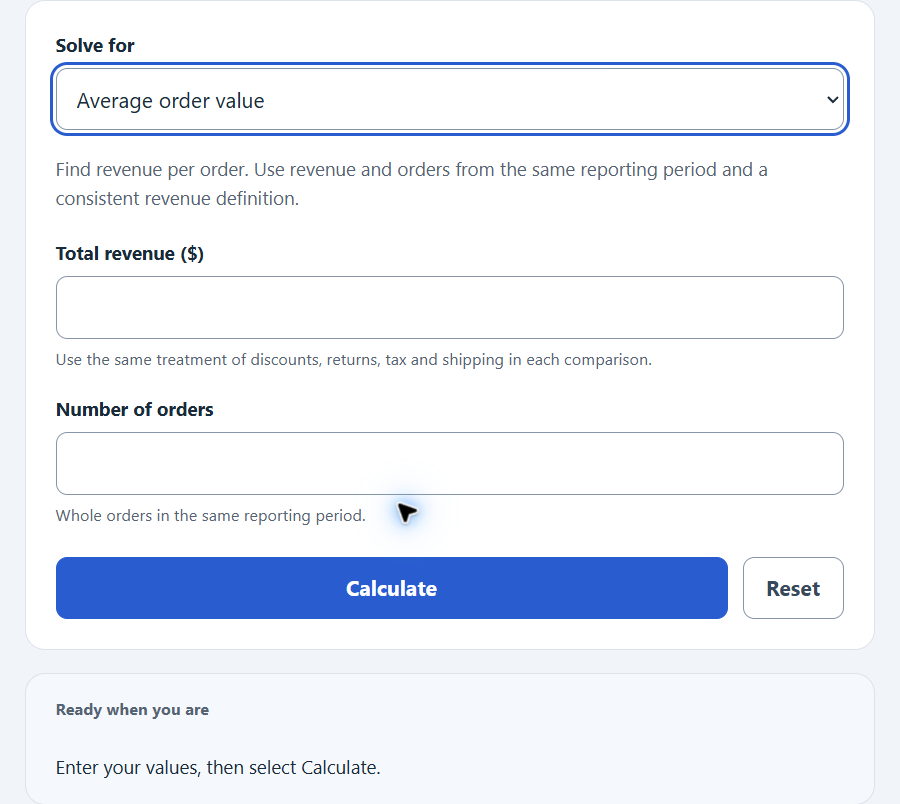
Calculate average order value, total revenue, or number of orders from any two ecommerce inputs: revenue, order count, and AOV values.
AOV Formula
The basic average order value formula is:
The same relationship can be rearranged to solve for total revenue or total number of orders:
- AOV = average order value, in dollars per order
- TR = total revenue, in dollars
- O = total number of orders
Choose the value to solve for, then enter the other two values from the same reporting period. Order-count results show the unrounded estimate and the nearest whole count; a rounded AOV may not reproduce the original order count exactly.
Factors Affecting AOV by Store Type
AOV varies by product category, price point, reporting definition and customer behavior. No verified benchmark dataset is supplied here; compare your own consistent reporting periods rather than treating a universal range as a target.
| Store or product type | Benchmark status | What usually affects it |
|---|---|---|
| Low-cost consumer goods | No verified range supplied | Small basket sizes, repeat purchases, shipping thresholds |
| Apparel and accessories | No verified range supplied | Discounts, bundles, seasonal demand, returns |
| Home goods and furniture | No verified range supplied | Higher item prices, financing, large-ticket purchases |
| B2B or wholesale orders | No verified range supplied | Bulk buying, contract pricing, minimum order quantities |
How Changes in AOV Affect Revenue
| Orders per month | AOV | Monthly revenue |
|---|---|---|
| 500 | $40 | $20,000 |
| 500 | $50 | $25,000 |
| 500 | $60 | $30,000 |
| 500 | $75 | $37,500 |
Example AOV Calculations
Example 1: Calculate average order value
You have $18,000 in total revenue from 300 orders.
Your average order value is $60.00 per order.
Example 2: Calculate total revenue
Your average order value is $85 and you received 420 orders.
Your total revenue is $35,700.00.
AOV Calculator FAQ
What does average order value tell you?
Average order value tells you how much revenue you earn per order on average. It is useful for tracking customer spending patterns, comparing sales periods, and estimating how changes in pricing, bundling, or promotions may affect revenue.
Should shipping and tax be included in AOV?
It depends on the purpose of the calculation. For sales performance, many businesses use product revenue only and exclude tax and shipping. For cash collected per order, you may include shipping fees and taxes. Use the same method each time so your AOV comparisons stay consistent.
Why does the order count need to be greater than zero?
AOV is calculated by dividing revenue by the number of orders. Dividing by zero is not valid, so you need at least one order to calculate average order value.