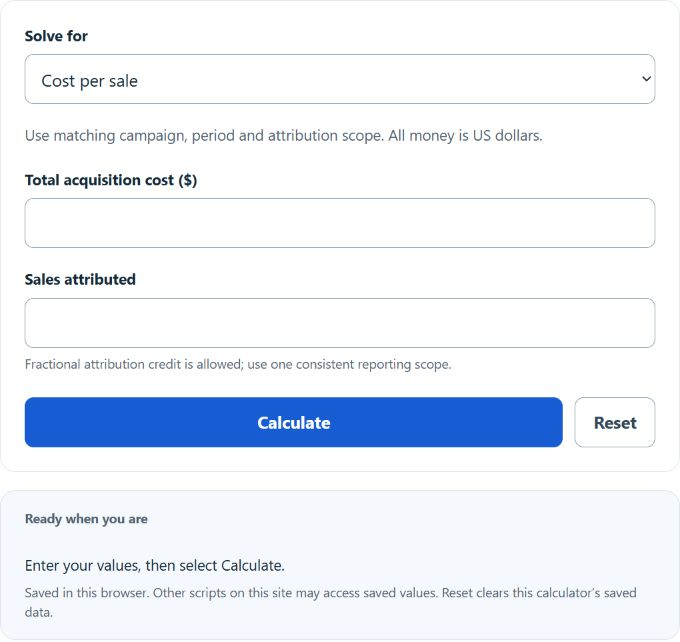
Choose cost per sale, total acquisition cost, or estimated sales volume. Monetary amounts are US dollars; sales volume is a count or attributed credit, not a dollar amount.
- All Business Calculators
- Unit Product Cost Calculator
- Total Manufacturing Cost Calculator
- AOV (Average Order Value) Calculator
- Cost Per Reportable Test Calculator
- Cost of Sales Calculator
CPS Formula
The CPS calculator uses the relationship between total acquisition cost, sales attributed, and cost per sale. Select a quantity to solve and enter the two required values for the same campaign, period and attribution scope.
- CPS = cost per sale, usually shown in dollars per sale
- Total Cost Spent = the total amount spent to generate sales
- Total Number of Sales Made = the number of completed sales from that spending
Select CPS to divide total cost by sales, total cost to multiply CPS by sales, or sales volume to divide cost by CPS. Reverse volume estimates may be fractional, as may attribution credit. A supplied CPS times zero planned sales gives zero planned spend; zero sales still leaves observed CPS undefined.
Common CPS Benchmarks and What They Mean
Compare CPS with the contribution per sale before deducting the acquisition cost already included in CPS. This avoids counting the same cost twice. Match revenue, variable costs, refunds and attribution scope; CPS alone does not establish overall profitability.
| CPS Compared With Contribution Before Acquisition Cost | General Meaning |
|---|---|
| CPS is lower than contribution before acquisition cost | The campaign may be profitable before other fixed costs. |
| CPS is equal to contribution before acquisition cost | The campaign is near break-even on a per-sale basis. |
| CPS is higher than contribution before acquisition cost | The campaign may be losing money unless repeat purchases or upsells make up the difference. |
| Input You Know | Input You Know | Result You Can Find |
|---|---|---|
| Total Cost Spent | Total Sales Made | CPS |
| CPS | Total Sales Made | Total Cost Spent |
| Total Cost Spent | CPS | Total Sales Made |
Example CPS Calculations
Example 1: Calculate CPS
You spent $2,400 and made 80 sales.
Your cost per sale is $30.00 per sale.
Example 2: Calculate Total Cost Spent
Your CPS is $18.50 and you made 120 sales.
Your total cost spent is $2,220.00.
FAQ
What does CPS mean?
CPS means cost per sale. It tells you how much you spent, on average, to generate one sale. For example, if you spent $500 and made 25 sales, your CPS is $20 per sale.
Is a lower CPS always better?
A lower CPS is usually better, but it does not tell the full story by itself. You should compare CPS with your revenue, gross profit, and customer lifetime value. A $50 CPS may be good for a product with $200 profit per sale, but bad for a product with $20 profit per sale.
Why can’t sales or CPS be zero in some calculations?
The calculator cannot divide by zero. If total sales are zero, CPS cannot be calculated because there are no sales to divide the cost across. If CPS is zero, total sales cannot be calculated from cost divided by CPS.