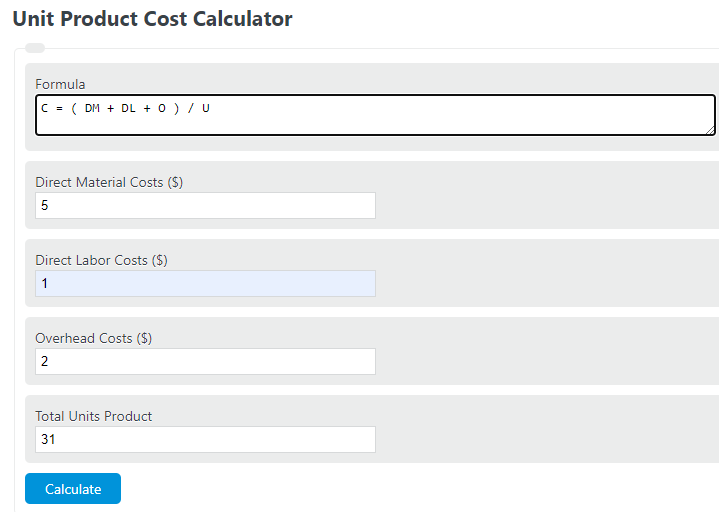
Calculate product cost per good unit from materials, labor, overhead, output, and yield, or reverse-solve allowable cost and required production volume.
- All Business Calculators
- Direct Labor Costs Calculator
- Total Manufacturing Cost Calculator
- Manufacturing Overhead Calculator
- Units of Production Depreciation Calculator
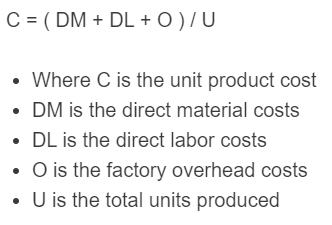
Unit Product Cost Formula
Unit product cost measures the average manufacturing cost assigned to each unit produced. It combines direct materials, direct labor, and factory overhead, then spreads that total across the number of units made during the period.
- C = unit product cost
- DM = direct material costs
- DL = direct labor costs
- O = factory overhead costs
- U = total units produced
This is an average cost per unit, not the selling price and not the profit per unit. It is most useful for manufacturing analysis, pricing review, margin planning, inventory valuation, and production efficiency tracking.
Rearranged Formula Versions
If you know any four values, the calculator can solve for the missing one by rearranging the same equation.
| Missing Value | Formula |
|---|---|
| Unit Product Cost | C = (DM + DL + O) / U |
| Direct Material Costs | DM = C × U - DL - O |
| Direct Labor Costs | DL = C × U - DM - O |
| Factory Overhead | O = C × U - DM - DL |
| Total Units Produced | U = (DM + DL + O) / C |
How to Calculate Unit Product Cost
- Find direct materials. Include raw materials and components physically used in production.
- Find direct labor. Include wages directly tied to making the product.
- Find factory overhead. Include indirect production costs such as utilities, equipment depreciation, indirect labor, maintenance, rent, and factory supplies.
- Count total units produced. Use the number of units manufactured during the same period as the costs above.
- Divide total manufacturing cost by units produced. The result is the average cost assigned to each unit.
Example Calculation
Suppose a production run has the following costs:
- Direct materials = $12,500
- Direct labor = $8,000
- Factory overhead = $4,500
- Total units produced = 1,000
First, calculate total manufacturing cost:
Now divide by total units produced:
The unit product cost is $25 per unit.
What to Include in Each Input
| Input | Usually Included | Usually Excluded |
|---|---|---|
| Direct Material Costs | Raw materials, purchased parts, packaging tied to the product | Office supplies, marketing materials, shipping to customers |
| Direct Labor Costs | Assembly wages, machine operator time, production line labor | Sales salaries, office payroll, executive compensation |
| Factory Overhead | Factory rent, utilities, indirect labor, maintenance, depreciation, production insurance | Selling expenses, administrative expenses, interest expense |
| Total Units Produced | Units manufactured during the same cost period | Units sold if different from production volume |
Why This Metric Matters
- Pricing decisions: it gives a baseline manufacturing cost before adding selling expenses and target profit.
- Margin analysis: it helps compare production cost against selling price.
- Cost control: it makes it easier to see whether materials, labor, or overhead are driving cost increases.
- Operational planning: it supports budgeting, quoting, and scenario analysis at different production volumes.
- Inventory accounting: it helps assign production cost to units made during the period.
Unit Product Cost vs. Related Cost Measures
| Measure | Formula | Use |
|---|---|---|
| Unit Product Cost | C = (DM + DL + O) / U |
Average manufacturing cost per unit produced |
| Prime Cost | PC = DM + DL |
Direct production cost only |
| Conversion Cost | CC = DL + O |
Cost to convert materials into finished goods |
| Total Manufacturing Cost | TM = DM + DL + O |
Total production cost before dividing by units |
Common Mistakes
- Using units sold instead of units produced. This changes the cost per unit and can distort analysis.
- Mixing time periods. Monthly costs should be divided by monthly production, not quarterly or annual output.
- Leaving out overhead. Ignoring indirect factory costs usually understates the true production cost.
- Including non-manufacturing expenses. Selling, advertising, and general administration are normally not part of unit product cost.
- Ignoring low production volume. When output drops, fixed overhead is spread over fewer units, which raises the unit cost.
FAQ
Is unit product cost the same as selling price?
No. Unit product cost measures manufacturing cost per unit. Selling price is usually higher because businesses also need to cover non-manufacturing expenses, taxes, risk, and desired profit.
Does unit product cost include overhead?
Yes. In this calculator, factory overhead is one of the core inputs, along with direct materials and direct labor.
What happens if total units produced is zero?
The calculation is undefined because the formula requires division by the number of units produced. If no units were made, there is no valid per-unit production cost for that period.
Can this be used for multiple products?
Yes, but each product should have costs assigned consistently. If several products share factory overhead, allocate that overhead using a reasonable base before calculating each product’s unit cost.
Why does unit cost change when production volume changes?
Many overhead costs are fixed over a short period. When more units are produced, those costs are spread across more units, which often lowers the average unit product cost.