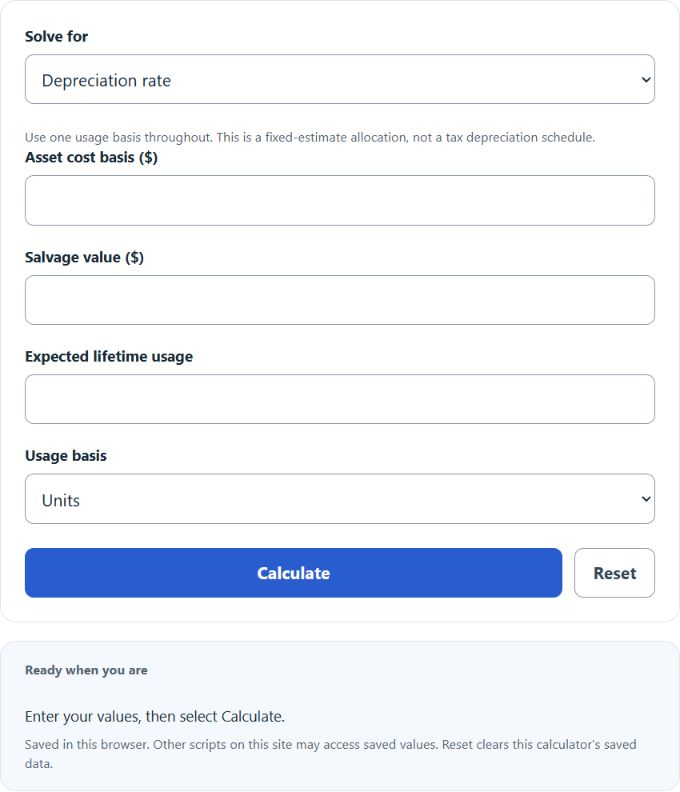
Calculate units of production depreciation per unit from asset cost, salvage value, and lifetime output, or solve for any missing value.
- All Business Calculators
- Labor Productivity Calculator
- Total Manufacturing Cost Calculator
- Capacity Utilization Calculator
Units of Production Depreciation Formula
Units of production depreciation assigns expense based on actual output or usage instead of time. It is most useful for machinery, vehicles, and equipment whose wear is driven by production volume, run time, or similar activity.
To calculate depreciation for a specific period, multiply the per-unit rate by the actual units produced during that period.
If you are tracking book value over time, reduce the asset cost by accumulated depreciation, but do not depreciate below salvage value.
| Variable | Meaning |
|---|---|
| UPD | Depreciation rate per unit of output or usage |
| C | Asset cost basis, typically purchase price plus costs to place the asset into service |
| SV | Estimated salvage or residual value at the end of useful life |
| TP | Total expected lifetime production or usage |
| U | Actual units produced in the period |
| D | Depreciation expense for the period |
| AD | Accumulated depreciation before the current period |
| BVend | Ending book value after current-period depreciation |
How to Use the Calculator
- Select Depreciation rate and a consistent usage basis, then enter the asset cost basis.
- Enter the salvage value.
- Enter the asset’s total expected lifetime units, such as items, hours, batches, or miles.
- Select Calculate to find the depreciation per usage unit. Choose another solve mode to find cost, salvage value, or lifetime usage from the other three values.
- To find depreciation for a period, multiply that rate by the actual units produced in the period.
You can use any consistent unit of measure: units, items, hours, batches, cycles, miles, or machine hours. The key is consistency between total expected usage and actual period usage.
Example Calculation
| Input | Amount |
|---|---|
| Cost basis | $120,000 |
| Salvage value | $20,000 |
| Total expected lifetime units | 50,000 units |
| Actual units this period | 8,000 units |
In this case, the asset depreciates at $2.00 per unit, and the depreciation expense for the period is $16,000.
When This Method Makes Sense
| Best Use Case | Why It Fits |
|---|---|
| Manufacturing equipment | Wear depends on the number of parts or batches produced |
| Vehicles or transport assets | Usage can be tied to miles, loads, or hours operated |
| Mining, drilling, or extraction equipment | Consumption is closely tied to output volume |
| Assets with uneven usage from year to year | Expense rises in high-output periods and falls in low-output periods |
Advantages
- Matches depreciation more closely to actual asset usage.
- Provides a clearer cost-per-unit view for pricing and production analysis.
- Reflects higher expense in busy periods and lower expense in slower periods.
Limitations
- Requires a reasonable estimate of total lifetime production.
- Can produce uneven period-to-period expense.
- Needs accurate tracking of output or machine usage.
- Estimates may need revision if expected lifetime production changes materially.
Common Mistakes
- Using inconsistent units, such as estimating total hours but recording monthly output in items.
- Forgetting to subtract salvage value before calculating the per-unit rate.
- Allowing book value to fall below salvage value.
- Ignoring delivery, setup, or installation costs in the asset’s cost basis.
Quick Comparison
| Method | Expense Driver | Best For |
|---|---|---|
| Units of Production | Actual usage or output | Assets with variable production levels |
| Straight-Line | Time | Assets used evenly over their useful life |
| Declining Balance | Accelerated early-life expense | Assets that lose value faster in earlier years |
FAQ
- What does the calculator return?
- It returns the depreciation rate per unit of production or usage.
- Can I use hours instead of units?
- Yes. Machine hours, batches, miles, and similar usage measures all work if used consistently.
- Is this method better than straight-line depreciation?
- It is usually better when asset wear depends on usage rather than simply the passage of time.
- What happens when production is low?
- Depreciation expense is lower because the method ties expense directly to actual output.
- Can depreciation exceed the depreciable base?
- No. Total depreciation should not reduce the asset below its salvage value.