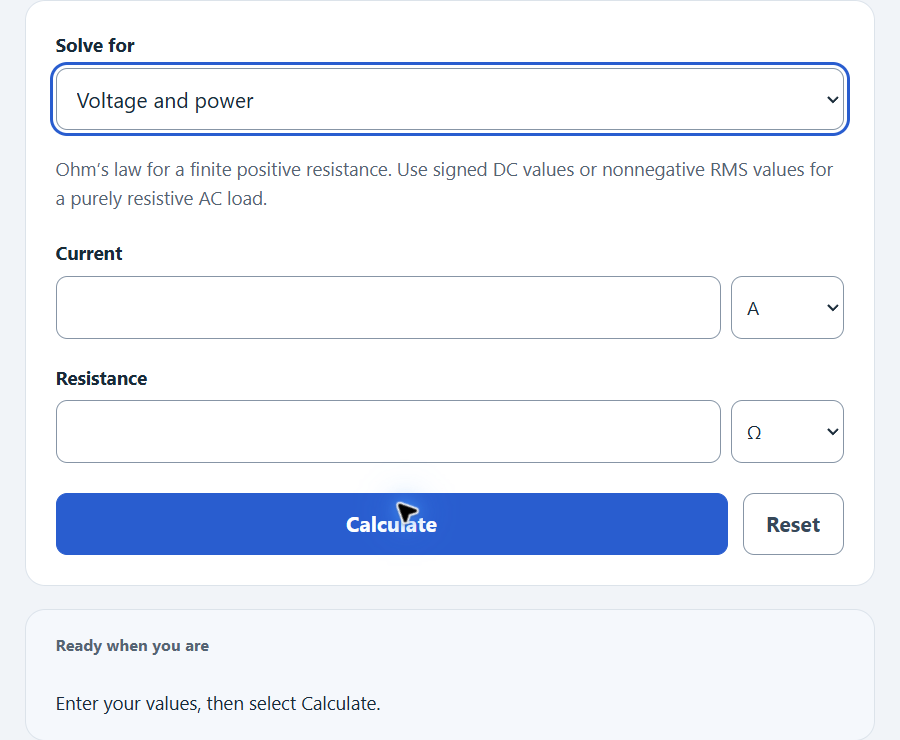
Calculate applied voltage from current and resistance, or solve voltage, current, resistance and power in a resistive circuit with Ohm's law.
- All Physics Calculators
- All Electrical Calculators
- Voltage Calculator
- Ohms to Volts Calculator
- Secondary Voltage Calculator
- Source Voltage Calculator
- Total Voltage Calculator
Applied Voltage Formula
The default solve mode uses Ohm’s law to find the voltage applied across a resistive load from the current through it and its total resistance.
Choose the pair of values to solve for; the calculator shows the two required inputs from V, I, R and P. It uses these relations:
- V = applied voltage, in volts (V)
- I = current through the load, in amperes (A)
- R = total resistance of the load, in ohms (Ω)
- P = power dissipated by the load, in watts (W)
The default mode accepts current and resistance and returns applied voltage and dissipated power. The other solve modes cover every pair of known quantities. Resistance must be finite and positive; zero inputs that do not determine a unique solution are explained. Signed DC voltage and current must agree in direction for a passive resistor.
Reference Tables
Use these tables to sanity check your inputs and the result the calculator returns.
| Source | Typical applied voltage |
|---|---|
| AA alkaline cell | 1.5 V |
| USB (nominal, before higher-voltage negotiation) | 5 V |
| Car battery | 12 V |
| US wall outlet | 120 V |
| EU wall outlet | 230 V |
| US clothes dryer | 240 V |
| Unit | Equals |
|---|---|
| 1 kV | 1,000 V |
| 1 V | 1,000 mV |
| 1 mV | 0.001 V |
| 1 kΩ | 1,000 Ω |
| 1 MΩ | 1,000,000 Ω |
Examples and FAQ
Example 1. A 220 Ω resistor carries 0.05 A. The applied voltage is V = 0.05 × 220 = 11 V. Power dissipated is P = 11 × 0.05 = 0.55 W, which exceeds a 1/4 W rating. Component selection also requires the manufacturer’s voltage, temperature and derating specifications; this calculation alone does not establish a suitable rating.
Example 2. A heater is rated 1,500 W at 120 V. Its current draw is I = P / V = 1,500 / 120 = 12.5 A, and its resistance is R = V² / P = 14,400 / 1,500 = 9.6 Ω.
Is applied voltage the same as voltage drop? For a single resistor connected directly to a source, yes. In a series circuit, the applied voltage equals the sum of the voltage drops across each element.
Why does each solve mode require two values? Two compatible known quantities usually determine the others through Ohm’s law and the power equation. Some zero combinations are underdetermined or inconsistent. Choose a solve mode rather than leaving arbitrary fields blank.
Does this work for AC circuits? Only for purely resistive loads, where you use RMS values for V and I. Circuits with significant inductance or capacitance need impedance, not just resistance.
What if my measured voltage is lower than calculated? Check that voltage, current and resistance refer to the same load under the same conditions. Source and wiring resistance can create additional drops; include them only when calculating the voltage across the entire corresponding circuit.