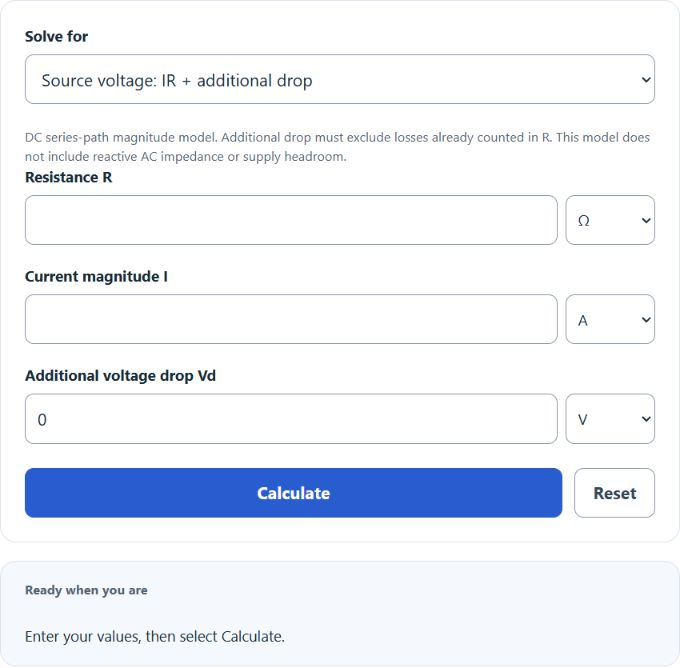
Calculate source voltage with Vs=IR+Vd, or solve for current, resistance or additional drop. Select an unknown and enter the displayed values; separate Ohm’s-law modes use V=IR.
- All Physics Calculators
- All Electrical Calculators
- LED Voltage Calculator
- Thevenin Voltage Calculator
- Series Voltage Calculator
- Applied Voltage Calculator
- Line to Phase Voltage Calculator
- Stepper Motor Voltage Calculator
- Voltage Rise Calculator
Source Voltage Formula
Source voltage is the total supply voltage required to push a desired current through a resistance while also overcoming any additional voltage drop in the same current path. In a simple series-circuit model, the source must provide enough voltage for both effects at the same time.
| Symbol | Meaning | Common Unit |
|---|---|---|
| Vs | Source voltage supplied by the power source | volts (V) |
| R | Resistance in the current path | ohms (Ω) |
| I | Circuit current | amps (A) |
| Vd | Additional voltage drop that must also be supplied | volts (V) |
This means the supply must cover the resistive drop caused by the current flowing through the resistance, plus any separate voltage drop already known for another component, conductor, or section of the circuit. If there is no extra drop beyond the resistance term, use a voltage drop of zero.
How to Calculate Source Voltage
- Determine the resistance in the relevant current path.
- Determine the current the source must deliver.
- Determine any additional voltage drop that must be overcome.
- Apply the source-voltage formula to find the required supply voltage.
For accurate results, keep units consistent before calculating. If your values are entered in kiloohms, milliamps, or millivolts, convert them or use the calculator’s unit controls so the inputs stay compatible.
Rearranged Equations
If you know the source voltage and need to solve for a different variable, these equivalent forms are useful:
Example Calculations
Example 1: A circuit has a resistance of 4 ohms, a current of 5 amps, and an additional voltage drop of 20 volts.
The required source voltage is 40 volts.
Example 2: A circuit has a resistance of 12 ohms, a current of 0.5 amps, and an additional voltage drop of 3 volts.
The required source voltage is 9 volts.
Where This Calculation Is Useful
- Estimating the minimum supply voltage for a series circuit
- Sizing a DC power source for a resistive load
- Checking whether a battery or power supply can meet a target current
- Accounting for wiring, component, or device voltage losses
- Evaluating simple LED, sensor, and control-circuit supply requirements
Practical Notes
- Use the correct resistance: enter the resistance associated with the same current path being analyzed.
- Avoid double-counting: if a voltage loss is already represented by the resistance term, do not also add it again as a separate voltage drop.
- Use positive drop values: in most basic circuit calculations, voltage drops are treated as positive magnitudes.
- Check feasibility: if the required source voltage is higher than the available supply, the circuit will not reach the intended current under this simplified model.
- Match the model to the circuit: this equation is most appropriate for straightforward series-style calculations and single current paths.
Common Mistakes
- Mixing milliamps and amps without conversion
- Using only part of the total path resistance
- Treating a component’s rated voltage as the same thing as circuit source voltage
- Adding a voltage drop that should have been included in the resistance-based drop instead
- Applying the formula to a more complex network without first simplifying the circuit
Frequently Asked Questions
- Is source voltage the same as supply voltage?
- In most basic circuit problems, yes. It is the voltage provided by the power source to the circuit.
- What if the additional voltage drop is zero?
- Then the required source voltage is only the amount needed to overcome the resistive portion of the circuit.
- What resistance should I use?
- Use the effective resistance in the current path being analyzed, not an unrelated component elsewhere in the circuit.
- Can this be used for AC circuits?
- This calculator uses a resistive DC magnitude model. General AC circuits require complex impedance and phase-aware analysis; adding scalar voltage magnitudes is not generally valid.