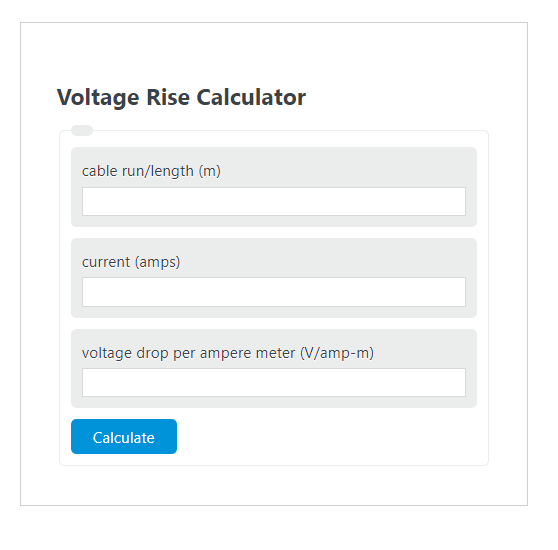
Calculate voltage rise from cable length, current, and voltage drop per ampere meter, with copper or aluminum AWG presets for cable sizing.
Voltage Rise Formula
Voltage rise is the product of conductor length, current, and the conductor’s resistivity factor. When Vd is expressed in millivolts per ampere-meter (mV/A·m) as listed in Australian and IEC cable tables, the /1000 factor converts the result to volts. When Vd is in V/A·m as used in this calculator’s basic mode, the formula applies directly without the divisor.
Variables:
- Vr is the Voltage Rise (volts)
- L is the cable run/length (m)
- I is the current (amps)
- Vd is the voltage drop per ampere meter (mV/A·m in the /1000 form; V/A·m when used directly)
The Vd factor is a property of the conductor material and cross-sectional area: Vd = ρ / A, where ρ is resistivity (Ω·m) and A is cross-sectional area (m²). For copper at 20°C, ρ = 1.72 x 10⁻⁸ Ω·m; for aluminum, ρ = 2.65 x 10⁻⁸ Ω·m. Aluminum therefore requires 1.54 times the cross-sectional area of copper to produce the same voltage rise under identical length and current conditions.
Voltage Rise vs. Voltage Drop
Both phenomena describe the resistive potential difference across a conductor carrying current. In a conventional load circuit, current flows from the supply toward the load, so the terminal voltage at the load is lower than the source (a drop). In a generation circuit, current flows from a distributed source such as a solar inverter, battery, or generator back toward the main supply point, so the connecting point sees more voltage than the inverter terminals (a rise). The magnitude is identical for the same current, cable length, and conductor size. The distinction is directional: which end of the cable sits at higher potential.
A separate phenomenon sometimes confused with resistive voltage rise is the Ferranti Effect, which occurs in long, lightly loaded high-voltage transmission lines. In that case, the distributed capacitance of the line raises the open-circuit receiving-end voltage above the sending end. The Ferranti Effect is reactive and capacitance-driven, not resistive, and does not apply to low-voltage distribution or building wiring circuits where this calculator is used.
Conductor Resistivity Factor (Vd) by Cable Size
The table below gives the DC resistivity factor at 20°C for copper and aluminum conductors by AWG size in millivolts per ampere per meter. For round-trip runs where the source is at one end and the grid connection at the other, multiply the one-way distance by 2 before applying the formula, since both the outgoing and return conductors contribute resistance. At 50/60 Hz power frequencies, skin effect is negligible for conductors 2/0 AWG and smaller, so these DC values are accurate for standard building and grid-interconnect wiring.
| AWG | Area (mm²) | Copper Vd (mV/A·m) | Aluminum Vd (mV/A·m) |
|---|---|---|---|
| 18 | 0.823 | 20.9 | 32.2 |
| 16 | 1.31 | 13.1 | 20.2 |
| 14 | 2.08 | 8.27 | 12.7 |
| 12 | 3.31 | 5.20 | 8.01 |
| 10 | 5.26 | 3.27 | 5.04 |
| 8 | 8.37 | 2.06 | 3.17 |
| 6 | 13.3 | 1.29 | 1.99 |
| 4 | 21.2 | 0.812 | 1.25 |
| 2 | 33.6 | 0.512 | 0.789 |
| 1/0 | 53.5 | 0.322 | 0.495 |
| 2/0 | 67.4 | 0.255 | 0.393 |
| 3/0 | 85.0 | 0.202 | 0.312 |
| 4/0 | 107.2 | 0.160 | 0.247 |
Compliance Limits by Standard
Most electrical standards express voltage rise and drop limits as a percentage of nominal supply voltage rather than an absolute figure. The limits below apply to the total conductor path between the source and connection point. Round-trip wiring doubles the effective resistance compared to one-way cable length and must be accounted for in calculations.
| Standard | Region | Application | Max Rise / Drop |
|---|---|---|---|
| AS/NZS 4777.1 | Australia / NZ | Grid-connected inverters (solar, battery) | 2% of nominal |
| NEC Informational Note 210.19 / 215.2 | USA | Branch circuit and feeder combined | 5% total (3% branch, 2% feeder) |
| IEC 60364-5-52 | International | Building wiring final circuits | 5% from supply to outlet |
| EN 50160 | Europe | Public LV supply voltage quality | Plus or minus 10% steady-state tolerance |
| IEEE 1547-2018 | USA | Distributed energy resources | Volt-VAR control mandatory; ride-through up to plus or minus 10% |
Rooftop Solar: Maximum Cable Length for Compliance
Voltage rise is typically the binding cable-sizing constraint for rooftop solar installations, often more restrictive than current-carrying capacity alone. A 5 kW inverter at 230 V AC nominal exports up to 21.7 A. Under AS/NZS 4777.1, the 2% limit equals 4.6 V. The maximum allowable round-trip cable resistance is therefore 4.6 V / 21.7 A = 0.212 ohms. Maximum one-way cable run = 0.212 ohms / (2 x Vd in ohms/m), where the factor of 2 accounts for both conductors. Results by conductor size are shown below.
| Conductor | Vd (mV/A·m) | Max One-Way Run (m) | Max One-Way Run (ft) |
|---|---|---|---|
| 12 AWG Copper | 5.20 | 20.4 | 67 |
| 10 AWG Copper | 3.27 | 32.4 | 106 |
| 8 AWG Copper | 2.06 | 51.5 | 169 |
| 6 AWG Copper | 1.29 | 82.2 | 270 |
| 6 AWG Aluminum | 1.99 | 53.3 | 175 |
| 4 AWG Aluminum | 1.25 | 84.8 | 278 |
When voltage rise is the binding constraint, available remedies include upgrading to a larger conductor, shortening the cable run by repositioning the inverter or subpanel, or configuring the inverter’s output voltage setpoint lower than nominal if the inverter supports a voltage offset. Some smart inverters compliant with IEEE 1547-2018 and AS/NZS 4777.2 can absorb reactive power through Volt-VAR operation to reduce apparent voltage rise on inductive networks, though this has limited effect on the resistive low-voltage feeders typical of residential installations.
High-penetration solar neighborhoods frequently experience midday voltage creep from the combined voltage rise of many simultaneous exporters on the same low-voltage feeder. When local grid voltage exceeds approximately 253 V (10% above 230 V nominal under EN 50160 and AS 61000.3.100), properly configured inverters throttle output or disconnect entirely, cutting actual solar production by as much as 50% during peak generation hours. This condition is measurable with a revenue-grade power quality analyzer during periods of maximum solar irradiance and is increasingly documented in utility interconnection studies as residential PV penetration climbs above 40% of feeder capacity.