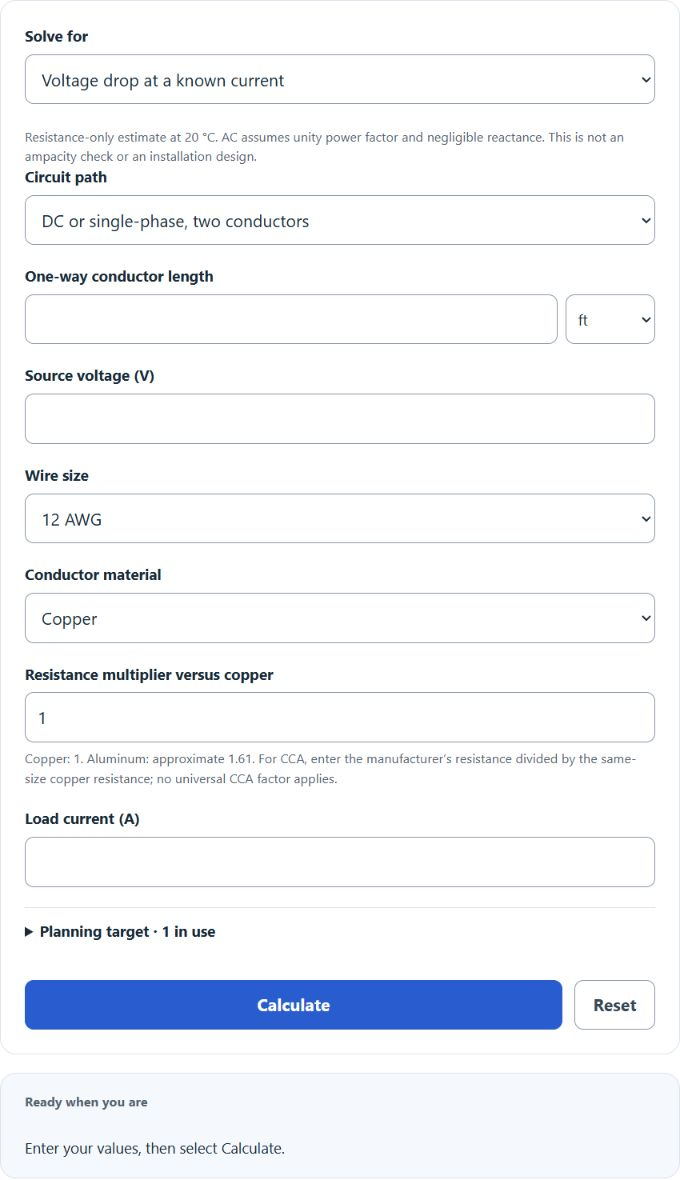
Calculate wire voltage drop, load voltage, percentage loss, heat loss, and a planning gauge—or solve maximum current from a target drop for copper, CCA, or aluminum.
- All Electrical Calculators
- Voltage Calculator
- Amps Draw Calculator
- Wire Resistance Calculator
- All Construction Calculators
- Amp to Volt Calculator
Amp Drop Formula
The calculator estimates voltage drop from conductor resistance at 20 °C. For AC, the resistance-only estimate assumes unity power factor and negligible reactance.
- Where I is the current (amps)
- r is one conductor’s resistance over the one-way run (ohms)
- R1000 is the copper reference resistance per 1,000 feet, multiplied by the selected material factor
- L is one-way length in feet; meters are converted before calculation
- ΔV is the two-wire voltage drop or balanced three-phase line-to-line drop (volts)
To solve current at a target drop, use I = (source voltage × target percentage / 100) / (path factor × r), with path factor 2 for two wires or √3 for balanced three-phase. Total conductor heat is 2I²r or 3I²r, respectively. Gauge planning checks voltage drop only, not ampacity or installation compliance. CCA resistance requires manufacturer data; the aluminum factor 1.61 is approximate.
Definition
What is an amperage drop?
In most electrical contexts, “amp drop” is not a standard engineering term. In a simple series circuit, the current is (approximately) the same everywhere; what “drops” along a wire is voltage due to the wire’s resistance. People sometimes use “amp drop” informally to mean a reduction in current caused by lower available voltage at the load or increased resistance in the circuit. This calculator estimates conductor voltage drop, current at a chosen drop target, and conductor heat loss using a resistance-only model. The voltage delivery ratio is not overall equipment efficiency.
Example Problem
How to estimate wire voltage drop?
Select voltage drop, two-wire circuit, 12 AWG copper, and the copper resistance multiplier 1.
Assume a 100-foot one-way run, 120 V source, and 10 A load. The reference resistance is 1.588 Ω per 1,000 ft.
Finally, calculate resistance, voltage drop, and wire heat using the formulas above:
r = 1.588 × 100 / 1,000 = 0.1588 Ω per conductor
ΔV = 2 × 10 × 0.1588 = 3.176 V (about 2.647%)
Estimated load voltage is 116.824 V; total wire heat is 31.76 W. Check the actual conductor and installation separately.