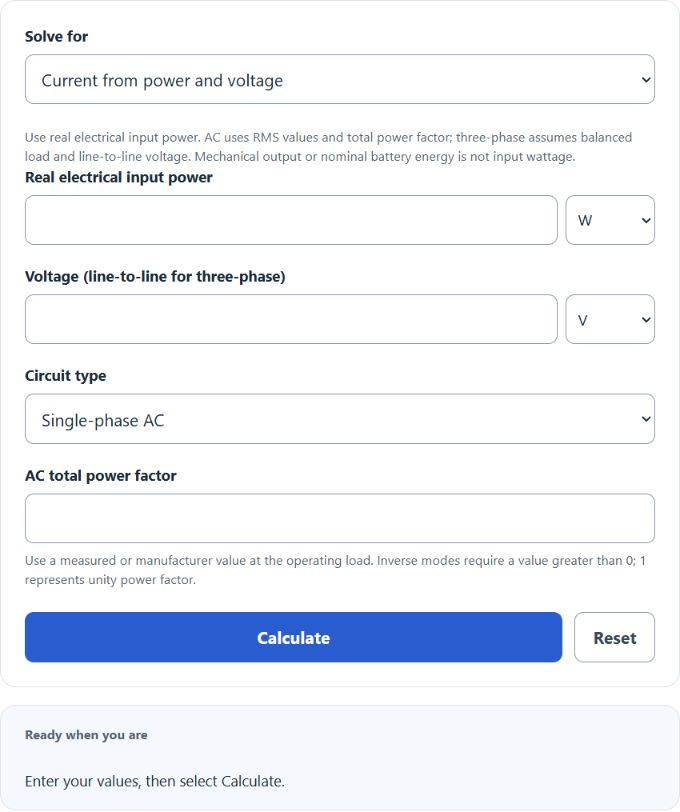
Calculate amps draw, power rating, or source voltage from any two electrical values, with unit choices for W or kW, V or kV, and A or mA.
- All Physics Calculators
- Amp Calculator
- Watts to Amps Calculator
- Amps to Watts Calculator
- Amps to kVA Calculator
- Amp Drop Calculator
- Power Loss Calculator
- Watts to Voltage Calculator
- Load Wattage Calculator
Amps Draw Formula
For steady DC, or single-phase AC at unity power factor, current is real input power divided by voltage. AC at other power factors requires the additional PF term, and balanced three-phase requires √3 and line-to-line voltage.
- Where A is the amps draw (amps)
- WR is the wattage rating (watts)
- SV is the source voltage
Use A = W / V for steady DC; A = W / (V × PF) for single-phase AC; A = W / (√3 × VLL × PF) for balanced three-phase AC. AC voltage and current are RMS values, and PF is total power factor at the operating load. Watts mean real electrical input, not mechanical output. Inverse modes require positive voltage/current and positive PF.
Amps Draw Definition
What is amp draw? Current draw is current supplied to a load under its operating conditions. Real power, voltage and AC power factor determine it within this model; starting current, pulsed DC and unbalanced three-phase loads need additional information.
Example Problem
How to calculate amps draw?
- First, determine the wattage rating.
For this example, we are looking at a lightbulb with a wattage rating of 200 watts.
- Next, determine the source voltage.
The light bulb is connected to a standard outlet, so the source voltage is 120 volts.
- Finally, calculate the amps draw.
Assuming a single-phase load with PF = 1, current is 200/120 = approximately 1.67 amps.
FAQ
Are amps drawn or pushed? The source and load together determine current through their electrical behavior. “Draw” is a useful everyday term, not a rule that replaces circuit equations.
What determines amps draw? Use real input power and voltage at the operating condition; AC also needs total power factor. A maximum nameplate wattage may differ from actual running input. The retained 125% current allowance and rounded reference steps are arithmetic illustrations, not breaker or conductor sizing advice.