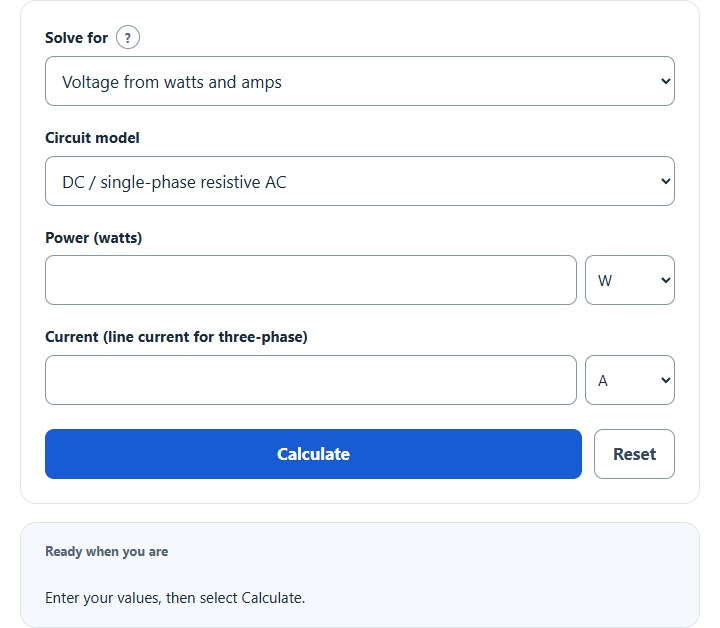
Convert watts to volts from power and amps or resistance, or convert volts to watts and find amps, for DC, single-phase or three-phase AC circuits.
- All Unit Converters
- Electricity, Magnetism, & Electronics Unit Converters
- All Electrical Calculators
- Amp to Volt Calculator
- Voltage Divider Calculator
- RMS Voltage (VRMS) Calculator
Voltage from Watts Formula
The following formula applies to DC or single-phase resistive AC at unity power factor. Voltage cannot be determined from watts alone.
Variables:
- Where V is the Voltage from Watts (volts)
- W is the total number of watts (watts)
- A is the total current (amps)
For DC or unity-PF single-phase AC, divide watts by amps. Single-phase AC uses V = P/(I × PF); balanced three-phase uses line-to-line V = total P/(√3 × line current × PF). The resistance mode uses V = √(P × R) for one DC resistor or single-phase resistive load; it ignores any previously selected AC circuit/PF.
| Power (W) | Current (A) | Voltage (V) |
|---|---|---|
| 3.3 | 1 | 3.3 |
| 5 | 1 | 5 |
| 9 | 1 | 9 |
| 12 | 1 | 12 |
| 30 | 2 | 15 |
| 36 | 2 | 18 |
| 65 | 3.42 | 19.01 |
| 120 | 5 | 24 |
| 360 | 10 | 36 |
| 96 | 2 | 48 |
| 300 | 5 | 60 |
| 720 | 10 | 72 |
| 480 | 5 | 96 |
| 1100 | 10 | 110 |
| 1200 | 10 | 120 |
| 3120 | 15 | 208 |
| 2300 | 10 | 230 |
| 2400 | 10 | 240 |
| 2770 | 10 | 277 |
| 4800 | 10 | 480 |
| Formula: V = P / I. Examples use DC or single-phase unity power factor. Supported inputs: W, kW, MW; A, mA, kA; V, kV, mV; Ω and kΩ in resistance mode (1 kW = 1000 W, 1 mA = 0.001 A). | ||
Convert Watts to Volt-Amps (VA)
For apparent power, select Volt-amps (VA) from watts, enter the real power and choose the load’s power factor. The calculator shows VA and kVA. Select Watts from volt-amps (VA) for the reverse conversion, with watts and kW in the result.
VA = W ÷ PF; W = VA × PF. Power factor (PF) is the ratio of real power in watts to apparent power in volt-amperes. For example, 900 W at PF 0.9 corresponds to 1,000 VA, or 1 kVA. Conversely, 1,000 VA at PF 0.8 corresponds to 800 W. Watts to VA requires PF greater than zero; VA to watts permits zero PF. One kVA equals 1,000 VA.
Use measured or manufacturer-specified load power factor at the same operating condition. The 0.9 and 0.8 choices are examples, not universal UPS or motor values; use Custom for a known value. Power factor is not efficiency. As Schneider Electric’s explanation of VA and watts describes, the conversion uses the load’s power factor. A UPS must satisfy both its watt and VA ratings; this calculation does not establish runtime, startup capacity or wiring suitability.
How to Calculate Voltage from Watts?
The following DC example outlines the steps and information needed to calculate voltage from watts and amps.
Example Problem #1:
- First, determine the total number of watts (watts). In this example, the total number of watts (watts) is measured to be 31.
- Next, determine the total current (amps). For this problem, the total current (amps) is calculated to be 20.
- Finally, calculate the Voltage from Watts using the formula above:
V = W / A
Inserting the values from above into the equation yields:
V = 31 / 20 = 1.55 (volts)
FAQ
What is the significance of calculating voltage from watts?
Calculating voltage from watts is crucial in electrical engineering and electronics because it helps check relationships among electrical quantities under a stated model. This arithmetic does not establish safe equipment ratings, wiring capacity or compatibility. It allows engineers to understand the electrical potential that can be provided given a certain power (watts) and current (amps), which is fundamental in power distribution and consumption analysis.
Can I calculate voltage if only the power (in watts) is known, without current?
Power alone does not determine voltage. Enter current and the applicable circuit/PF, or enter resistance for the DC/single-phase resistive model. V = W/A is the DC or single-phase unity-PF case. Current and PF must be positive for that inverse; zero watts with a zero denominator cannot determine a unique voltage.
Are there any limitations to using the V = W / A formula for calculating voltage?
V = W/A is exact for the stated DC or single-phase unity-PF model. Other sinusoidal AC calculations require power factor; balanced three-phase also requires √3 and line-to-line RMS voltage. Harmonic distortion and unbalanced loads are excluded. The retained voltage-reference list in details is an arithmetic comparison, not a compatibility recommendation.