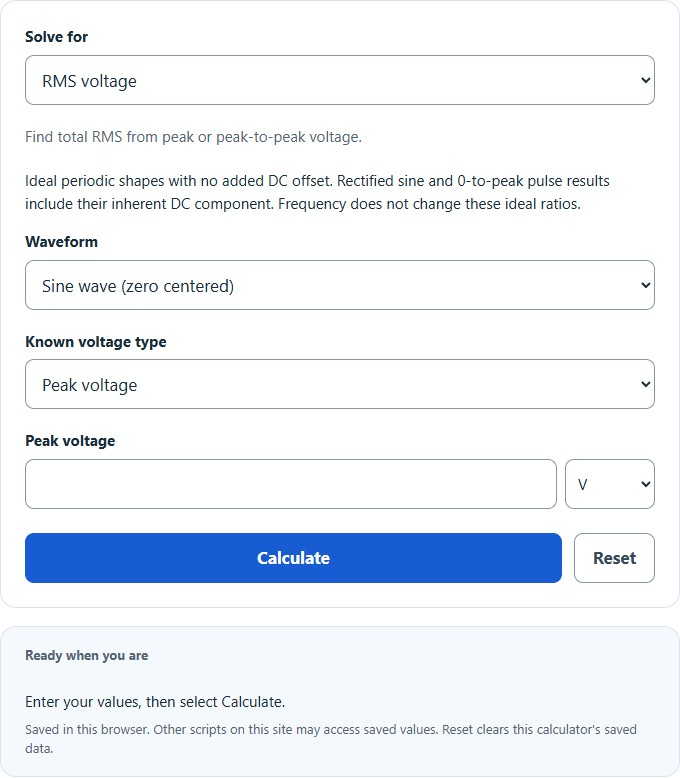
Calculate RMS, peak, or peak-to-peak voltage for sine, square, triangle, sawtooth, rectified sine, and pulse waveforms in mV, V, or kV.
- All Physics Calculators
- All Electrical Calculators
- Peak Voltage Calculator
- Voltage Calculator
- Voltage Divider Calculator
- Internal Resistance Calculator
- RMS Wattage Calculator
- Average Voltage Calculator
VRMS Formula
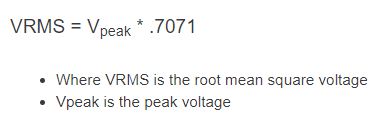
The following formula can be used to calculate the root mean square voltage of a zero-centered sinusoidal periodic voltage.
- Where VRMS is the root mean square voltage
- Vpeak is the peak voltage
To calculate RMS voltage (VRMS) for a zero-centered sine wave, multiply the peak voltage by approximately 0.7071 (which is 1/√2).
VRMS Definition
VRMS stands for root mean square voltage. It is defined as the square root of the mean of the squared instantaneous voltage over one full cycle. For a purely resistive load, VRMS is the equivalent DC voltage that would produce the same average heating (power) as the AC waveform.
How to calculate VRMS?
How to calculate VRMS?
- First, determine the peak voltage.
Measure or calculate the peak voltage of the zero-centered sinusoidal voltage source.
- Next, enter the value into the formula.
Enter the value of the peak voltage into the formula and multiply it by 0.7071 (1/√2).
- Analyze the results.
Compare the results of the VRMS calculated in step 2 with the expected outcome.
FAQ
VRMS stands for root mean square voltage. For any periodic waveform, VRMS is defined as the square root of the average of v(t)^2 over one period. For a zero-centered sine wave, VRMS = Vpeak/√2 (≈ 0.7071 × Vpeak). In a purely resistive load, VRMS is the equivalent DC voltage that would produce the same average heating (power) as the AC waveform.