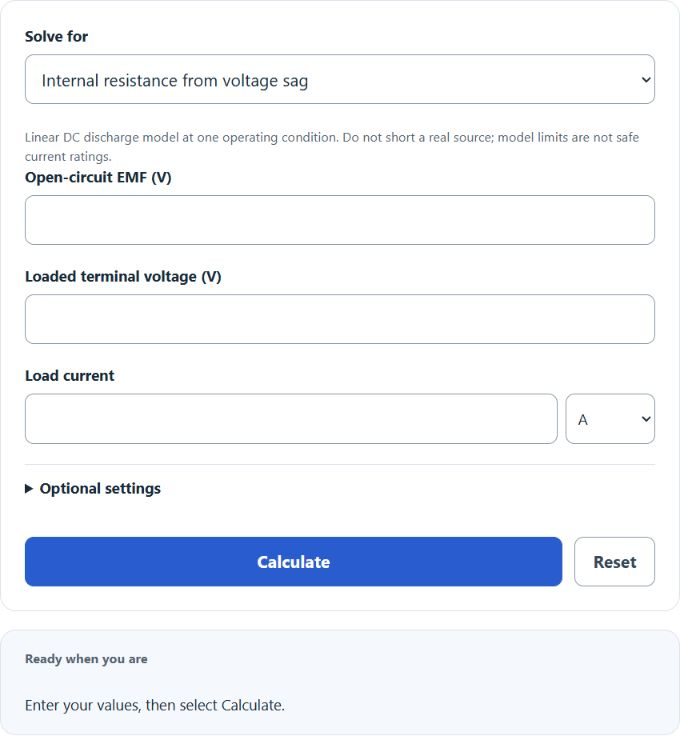
Calculate source or battery internal resistance, loaded voltage, or current from EMF and voltage sag, with milliohms, heat loss, efficiency, and a planned-load check.
Internal Resistance Formula
The following formula is used to calculate an internal resistance.
- Where r is the internal resistance (ohms)
- e is the electromotive force (volts)
- i is the current (amps)
- R is the resistance of the load in the circuit.
To use the load-resistance mode, divide the electromotive force by the current, then subtract the external load resistance. Equivalently, with measured terminal voltage V, use r = (e – V) / i. The model describes DC discharge with a nonnegative terminal voltage; it does not predict a safe source current rating.
Internal Resistance Definition
Internal resistance is the effective resistance inside a source of electromotive force (such as a battery, generator, or power supply) that causes the terminal voltage to drop when current flows.
Internal Resistance Example
How to calculate the internal resistance?
- First, determine the electromotive force.
For this example we will say this value is 10 V.
- Next, determine the current.
For this example we will assume a current of 0.4 amps.
- Next, determine the load resistance.
For this example the value is 20 ohms.
- Finally, calculate the internal resistance.
Using the formula we find the internal resistance to be 10/0.4 – 20 = 5 ohms.