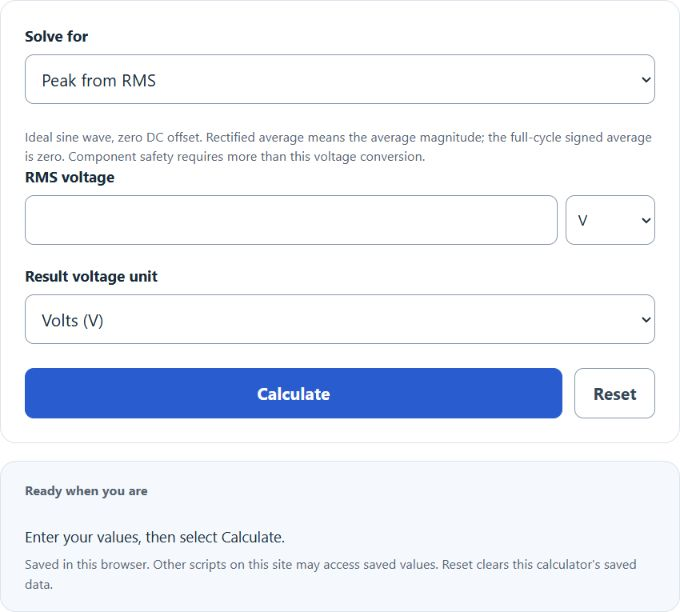
Calculate peak, RMS, full-wave rectified average or peak-to-peak voltage for an ideal sine wave with zero DC offset. The waveform modes also evaluate instantaneous voltage and explicitly labeled signed principal inverse solutions; one sample does not identify a unique frequency or time.
- All Physics Calculators
- All Electrical Calculators
- Voltage Calculator
- RMS Voltage (VRMS) Calculator
- Ripple Voltage Calculator
- Average Voltage Calculator
Peak Voltage Formula
Peak voltage is the highest instantaneous value reached by a voltage waveform. For a pure sine wave, you can calculate it directly from either RMS voltage or average voltage.
| Known Value | Relationship | Use When |
|---|---|---|
| RMS voltage | Vₚ = VRMS√(2) |
You know the AC RMS value of a sinusoidal waveform. |
| Average voltage | Vₚ = Vavg(π) / (2) |
You know the rectified average value of a sine wave. |
Related Sine-Wave Conversions
| Conversion | Formula |
|---|---|
| Peak from RMS | Vₚ = VRMS√(2) |
| RMS from peak | VRMS = (Vₚ) / (√(2)) |
| Average from peak | Vavg = (2Vₚ) / (π) |
| Peak-to-peak from peak | Vₚₚ = 2Vₚ |
| Crest factor for a sine wave | (Vₚ) / (VRMS) = √(2) |
Variable Definitions
| Symbol | Meaning | Typical Unit |
|---|---|---|
| Vp | Peak voltage, measured from zero to the waveform crest | V, mV, kV |
| VRMS | Root-mean-square voltage, the effective AC value | V, mV, kV |
| Vavg | Average rectified voltage of a sine wave | V, mV, kV |
| Vpp | Peak-to-peak voltage, from negative peak to positive peak | V, mV, kV |
How to Calculate Peak Voltage
- Choose whether your known input is RMS voltage or average voltage.
- Enter the value into the calculator using the correct unit.
- Select the matching mode:
- RMS if the input is VRMS
- Average if the input is Vavg
- Select Calculate, then read the primary answer in the chosen result unit. Expand Calculation details for the relationships used. Other modes solve the selected sine-wave quantity; inverse frequency and time give one signed principal solution, not a unique physical frequency or earliest nonnegative time.
Common Peak Voltage Values
| Known Value | Type | Peak Voltage | Peak-to-Peak Voltage |
|---|---|---|---|
| 5 V | RMS | 7.07 V | 14.14 V |
| 12 V | RMS | 16.97 V | 33.94 V |
| 24 V | RMS | 33.94 V | 67.88 V |
| 120 V | RMS | 169.7 V | 339.4 V |
| 230 V | RMS | 325.3 V | 650.6 V |
Important Notes
- The RMS and average formulas above are valid for a sinusoidal waveform.
- Average voltage here means the rectified average of a sine wave, not the full-cycle average. A full sine wave averaged over one complete cycle is 0 V.
- For square, triangle, clipped, or distorted waveforms, the conversion factors are different.
- Peak voltage is critical when selecting capacitors, diodes, insulation, probes, and power components that must survive the highest instantaneous voltage.
Where Peak Voltage Is Used
- AC power analysis
- Oscilloscope waveform interpretation
- Rectifier and filter design
- Capacitor voltage rating checks
- Insulation and component stress calculations
- Signal and audio electronics
Quick Comparison: RMS vs Peak vs Peak-to-Peak
| Measurement | What It Represents |
|---|---|
| RMS | The effective heating or power-equivalent value of AC voltage |
| Peak | The maximum voltage above zero at the crest of the wave |
| Peak-to-peak | The total swing from the negative peak to the positive peak |