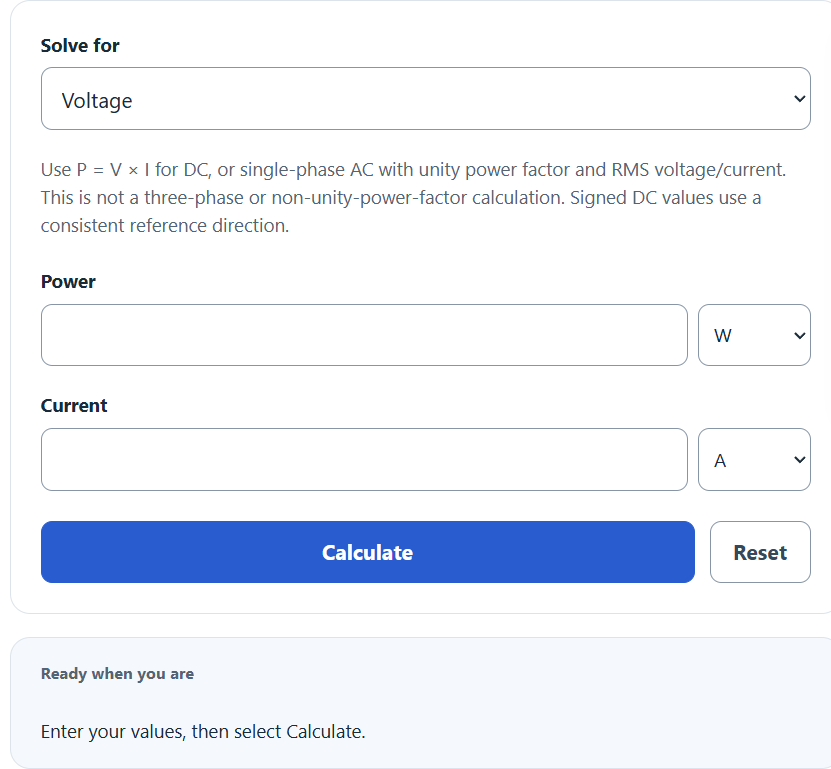
Select the value to solve for, then enter the other two quantities with W/kW, A/mA or V/mV units. Uses P = V × I for DC or single-phase AC at unity power factor.
- All Unit Converters
- Voltage Calculator
- Voltage Divider Calculator
- Peak Voltage Calculator
- Amps to Watts Calculator
- Amp Drop Calculator
- Volts to mA Calculator
- mA to Voltage Calculator
| Calculator Operations | Required Inputs |
|---|---|
| Convert Volts and Amps to Watts | Enter Volts, Enter Amps |
| Convert Watts and Volts to Amps | Enter Watts, Enter Volts |
| Convert Watts and Amps to Volts | Enter Watts, Enter Amps |
Amp to Volt Formula
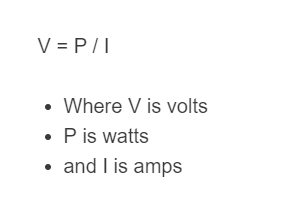
The following formula is used to calculate the total number of volts from amps and watts.
- Where V is volts
- P is watts
- and I is amps
To convert amps to volts, divide the power by the current.
| Watts (W) | Amps (A) | Volts (V) |
|---|---|---|
| 0.75 | 0.5 | 1.5 |
| 10 | 2 | 5 |
| 18 | 2 | 9 |
| 24 | 2 | 12 |
| 95 | 5 | 19 |
| 48 | 2 | 24 |
| 180 | 5 | 36 |
| 240 | 5 | 48 |
| 300 | 5 | 60 |
| 720 | 10 | 72 |
| 960 | 10 | 96 |
| 1200 | 10 | 120 |
| 2080 | 10 | 208 |
| 2200 | 10 | 220 |
| 2300 | 10 | 230 |
| 2400 | 10 | 240 |
| 2770 | 10 | 277 |
| 4000 | 10 | 400 |
| 4800 | 10 | 480 |
| 6000 | 10 | 600 |
| *Uses P = V × I. Volts (V) = Watts (W) ÷ Amps (A). For single-phase AC circuits, use RMS values and power factor = 1; this is not a three-phase formula. | ||
Amp to Volt Definition
Converting amps to volts is the process of dividing the total watts by the total amps to yield total volts.
Amp to Volt Example
How to calculate volts?
- First, determine the total power of the circuit or system
Power in electric terms is measured in watts.
- Next, determine the current of the system
This is typically measured in amps.
- Calculate the voltage
Calculate the total number of volts using the watts and amps found in steps 1 and 2.
FAQ
Voltage is electric potential difference, measured in volts (joules per coulomb).
Current is the rate of flow of electric charge, measured in amperes (coulombs per second). For DC, voltage is power divided by nonzero current.