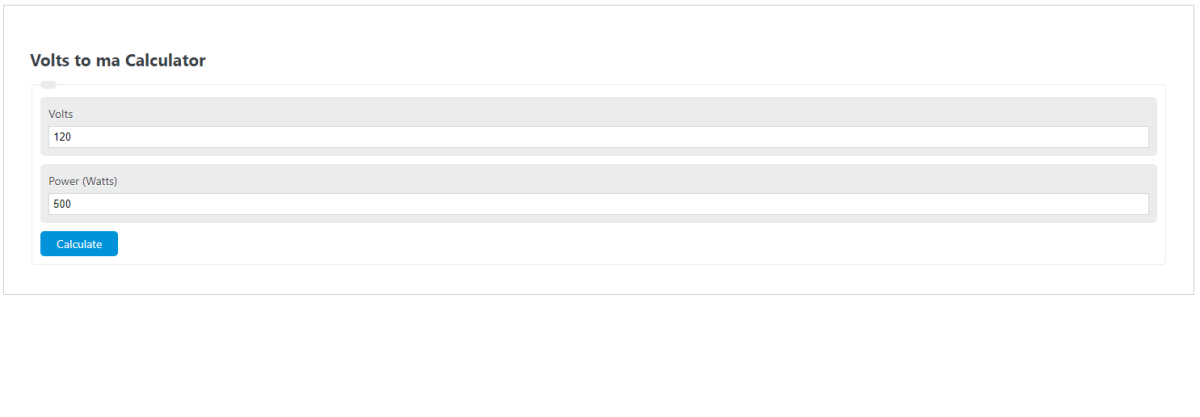
Calculate volts, power, or current by entering any two values and finding the missing variable in V, kV, W, kW, mA, or A units as needed.
| Watts to mA | mA to Watts |
|---|---|
| 0.1 W = 20 mA | 10 mA = 0.05 W |
| 0.25 W = 50 mA | 30 mA = 0.15 W |
| 0.5 W = 100 mA | 75 mA = 0.375 W |
| 1 W = 200 mA | 150 mA = 0.75 W |
| 2 W = 400 mA | 250 mA = 1.25 W |
| 2.5 W = 500 mA | 350 mA = 1.75 W |
| 3 W = 600 mA | 700 mA = 3.5 W |
| 5 W = 1000 mA | 1200 mA = 6 W |
| 7.5 W = 1500 mA | 1800 mA = 9 W |
| 10 W = 2000 mA | 2200 mA = 11 W |
| 12 W = 2400 mA | 2600 mA = 13 W |
| 15 W = 3000 mA | 5000 mA = 25 W |
| mA = (W / V) x 1000 | W = (V x mA) / 1000 | |
| Watts to mA | mA to Watts |
|---|---|
| 1 W = 83.3 mA | 50 mA = 0.6 W |
| 3 W = 250 mA | 150 mA = 1.8 W |
| 5 W = 416.7 mA | 300 mA = 3.6 W |
| 10 W = 833.3 mA | 500 mA = 6 W |
| 15 W = 1250 mA | 800 mA = 9.6 W |
| 18 W = 1500 mA | 1000 mA = 12 W |
| 25 W = 2083.3 mA | 2000 mA = 24 W |
| 35 W = 2916.7 mA | 2500 mA = 30 W |
| 50 W = 4166.7 mA | 4000 mA = 48 W |
| 60 W = 5000 mA | 6000 mA = 72 W |
| 75 W = 6250 mA | 7500 mA = 90 W |
| 100 W = 8333.3 mA | 10000 mA = 120 W |
| mA = (W / V) x 1000 | W = (V x mA) / 1000 | |
| Watts to mA | mA to Watts |
|---|---|
| 0.5 W = 20.8 mA | 10 mA = 0.24 W |
| 1 W = 41.7 mA | 50 mA = 1.2 W |
| 2 W = 83.3 mA | 100 mA = 2.4 W |
| 5 W = 208.3 mA | 250 mA = 6 W |
| 10 W = 416.7 mA | 500 mA = 12 W |
| 24 W = 1000 mA | 1000 mA = 24 W |
| 48 W = 2000 mA | 2000 mA = 48 W |
| 72 W = 3000 mA | 3000 mA = 72 W |
| 120 W = 5000 mA | 5000 mA = 120 W |
| mA = (W / V) x 1000 | W = (V x mA) / 1000 | |
| Voltage | 100 Ω | 220 Ω | 470 Ω | 1 kΩ | 10 kΩ |
|---|---|---|---|---|---|
| 3.3 V | 33 mA | 15 mA | 7 mA | 3.3 mA | 0.33 mA |
| 5 V | 50 mA | 22.7 mA | 10.6 mA | 5 mA | 0.5 mA |
| 9 V | 90 mA | 40.9 mA | 19.1 mA | 9 mA | 0.9 mA |
| 12 V | 120 mA | 54.5 mA | 25.5 mA | 12 mA | 1.2 mA |
| 24 V | 240 mA | 109.1 mA | 51.1 mA | 24 mA | 2.4 mA |
| 48 V | 480 mA | 218.2 mA | 102.1 mA | 48 mA | 4.8 mA |
| 120 V | 1200 mA | 545.5 mA | 255.3 mA | 120 mA | 12 mA |
| Resistance values are standard E24 series resistors. | |||||
| Component | Voltage | Current |
|---|---|---|
| Standard LED | 2-3.3 V | 10-20 mA |
| High-power LED | 3-3.6 V | 350-700 mA |
| Arduino Uno | 5 V | 40-50 mA |
| ESP32 (TX) | 3.3 V | 160-260 mA |
| 4-20 mA loop | 12-24 V | 4-20 mA |
| DC motor (hobby) | 3-6 V | 100-300 mA |
| Servo (SG90) | 5 V | 100-550 mA |
| 5 V relay coil | 5 V | 70-80 mA |
| USB 2.0 max | 5 V | 500 mA |
| USB 3.0 max | 5 V | 900 mA |
| USB-C PD phone | 5-20 V | 1500-3000 mA |
- All Unit Converters
- Electricity, Magnetism, & Electronics Unit Converters
- Volts to Joules Calculator
- Watts to Amps Calculator
- Amps to Watts Calculator
- HP to Amps Calculator
- kW to Joules Calculator
Volts to mA Formulas
There are two primary formulas for converting volts to milliamps, depending on whether you know the circuit’s power consumption or its resistance.
Method 1: Using Power (Watts)
Where P is power in watts and V is voltage in volts. This method is practical when working with device power ratings, which are commonly printed on power supplies and appliance labels. A 60 W light bulb on a 120 V circuit draws (60 / 120) x 1000 = 500 mA.
Method 2: Using Resistance (Ohm’s Law)
Where V is voltage in volts and R is resistance in ohms. This is derived directly from Ohm’s Law (I = V/R) and is the standard approach in circuit design. When resistance is expressed in kilohms, the formula simplifies to mA = V / R(kilohms), eliminating the multiplication step entirely. 5 V across a 1-kilohm resistor yields exactly 5 mA.
Where Volts-to-mA Conversions Are Used
LED Circuit Design
Every LED circuit requires a current-limiting resistor sized using the volts-to-mA conversion. A standard indicator LED has a forward voltage of roughly 2 V and a rated current of 20 mA. To drive it from a 5 V supply, you subtract the forward voltage (5 – 2 = 3 V across the resistor) and apply Ohm’s Law: R = 3 V / 0.020 A = 150 ohms. Choosing the wrong resistor value by even a factor of two can either burn out the LED instantly or leave it too dim to see. High-power LEDs used in automotive and architectural lighting operate at 350 mA to 1 A or more, making precise current calculation critical for thermal management.
4-20 mA Industrial Control Loops
The 4-20 mA current loop is the dominant signaling standard in process control. Sensors for temperature, pressure, level, and flow transmit their readings as a current between 4 mA (representing 0% of scale) and 20 mA (representing 100% of scale). The loop is powered at 12 V to 24 V DC. A key advantage of current signaling over voltage signaling is noise immunity: the current is identical at every point in the loop regardless of wire resistance, so long cable runs in electrically noisy factory environments do not degrade accuracy. The 4 mA lower bound also serves as a fault indicator. If the signal drops below 4 mA, the control system knows the sensor or wiring has failed, which would be impossible to distinguish from a zero reading on a 0-20 mA or 0-10 V scale.
USB Power Delivery and Charging
USB specifications define strict current limits at each voltage level. USB 2.0 ports supply a maximum of 500 mA at 5 V (2.5 W). USB 3.0 raised this to 900 mA. The USB Battery Charging spec allows up to 1,500 mA from a dedicated charging port. USB Power Delivery (USB-PD), common on USB-C connectors, negotiates voltage and current levels dynamically, supporting profiles up to 5 A at 48 V (240 W) as of the USB-PD 3.1 specification. A phone negotiating fast charge at 9 V and 2,000 mA receives 18 W, while a laptop charger operating at 20 V and 3,000 mA delivers 60 W.
Battery Life Estimation
Battery capacity is rated in milliamp-hours (mAh), making mA the natural unit for calculating runtime. A device drawing 50 mA from a 2,000 mAh battery lasts approximately 2,000 / 50 = 40 hours under ideal conditions. In practice, battery voltage drops as it discharges, which changes the current draw of voltage-regulated circuits. Knowing the exact mA draw at the operating voltage is essential for accurate runtime predictions in portable devices, remote sensors, and IoT nodes.
DC vs. AC: How the Conversion Differs
The formulas above apply directly to DC (direct current) circuits, where voltage and current are constant. In AC (alternating current) circuits, voltage and current vary sinusoidally and may be out of phase with each other. For purely resistive AC loads (heaters, incandescent bulbs), the DC formulas work if you use the RMS (root-mean-square) voltage, which is the value reported by standard multimeters. A 120 V RMS household outlet actually has a peak voltage of about 170 V, but the RMS value is what matters for power and current calculations.
For AC loads with significant inductance or capacitance (motors, transformers, fluorescent ballasts), a power factor term is needed: mA = (P / (V x PF)) x 1000, where PF is the power factor ranging from 0 to 1. A motor rated at 100 W on 120 V with a power factor of 0.8 draws (100 / (120 x 0.8)) x 1000 = 1,042 mA, not the 833 mA you would calculate ignoring power factor.
Current Thresholds and the Human Body
Understanding milliamp levels has direct safety implications. The physiological effects of electric current on the human body follow well-documented thresholds. It is the current through the body that causes harm, with voltage determining how much current flows through the body’s resistance.
| Current (mA) | Effect |
|---|---|
| 0.5-1 mA | Threshold of perception (faint tingling) |
| 1-5 mA | Slight shock, not painful; person can let go |
| 5-15 mA | Painful shock; muscular control usually retained |
| 15-80 mA | Painful shock; muscles may contract involuntarily |
| 80-200 mA | Ventricular fibrillation possible; potentially fatal |
| 200+ mA | Severe burns and cardiac arrest; high fatality rate |
| AC thresholds are generally lower than DC. Source: IEC 60479-1. | |
These thresholds explain why GFCI (ground fault circuit interrupter) outlets trip at 5 mA of leakage current. At household voltages, dry skin resistance of 1,000 to 100,000 ohms limits current flow. Wet skin can drop to as low as 300 to 1,000 ohms, which is why the same 120 V outlet that produces a mild tingle on dry hands can deliver a dangerous shock to wet skin: 120 V / 500 ohms = 240 mA, well into the fatal range.