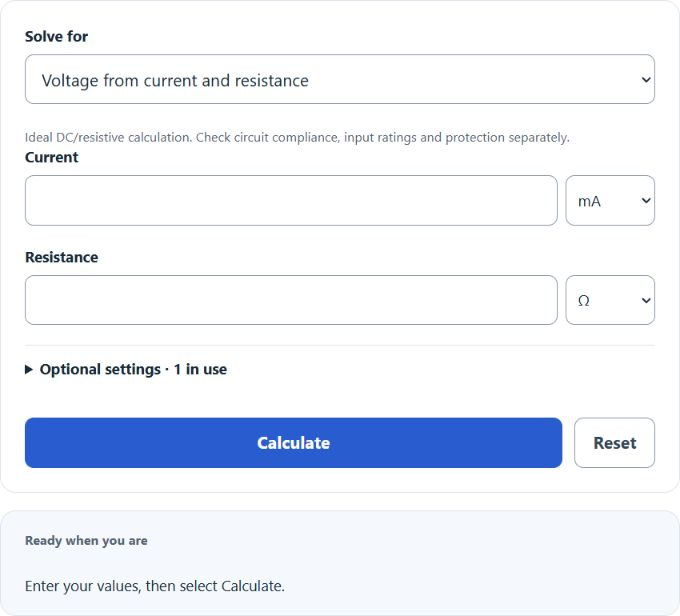
Select an Ohm’s-law solve mode and enter the two known quantities, or scale a current-loop signal. Unit choices preserve the entered physical quantity.
- All Unit Converters
- All Electrical Calculators
- Load to Voltage Calculator
- Amp to Volt Calculator
- VA to Voltage Calculator
- pH to Voltage Calculator
mA to Voltage Formula
The conversion from milliamps to voltage is a direct application of Ohm's Law:
Where V is the resulting voltage in volts, I is the current in milliamps, and R is the resistance in ohms. The division by 1000 converts milliamps to amps before applying V = IR. Without a known resistance value, milliamps cannot be converted to volts because current and voltage are fundamentally different electrical quantities linked only through impedance.
The formula can also be rearranged to solve for current (I = V/R) or resistance (R = V/I), which is why the calculator provides an explicit solve mode for each quantity.
Why Convert mA to Voltage?
Most analog-to-digital converters (ADCs), microcontrollers, PLCs, and data acquisition systems accept voltage inputs, not current. However, in industrial process control, sensors and transmitters frequently output a 4-20 mA signal because regulated current can tolerate cable voltage drops while the transmitter remains within its compliance limits. At the receiving end, a precision shunt resistor converts that loop current back into a voltage the controller can read.
Common scenarios that require mA to voltage conversion include reading a 4-20 mA pressure, temperature, or flow transmitter with a voltage-input data logger; interfacing industrial sensors with Arduino or Raspberry Pi platforms that accept 0-3.3 V or 0-5 V analog inputs; and troubleshooting control loops with a multimeter by measuring voltage across a known resistor instead of breaking the loop to measure current directly.
The 4-20 mA Current Loop Standard
The 4–20 mA current loop is a common analog signaling arrangement in industrial instrumentation. It maps a measured process variable (pressure, temperature, flow, level, pH) to a current range where 4 mA represents 0% of scale and 20 mA represents 100% of scale.
The "live zero" at 4 mA is a deliberate design choice. A reading of 0 mA is outside the normal 4–20 mA measurement span and may indicate loss of power, a broken wire or another fault; diagnose it using the device instructions. This built-in fault detection is one reason current loops remain the preferred analog signaling method in process plants, refineries, water treatment facilities, and HVAC systems, even as digital protocols like HART and fieldbus gain adoption.
Current loops are powered by a 24 VDC supply in most installations. The transmitter regulates current flow through the loop, and because current in a series circuit is identical at every point, the regulated signal remains valid only while sufficient compliance voltage remains across the transmitter. Cable resistance, supply voltage, other loads and the device specification determine the usable distance.
Common Shunt Resistor Values and Voltage Outputs
To extract a voltage from a 4-20 mA loop, a precision shunt resistor is placed in series at the receiver. The table below shows the resulting voltage at key points across the signal range for the most commonly used resistor values.
| Resistor (ohms) | V at 4 mA | V at 12 mA | V at 20 mA | Typical Application |
|---|---|---|---|---|
| 100 | 0.40 V | 1.20 V | 2.00 V | Low-voltage ADC inputs (0-2 V range) |
| 150 | 0.60 V | 1.80 V | 3.00 V | 3.3 V microcontroller analog inputs |
| 250 | 1.00 V | 3.00 V | 5.00 V | Common 1–5 V shunt example |
| 500 | 2.00 V | 6.00 V | 10.00 V | 0-10 V PLC/controller inputs |
| Calculated using V = I x R. A 250-ohm shunt is a common example; confirm the receiver and transmitter specifications. | ||||
Resistor Precision Requirements
The accuracy of a mA-to-voltage conversion depends directly on the shunt resistor's tolerance. A 1% tolerance resistor introduces up to 1% measurement error before any other sources of inaccuracy are considered. For process control applications where instrumentation accuracy matters, the following specifications are recommended: tolerance of 0.1% or better, temperature coefficient of 25 ppm/°C or lower to minimize thermal drift, and a power rating of at least 0.25 W for reliability margin. Metal film and wire-wound precision resistors are the preferred types for this application.
At 20 mA through a 250-ohm resistor, actual power dissipation is only P = I^2 x R = (0.02)^2 x 250 = 0.1 W, well within the rating of standard quarter-watt resistors. However, in high-temperature environments or enclosures with limited airflow, derating the power specification by 50% is good engineering practice.
| Current (mA) | Voltage (V) |
|---|---|
| 0.5 | 0.125 |
| 1 | 0.250 |
| 2 | 0.500 |
| 3 | 0.750 |
| 4 | 1.000 |
| 5 | 1.250 |
| 6 | 1.500 |
| 8 | 2.000 |
| 10 | 2.500 |
| 12 | 3.000 |
| 15 | 3.750 |
| 16 | 4.000 |
| 18 | 4.500 |
| 20 | 5.000 |
| 25 | 6.250 |
| 30 | 7.500 |
| 40 | 10.000 |
| 50 | 12.500 |
| 75 | 18.750 |
| 100 | 25.000 |
| * Assumes fixed resistance R = 250 ohms (standard for 4-20 mA loops). Ohm's Law: V = I x R. | |
Scaling mA to a Process Variable
In process control, the voltage reading from a shunt resistor ultimately represents a physical measurement. The linear scaling formula to convert any current within the 4-20 mA range back to the measured process variable is:
For example, a pressure transmitter calibrated for 0 to 100 PSI that outputs 12 mA: PV = ((12 - 4) / 16) x (100 - 0) + 0 = 50 PSI. With a 250-ohm resistor, that 12 mA produces 3.0 V, so 3.0 V corresponds to 50 PSI. The same math works for any calibrated range: a temperature transmitter spanning 0 to 500 degrees F at 8 mA reads ((8 - 4) / 16) x 500 = 125 degrees F, producing 2.0 V across 250 ohms.
Maximum Loop Resistance and Compliance Voltage
Every 4-20 mA transmitter has a maximum loop resistance it can drive, determined by the power supply voltage minus the transmitter's minimum operating voltage (compliance voltage). The relationship is: R_max = (V_supply - V_transmitter_min) / 0.020. For a typical 24 VDC supply with a transmitter requiring at least 12 V to operate, the maximum total loop resistance is (24 - 12) / 0.020 = 600 ohms. This budget must cover the shunt, the complete outgoing-and-return wire resistance and all other series loads. A 250-ohm shunt leaves 350 ohms in this example. Determine cable length from its specified resistance at operating temperature and allow for maximum signal or fault current.
Microcontroller and Arduino Applications
When interfacing a 4-20 mA sensor with a microcontroller, the shunt resistor value must be chosen to match the ADC's input voltage range. An Arduino Uno with a 10-bit ADC (0-5 V range) pairs well with a 250-ohm resistor, producing 1-5 V from the 4-20 mA signal. A 150-ohm resistor produces 0.6–3.0 V over 4–20 mA, but suitability depends on the ADC’s specified input range, common-mode limits, tolerance and fault behavior. Design input protection from the device specifications; a nominal 3.3 V Zener alone does not guarantee protection.
The ADC reading can then be converted to the process variable in firmware using the same linear scaling formula: PV = ((ADC_value - ADC_at_4mA) / (ADC_at_20mA - ADC_at_4mA)) x (PV_max - PV_min) + PV_min.