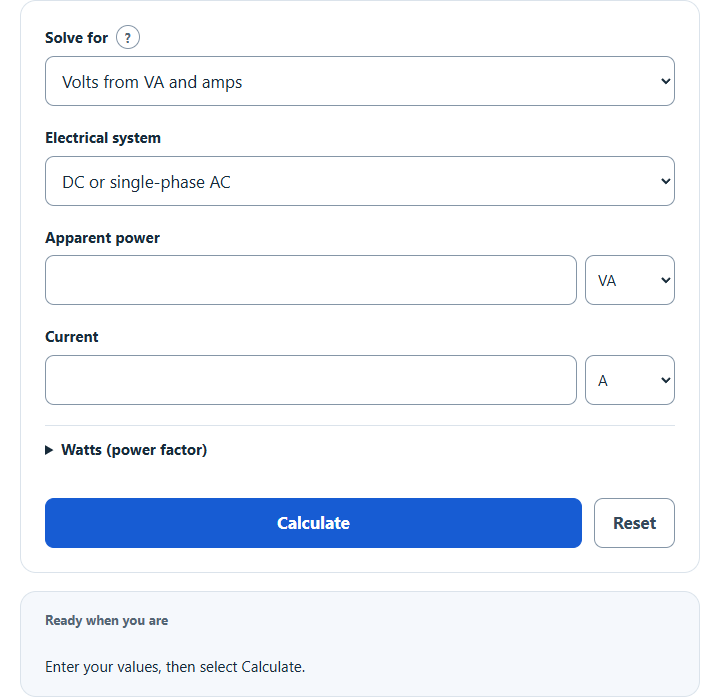
Convert VA to volts from apparent power and current, or VA to amps from voltage, for DC, single-phase or balanced three-phase circuits, in VA, kVA or MVA.
- All Unit Converters
- All Electrical Calculators
- mA to Voltage Calculator
- Impedance to Voltage Calculator
- Amp to Volt Calculator
Calculator Functions
| Function | What it does | What it requires |
|---|---|---|
| Volts from VA and amps | Finds voltage from apparent power and current | Requires the electrical system, the apparent power in VA, kVA or MVA and the current in A, mA or kA |
| Amps from VA and volts | Finds current from apparent power and voltage | Requires the electrical system, the apparent power and the voltage in V, mV or kV |
| VA from volts and amps | Finds apparent power from voltage and current | Requires the electrical system, the voltage and the current |
The electrical system is DC or single-phase AC, or balanced three-phase AC. For three-phase, the power is the total for all three phases, the voltage is line-to-line and the current is line current. An optional power factor from 0 to 1 adds real power in watts to the result.
VA to Voltage Formulas
| V | Voltage (volts). For AC this is the RMS value |
| S | Apparent power (VA) |
| I | Current (amps). For AC this is the RMS value |
Volts from VA and amps
Apparent power in a single-phase circuit is RMS voltage times RMS current [1], so dividing the volt-amps by the amps gives the volts: 1,200 VA at 10 A is 1,200 ÷ 10 = 120 V. A balanced three-phase system has an extra factor of √3:
A 10 kVA three-phase load drawing 12 A of line current runs at 10,000 ÷ (1.732 × 12) = 481.1 V line-to-line.
Amps from VA and volts
1,200 VA on a 240 V single-phase supply draws 1,200 ÷ 240 = 5 A. For balanced three-phase, I = S ÷ (√3 × V), so 10 kVA at 480 V is 12.03 A per line.
VA from volts and amps
A 120 V circuit carrying 10 A is 1,200 VA. For balanced three-phase, S = √3 × V × I [1], so 480 V at 20 A is 16,628 VA, or 16.63 kVA. With a power factor entered, real power is the VA times the power factor: 1,200 VA at 0.8 is 960 W.
VAC to Volts
VAC means volts of alternating current, so a VAC figure is already a voltage: 125 VAC is 125 volts. It is the effective, or RMS, value, which is 0.707 times the peak of the sine wave [1], so a 125 VAC supply peaks at about 177 V. VA is a different quantity. It is volts multiplied by amps, and converting it to volts needs the current.
Limits of This Estimate
- VA is apparent power, not watts. The two are equal only at a power factor of 1, as in DC and purely resistive loads.
- The three-phase formulas apply to a balanced system. Unbalanced loads need each phase worked separately.
- The result is not a basis for sizing wiring, breakers or fuses.
Sources
- U.S. Department of Energy, DOE Fundamentals Handbook: Electrical Science, Volume 3 (DOE-HDBK-1011/3-92), Modules 7 and 9: apparent power, the balanced three-phase power equations, power factor and effective (RMS) values