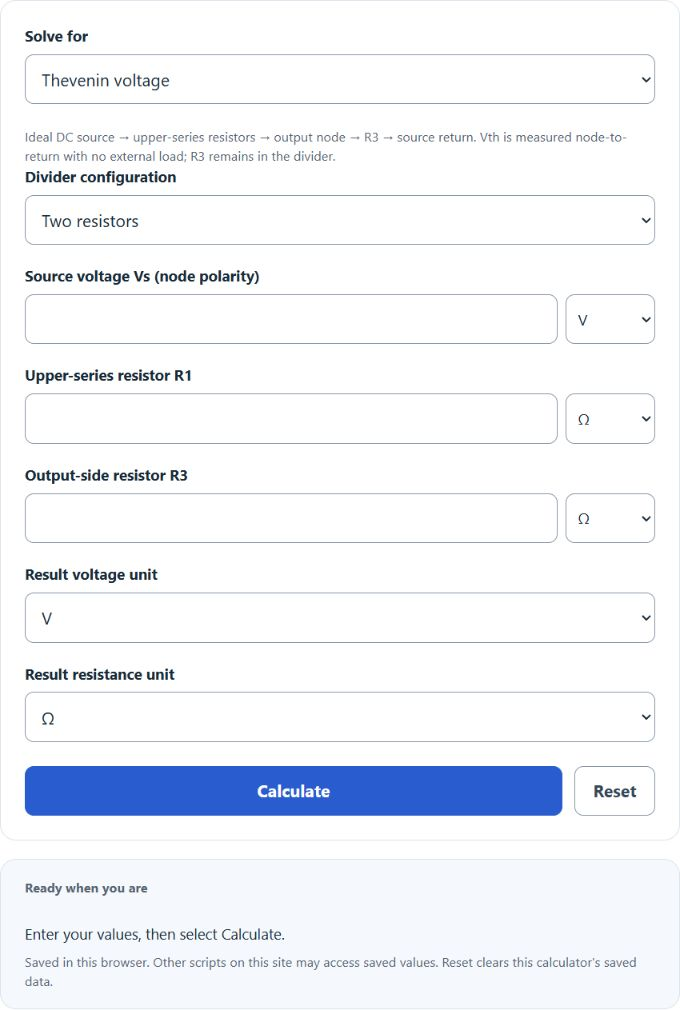
Calculate Thevenin voltage, source voltage, missing series resistance, and Rth from voltage divider values in V, mV, kV, Ω, kΩ, or MΩ.
- All Physics Calculators
- All Electrical Calculators
- Series Voltage Calculator
- Output Voltage Calculator
- Parallel Voltage Calculator
- Source Voltage Calculator
- Norton Current Calculator
Thevenin Voltage Formula
For the ideal-source resistive divider shown by the input labels, the following formula gives the unloaded node-to-return voltage across R3. The external load is disconnected, while R3 remains part of the source network. It is not a general formula for every circuit topology.
- Where Va-b is the Thevenin Voltage (volts)
- Vs is the source voltage (volts)
- R1 is the upper-series resistance (ohms); in multi-resistor mode, replace R1 by the sum of all upper-series resistors
- R3 is the output-side resistor from the output node to source return (ohms)
Choose the value to solve for. In multi-resistor mode, enter known upper-series resistors one per line, using optional Ω, kΩ or MΩ suffixes; omit the unknown upper resistor when solving for it. Vth = Vs R3/(Rupper + R3), and Rth = Rupper parallel R3 after shorting the ideal source. A connected external load changes the output voltage.
How to Calculate Thevenin Voltage?
The following example problems outline how to calculate the Thevenin Voltage.
Example Problem #1
- First, determine the source voltage (volts). In this example, the source voltage (volts) is determined to be 10.
- Next, determine the resistance 1 (ohms). For this problem, the resistance 1 (ohms) is measured to be 3.
- Next, determine the resistance 3 (ohms). In this case, the resistance 3 (ohms) is found to be 4.
- Finally, calculate the Thevenin Voltage using the formula above:
Va-b = Vs * R3 / (R1+R3)
Inserting the values from above into the equation gives:
Va-b = 10 * 4 / (3+4) = 5.71 (volts)
Example Problem #2
Using the same method as above, determine the variables required by the equation. For this example problem, these are provided as follows:
source voltage (volts) = 50
resistance 1 (ohms) = 5
resistance 3 (ohms) = 6
Entering these given values into the calculator above yields:
Va-b = 50 * 6 / (5+6) = 27.27 (volts)