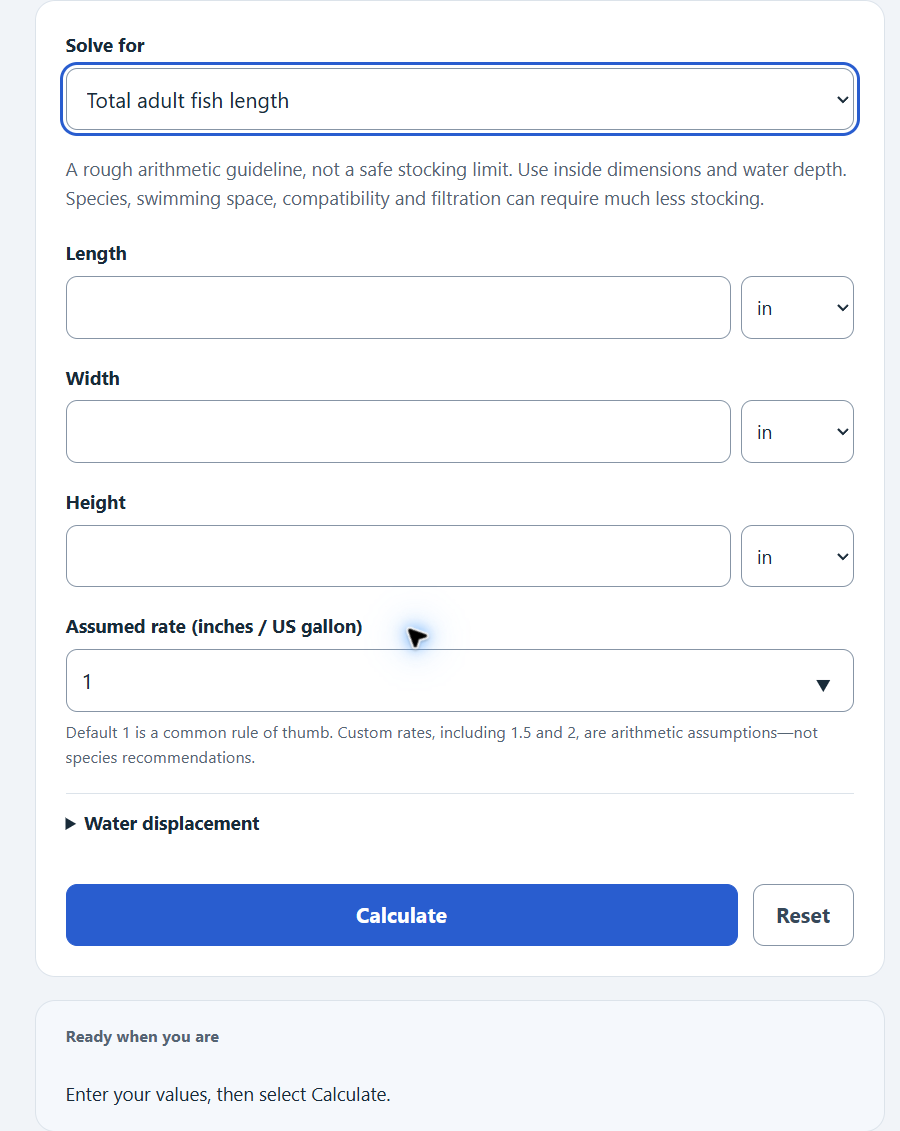
Calculate a rough adult fish length or whole-fish estimate from tank dimensions, adult fish size, and an assumed rate. This rule cannot establish a safe stocking maximum.
- Every Day Life And Education Calculators
- Fish Per Liter Calculator
- Fish Per Gallon Calculator
- Aquarium Gallons Calculator
- Goldfish Tank Size Calculator
- Aquarium Salt Calculator
- Water Change Calculator
Aquarium Stock Calculator Formula
The calculator uses net water volume and an assumed adult-fish-length rate. It now defaults to 1 inch per net US gallon, following Aqueon’s general rule of thumb. All modes accept custom rates, including the former 2-inch default. These are rough arithmetic assumptions, not species-specific recommendations.
G = L * W * H / 231
EG = G * (1 - D)
F = EG * R
N = (EG * R) / S
For solving a selected tank dimension:
L = F * 231 / (R * W * H * (1 - D))
W = F * 231 / (R * L * H * (1 - D))
H = F * 231 / (R * L * W * (1 - D))
- L = tank length, converted to inches
- W = tank width, converted to inches
- H = tank height, converted to inches
- G = tank volume in US gallons before displacement
- EG = effective water volume after decor and substrate displacement
- D = displacement rate, such as 0.10 for 10%
- R = stocking rate in inches of adult fish per gallon
- F = total adult fish inches under the chosen rule
- S = average adult fish size in inches
- N = unrounded fish-count arithmetic (the primary result rounds down)
Choose the desired answer in Solve for. Enter the displayed values and assumed rate. The calculator converts dimensions to inches, uses exactly 231 cubic inches per US gallon, and applies displacement. Original nominal tank presets remain available in a separate mode; check them against actual inside dimensions.
In fish count mode, enter volume, average adult length and the assumed rate. Optional displacement is zero when blank. The whole-fish arithmetic result rounds down; it is not a safe stocking limit.
Stocking Rate and Displacement Reference
These values help you interpret the inputs used by the calculator. Use adult fish size, not juvenile size.
| Rate | Meaning | Limitation |
|---|---|---|
| 1 in/US gal | Default rough guideline | Does not determine a safe species-specific maximum |
| 1.5 in/US gal | Custom arithmetic assumption | No general suitability claim |
| 2 in/US gal | Former default, still available as a custom rate | No general suitability claim |
| Displacement input | Volume retained | Meaning |
|---|---|---|
| Blank or 0% | 100% | No allowance applied |
| 5% | 95% | User-supplied estimate |
| 10% | 90% | User-supplied estimate |
| 20% | 80% | User-supplied estimate |
Example Aquarium Stock Calculations
Example 1: Estimate total inches of fish
You have a tank that measures 30 in long, 12 in wide, and 12 in high. Displacement is set to none.
G = 30 * 12 * 12 / 231 ≈ 18.7013 US gal
F = (30 * 12 * 12 / 231) * 1 ≈ 18.7013 inches
With the default rate of 1, the rule gives about 18.7 inches of adult fish; this is not a stocking recommendation.
Example 2: Estimate fish count
You have a 29-gallon tank, 10% displacement, an average adult fish size of 2 inches, and a stocking rate of 1.5 inches per gallon.
EG = 29 * (1 - 0.10) = 26.1
N = (26.1 * 1.5) / 2 = 19.575
The unrounded arithmetic is 19.575, so the primary result is 19 whole fish. This custom-rate example is not a recommendation to stock that many fish.
Aquarium Stock Calculator FAQ
Should you use the fish’s current size or adult size?
Use the adult size. Many aquarium fish are sold as juveniles, but stocking based on current size can lead to an overcrowded tank later. If a fish is 1 inch now but usually grows to 3 inches, enter 3 inches as the size.
Is inches of fish per gallon always accurate?
No. It is a rough stocking rule. It works best for small, slim-bodied community fish. It is less useful for large fish, messy fish, territorial fish, schooling fish, or fish with special swimming-space needs. Tank shape, filtration, water changes, oxygen level, and compatibility also matter.
Why does displacement reduce the stocking estimate?
Substrate, rocks, driftwood, and decorations take up space that would otherwise hold water. Less water means less dilution for waste, so the calculator reduces the usable volume by the selected displacement percentage.