Calculate the area of a rectangle, square, triangle, circle, trapezoid, parallelogram, ellipse, or sector using simple formulas and clear steps.
Area Formula
Area depends on the shape you are measuring. This calculator covers eight common shapes, and each one uses its own formula. The formulas below are the same ones the calculator applies.
Rectangle: A = L * W
Square: A = s^2
Triangle (base/height): A = 1/2 * b * h
Triangle (Heron): s = (a+b+c)/2 ; A = sqrt(s(s-a)(s-b)(s-c))
Circle: A = pi * r^2
Trapezoid: A = 1/2 * (a + b) * h
Parallelogram: A = b * h
Ellipse: A = pi * a * b
Circle Sector: A = pi * r^2 * (angle / 360)
- A is the area, returned in square units.
- L and W are the length and width of a rectangle.
- s is the side of a square, or the semi-perimeter in Heron’s formula.
- b and h are the base and the perpendicular height.
- a, b, and c are the three side lengths of a triangle in Heron’s formula.
- r is the radius of a circle or sector.
- a and b are the two parallel sides of a trapezoid, or the semi-axes of an ellipse.
- angle is the central angle of a sector, measured in degrees.
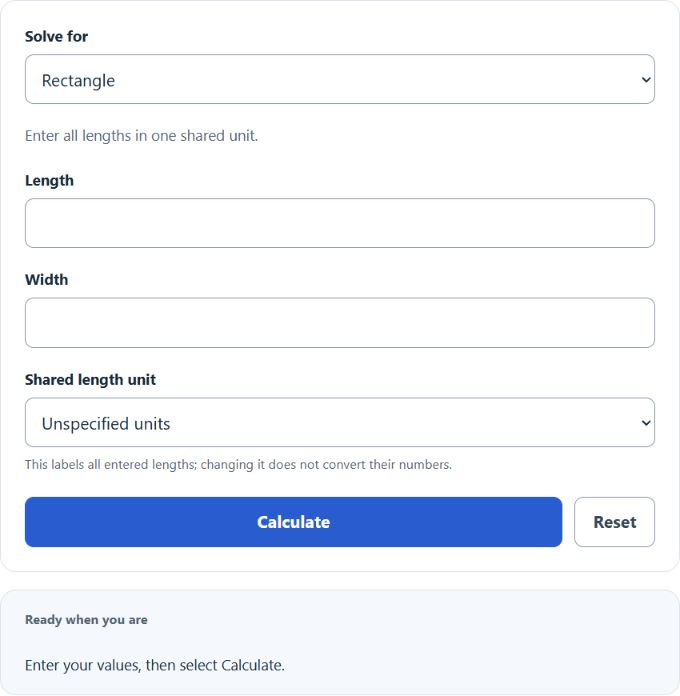
Pick the shape from the selector, then enter only the values that shape needs. For a triangle, choose either the base and height method or three sides (Heron) in the main selector. The shared length-unit selector labels all inputs and the result; it does not convert numbers. Select Custom unit label to enter another unit name. The area always comes out in the square of whatever unit you used for the inputs.
Area by Shape Reference
Use this table to see which inputs each shape needs and the formula the calculator runs.
| Shape | Inputs | Formula |
|---|---|---|
| Rectangle | length, width | L * W |
| Square | side | s * s |
| Triangle | base + height, or 3 sides | 1/2 b h or Heron |
| Circle | radius | pi r^2 |
| Trapezoid | two parallel sides, height | 1/2 (a+b) h |
| Parallelogram | base, height | b * h |
| Ellipse | two semi-axes | pi a b |
| Sector | radius, angle (deg) | pi r^2 (angle/360) |
Square Unit Conversions
Area is reported in square units. If you need to convert the result, the factors below cover the most common cases.
| From | To | Multiply by |
|---|---|---|
| square feet | square meters | 0.0929 |
| square meters | square feet | 10.7639 |
| square feet | square yards | 0.1111 |
| square meters | acres | 0.000247 |
Example Problems
Example 1. Find the area of a rectangle that is 12 m long and 8 m wide. Multiply length by width: 12 * 8 = 96. The area is 96 m squared.
Example 2. Find the area of a triangle with sides of 3, 4, and 5 using Heron’s formula. First find the semi-perimeter: s = (3 + 4 + 5) / 2 = 6. Then A = sqrt(6 * (6-3) * (6-4) * (6-5)) = sqrt(6 * 3 * 2 * 1) = sqrt(36) = 6. The area is 6 square units.
Frequently Asked Questions
What units does the area come out in?
The area is always in the square of the unit you used for the inputs. If you enter lengths in feet, the area is in square feet. If you enter centimeters, the area is in square centimeters. The unit field is only a label, so mixing units in the same calculation will give a wrong result.
Which triangle method should I use?
Use base and height when you know the length of one side and the perpendicular distance from that side to the opposite corner. Use the three sides (Heron) method when you know all three side lengths but not the height. Both give the same area for the same triangle.
What is the difference between a circle and a sector?
A full circle uses the whole 360 degrees, so its area is pi times the radius squared. A sector is a wedge of that circle defined by a central angle. The sector area is the circle area scaled by the fraction angle divided by 360, so a 90 degree sector is one quarter of the full circle.