Calculate the area of a regular hexagon from its side length, apothem, radius, perimeter, or diagonal, and find the perimeter and material cost.
- All Math & Numbers Calculators
- Pentagon Calculator
- Area Calculator
- Area Of A Triangle Without Height Calculator
Hexagon Area Formula
The area of a regular hexagon is found directly from its side length:
A = (3*sqrt(3)/2) * a^2
A regular hexagon is made of six identical equilateral triangles, so it can also be measured from its apothem (the distance from the center to the middle of a side) or from its circumradius (the distance from the center to a corner):
A = 2*sqrt(3) * r^2
A = (3*sqrt(3)/2) * R^2
If you only know the perimeter and apothem, the area is half the perimeter times the apothem, which works for any regular polygon:
A = (1/2) * P * r
- A: the area enclosed by the hexagon.
- a: the side length, the distance along one of the six edges.
- r: the apothem or inradius, measured from the center to the midpoint of a side. For a regular hexagon r = (sqrt(3)/2)*a.
- R: the circumradius, measured from the center to a corner. For a regular hexagon R equals the side length a.
- P: the perimeter, equal to 6 times the side length.
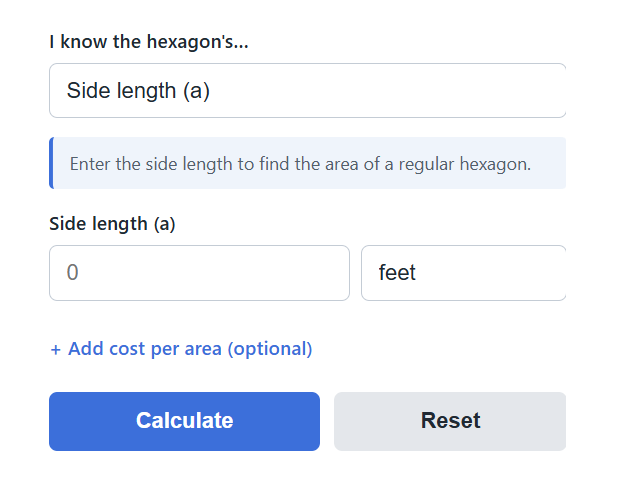
The calculator solves for area no matter which single measurement you start with. The "I know the hexagon's…" selector lets you enter the side, apothem, circumradius, perimeter, long diagonal (corner to corner), short diagonal (flat to flat), or even a known area. It converts your input to the side length first, then returns the area along with the perimeter and the other dimensions. The optional cost field multiplies the area by a price per square unit so you can estimate material cost. These formulas apply only to a regular hexagon, where all six sides and angles are equal.
Hexagon Dimensions in Terms of the Side
Every measurement of a regular hexagon is a fixed multiple of its side length a. Use this to convert between the values the calculator accepts.
| Measurement | In terms of side a | Decimal multiple |
|---|---|---|
| Side (a) | a | 1.000 |
| Apothem / across flats half (r) | (sqrt(3)/2)*a | 0.866 |
| Circumradius (R) | a | 1.000 |
| Short diagonal (across flats) | sqrt(3)*a | 1.732 |
| Long diagonal (across corners) | 2*a | 2.000 |
| Perimeter (P) | 6*a | 6.000 |
| Area (A) | (3*sqrt(3)/2)*a^2 | 2.598 * a^2 |
The next table gives the area straight from the side length for some common values, so you can sanity check a result.
| Side length a | Area (square units) |
|---|---|
| 1 | 2.598 |
| 2 | 10.392 |
| 5 | 64.952 |
| 10 | 259.808 |
| 12 | 374.123 |
Example Calculations
Example 1: Area from the side. A regular hexagon has a side length of 6 inches. The area is A = (3*sqrt(3)/2) * 6^2 = 2.598 * 36 = 93.53 square inches. Its perimeter is 6 * 6 = 36 inches.
Example 2: Area from the apothem. A hexagonal tile has an apothem of 4 cm. Using A = 2*sqrt(3) * r^2, the area is 2 * 1.732 * 16 = 55.43 square centimeters. The matching side length is a = 2r/sqrt(3) = 8/1.732 = 4.619 cm.
Frequently Asked Questions
What is the formula for the area of a regular hexagon? The area equals (3 times the square root of 3, divided by 2) multiplied by the side length squared, or about 2.598 times the side squared. This holds only for a regular hexagon, where all six sides and all six interior angles are equal.
How do I find the area if I only know the apothem? Use A = 2 times the square root of 3 times the apothem squared, which is the same as multiplying half the perimeter by the apothem. If you would rather work from the side, the apothem of a regular hexagon is (square root of 3 divided by 2) times the side, or about 0.866 times the side.
Does this work for an irregular hexagon? No. These formulas assume a regular hexagon with equal sides and angles. For an irregular six sided shape, split it into triangles or other simple shapes, find the area of each, and add them together, or use the coordinate (shoelace) method if you know the corner points.