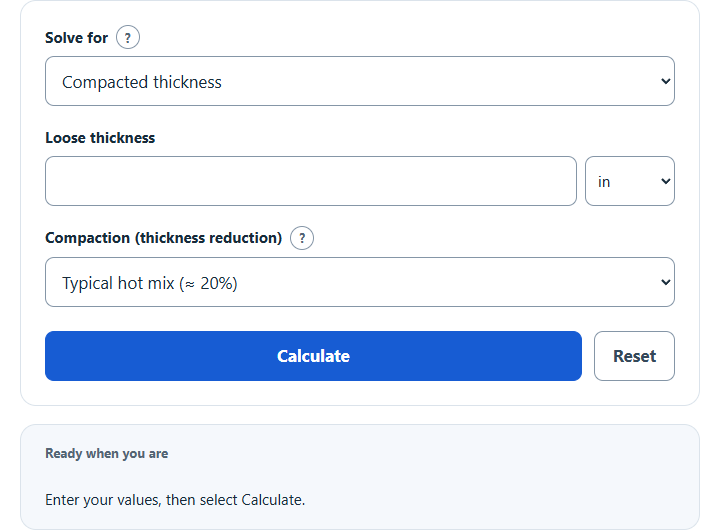
Calculate asphalt compaction: find compacted or loose thickness from a typical 20% rolldown or your own, or estimate asphalt tonnage for an area.
Related Calculators
- Cut And Fill Calculator
- Material Cost Calculator
- Crushed Shell Calculator
- Berm Volume Calculator
- All Construction Calculators
Calculator Functions
| Function | What it does | What it requires |
|---|---|---|
| Compacted thickness | Finds the thickness of an asphalt layer after rolling | Requires the loose thickness and a thickness reduction |
| Loose thickness | Finds how thick to place loose mix to reach a compacted thickness | Requires the compacted thickness and a thickness reduction |
| Thickness reduction factor | Finds the share of the loose thickness lost in rolling | Requires the loose thickness and the compacted thickness, measured in the same area |
| Asphalt tonnage | Finds the mass of mix needed for a paved area | Requires the paved area, the compacted thickness and a mix density |
Thickness can be entered in in, ft, cm or m and area in ft², yd² or m². The thickness reduction is picked from presets of 10% to 30%, with 20% for typical hot mix, or entered as a custom percentage or fraction. Tonnage can be shown in US short tons, metric tonnes, pounds or kilograms, and an optional reduction adds a loose thickness to the tonnage result.
Asphalt Compaction Formulas
| AC | Compacted thickness |
| T | Loose thickness as placed, in the same unit |
| CF | Thickness reduction, as a fraction of the loose thickness |
Paving references state the rule of thumb from the other side: place dense-graded mix about 25% thicker than the compacted thickness wanted, and gap-graded or open-graded mix about 15% thicker [1] [2]. Adding 25% to the compacted thickness is the same as losing 20% of the loose thickness, which is why 20% is the typical hot mix preset. Adding 15% equals a reduction of about 13%.
Compacted thickness
Mix placed 2.5 in thick with a 20% reduction rolls down to 2.5 × (1 − 0.20) = 2 in.
Loose thickness
A 2 in compacted layer at 20% needs 2 ÷ 0.80 = 2.5 in of loose mix, which is the 2 in to 2.5 in example paving handbooks use [1]. At a custom 13% for an open-graded mix, it needs 2.3 in.
Thickness reduction factor
A layer placed at 2.5 in that measures 2 in after rolling has lost 0.5 ÷ 2.5 = 0.20, or 20%.
Asphalt tonnage
Rolling changes the thickness of a layer and not its mass, so tonnage uses the compacted thickness and the in-place density. The presets are 145 lb/ft³ for typical hot mix, 150 lb/ft³ for dense-graded mix and 120 lb/ft³ for open-graded or porous mix. A common spread rate of 110 lb per square yard per inch of thickness [2] works out to about 147 lb/ft³, and agency rates of 88 to 100 lb per square yard per inch for open-graded layers [2] to about 117 to 133 lb/ft³. Paving 1,000 ft² at 2 in and 145 lb/ft³ takes 1,000 × 2 ÷ 12 × 145 = 24,167 lb, or 12.08 short tons.
Limits of This Estimate
- Thickness reduction is not percent compaction. Compaction is accepted on density, which this calculator does not check.
- Rolldown varies with the mix [1], so measure it on the job where possible. These estimates are based on the best available data and estimations.
- Tonnage leaves out waste and uses a preset density unless the project density is entered.
Sources
- National Asphalt Pavement Association, Asphalt Paving Handbook, Section 7.5, Layer Thickness: rolldown of about 25% for dense-graded mix and about 15% for gap-graded and open-graded mix
- Asphalt Institute, Asphalt magazine, Five handy rules of thumb for successful asphalt pavement construction: screed height of 1.25 times the compacted thickness and spread rates per square yard per inch