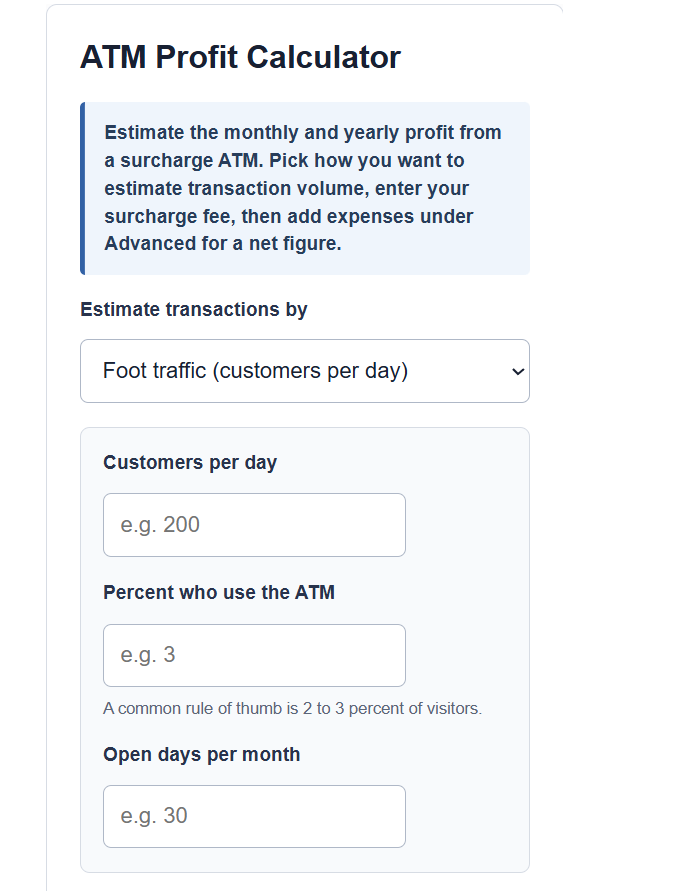
Calculate the monthly and yearly profit from a surcharge ATM using foot traffic, cash dispensed, surcharge fees, and operating costs.
ATM Profit Formula
This calculator works in two parts. First it estimates how many transactions the machine handles each month; then it turns those transactions into revenue, expenses, and net profit. You can estimate transactions in three ways, so use the one that matches the numbers you have.
To estimate transactions from foot traffic:
Transactions = Customers per Day * (Use Rate / 100) * Open Days
To estimate transactions from cash dispensed:
Transactions = Monthly Cash Dispensed / Average Withdrawal
To turn transactions into monthly profit:
Surcharge Revenue = Transactions * Surcharge Fee * (Your Share / 100)
Total Revenue = Surcharge Revenue + (Transactions * Interchange per Transaction)
Net Profit = Total Revenue - (Transactions * Processing Fee) - Fixed Costs
- Transactions is the number of paid withdrawals the ATM processes in a month.
- Use Rate is the percent of daily visitors who use the machine. Two to three percent is a common starting point.
- Surcharge Fee is the fee shown on screen that the customer agrees to pay, usually 2 to 3.50 dollars.
- Your Share is the percent of the surcharge you keep. Enter 100 when you take the whole fee, or less when you split it with the location.
- Interchange per Transaction is the small amount the card networks pay you on top of the surcharge. Many operators leave this at zero unless their processor pays it.
- Processing Fee is what your processor charges per transaction, often 0.20 to 0.30 dollars.
- Fixed Costs are flat monthly expenses such as rent, a location commission, or a data line.
Annual profit is simply the net monthly profit multiplied by 12. If you enter a machine cost, the calculator also divides that cost by the monthly net profit to show how many months it takes to pay the machine back.
Typical ATM Values and Profit Benchmarks
The first table shows ranges you can use as defaults when you do not have exact numbers. The second table shows the monthly and yearly net profit at a 2.50 dollar surcharge after a 0.25 dollar processing fee, before any fixed costs.
| Input | Typical Range |
|---|---|
| Surcharge fee | $2.00 to $3.50 |
| Transactions per month | 100 (slow) to 600+ (busy) |
| Average withdrawal | $40 to $60 |
| Visitor use rate | 2% to 3% |
| Processing fee | $0.20 to $0.30 |
| Transactions / Month | Net Profit / Month | Net Profit / Year |
|---|---|---|
| 100 | $225 | $2,700 |
| 300 | $675 | $8,100 |
| 600 | $1,350 | $16,200 |
| 900 | $2,025 | $24,300 |
Example Problems
Example 1. A store dispenses 30,000 dollars in cash each month and the average withdrawal is 40 dollars, so the machine handles 30,000 / 40 = 750 transactions. With a 2.00 dollar surcharge that you keep in full, gross surcharge revenue is 750 * 2.00 = 1,500 dollars. After a 0.25 dollar processing fee, expenses are 750 * 0.25 = 187.50 dollars, so net profit is 1,312.50 dollars per month, or 15,750 dollars per year.
Example 2. A shop sees 200 customers per day, 3 percent use the ATM, and it is open 30 days a month, giving 200 * 0.03 * 30 = 180 transactions. At a 2.50 dollar surcharge with no other costs, net profit is 180 * 2.50 = 450 dollars per month, or 5,400 dollars per year.
Frequently Asked Questions
How many transactions does an ATM get per month? It depends on location. A slow spot may see around 100 transactions a month, an average retail location sees a few hundred, and a busy bar or convenience store can exceed 600. A useful rule of thumb is that 2 to 3 percent of the people who pass the machine will use it.
Do I keep the entire surcharge fee? Not always. If you own the ATM and load your own cash, you usually keep the full surcharge. If a location owner hosts the machine, you often split the surcharge with them. Set the Your Share field to the percent you actually keep so the profit figure is accurate.
What is interchange income? Interchange is a small payment the card networks pay the ATM operator for each withdrawal, separate from the surcharge the customer sees. It is often only a few cents per transaction and many small operators do not receive it, so leave that field at zero unless your processor pays it to you.