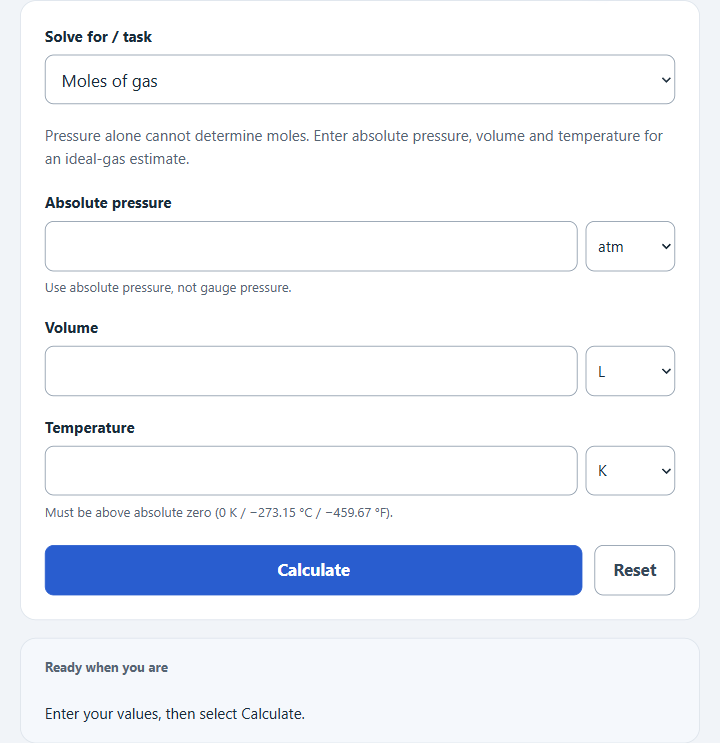
Choose Solve for / task to calculate moles, pressure, volume, temperature, molar volume, or check PV = nRT. Pressure alone is not a conversion to moles: volume and absolute temperature are also needed.
Ideal Gas Law Formula
The following formula is used to calculate the missing variable in the Ideal Gas Law equation.
Variables:
- P is the absolute pressure in atmospheres (atm), not gauge pressure
- V is the volume in liters (L)
- n is the number of moles of gas
- R is the ideal gas constant (approximately 0.0820573660809597 L·atm·K⁻¹·mol⁻¹)
- T is the temperature in kelvin (K)
Choose the unknown under Solve for / task, enter the known values and their units, then select Calculate. Fixed-temperature modes use 0 °C or 25 °C and default to 1 L only when optional volume is blank. Molar-volume presets use 1 atm explicitly. Positive pressure, volume, moles and kelvin temperature are required; the ideal-gas approximation can deviate for real gases.
| Pressure (atm) | Moles (mol) |
|---|---|
| 0.10 | 0.00409 |
| 0.20 | 0.00817 |
| 0.25 | 0.01022 |
| 0.33 | 0.01349 |
| 0.50 | 0.02044 |
| 0.75 | 0.03066 |
| 1.00 | 0.04087 |
| 1.25 | 0.05109 |
| 1.33 | 0.05436 |
| 1.50 | 0.06131 |
| 1.75 | 0.07153 |
| 2.00 | 0.08175 |
| 2.50 | 0.10219 |
| 3.00 | 0.12262 |
| 3.50 | 0.14306 |
| 4.00 | 0.16350 |
| 5.00 | 0.20437 |
| 6.00 | 0.24524 |
| 8.00 | 0.32699 |
| 10.00 | 0.40874 |
| Assumes ideal gas law with R ≈ 0.0820573660809597 L·atm·K⁻¹·mol⁻¹, V = 1.00 L, T = 298.15 K (25°C). Formula: n = PV / (RT). Moles are rounded to five decimals. | |
What is the Ideal Gas Law?
The Ideal Gas Law is a fundamental equation in chemistry and physics that describes the behavior of an ideal gas. It combines several gas laws, including Boyle’s Law, Charles’s Law, and Avogadro’s Law, into a single equation: PV = nRT. This equation relates the pressure, volume, and temperature of a gas to the number of moles of the gas and the ideal gas constant. The Ideal Gas Law is used to predict the behavior of gases under various conditions and is a crucial tool in both theoretical and practical applications in science and engineering.
How to Calculate Using the Ideal Gas Law?
The following steps outline how to calculate the missing variable using the Ideal Gas Law.
- First, determine the known values for pressure (P), volume (V), moles (n), and temperature (T).
- Next, rearrange the Ideal Gas Law formula to solve for the unknown variable.
- Insert the known values into the rearranged formula.
- Calculate the result to find the missing variable.
- After inserting the values and calculating the result, check your answer with the calculator above.
Example Problem :
Use the following variables as an example problem to test your knowledge.
Pressure (P) = 2 atm
Volume (V) = 5 L
Moles (n) = unknown; choose Moles of gas
Temperature (T) = 300 K. Then n = (2 × 5) / (0.0820573660809597 × 300) ≈ 0.40622 mol.