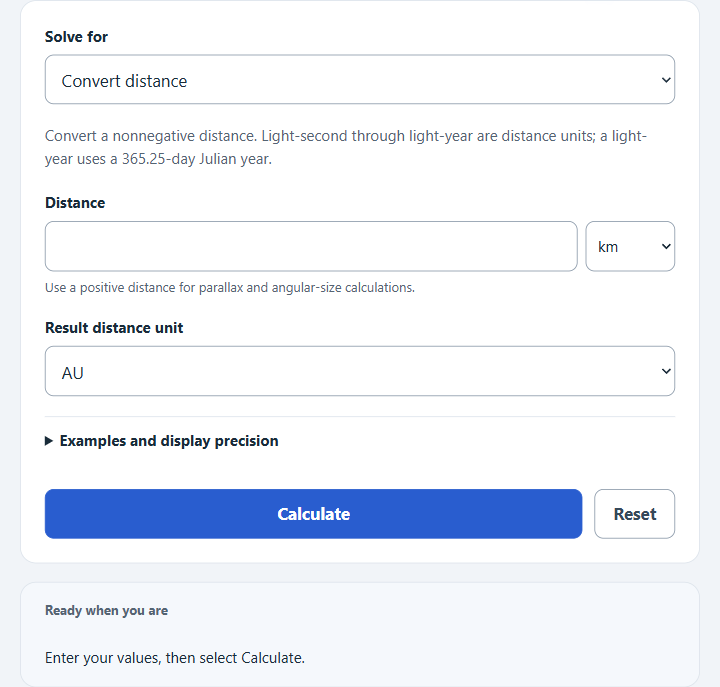
Convert astronomical distances between km, AU, light-years and parsecs, and calculate light travel time, parallax, angular size or orbital period.
AU (Astronomical Units) Formula
The following formula is used to calculate the distance in kilometers between two objects in Astronomical Units (AU).
Variables:
- D is the distance in kilometers
- AU is the distance in Astronomical Units
To calculate the distance in kilometers, multiply the distance in Astronomical Units by the conversion factor 149,597,870.7.
What Is an Astronomical Unit (AU)?
An astronomical unit (AU) is a unit of length defined by the International Astronomical Union in 2012 as exactly 149,597,870,700 meters, or 149,597,870.7 kilometers. It is close to the average Earth–Sun distance, but its definition is a fixed length. For scale, the orbital semi-major axes of Mars and Jupiter are about 1.5 AU and 5.2 AU, respectively.
How to Calculate AU (Astronomical Units)?
The following steps outline how to calculate the AU (Astronomical Units) for a given distance.
- First, determine the distance in kilometers (km).
- Next, divide the distance by the exact conversion factor, 149,597,870.7 kilometers per AU.
- Finally, express the quotient in AU.
- After inserting the distance and calculating the result, check your answer with the calculator above.
Example Problem:
Use the following variables as an example problem to test your knowledge.
Distance (km) = 300,000,000
AU = 300,000,000 / 149,597,870.7 ≈ 2.005376 AU